Board opts for district-operated vending deal
The Lawrence school board voted unanimously Monday night to approve a district-operated beverage vending machines program that could give the district about $98,000 a year.
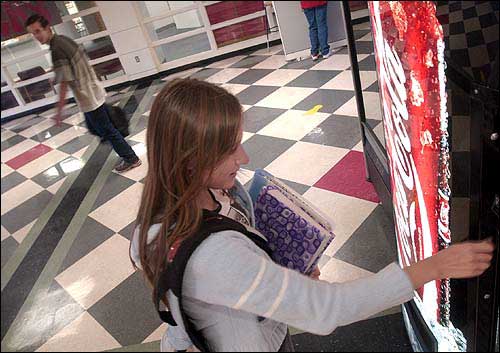
Olena Smetanenko, Lawrence High School junior, and an exchange student from the Ukraine, purchases a Coca-Cola after school. The Lawrence school board voted unanimously at Monday night's meeting to approve a district-operated beverage vending machines program.
Currently, Lawrence’s junior highs and high schools have individual contracts with Coke or Pepsi, said Paula Murrish, the district’s director of food services. Those contracts bring in about $60,000 divided between the seven schools each year plus an additional $4,000 to $7,000 each year for each school, she said.
There are no soft-drink machines in elementary schools except in the teachers’ lounges, she said.
The soft-drink machines at Lawrence Alternative High, Lawrence High and Free State High schools are open to students all day. Machines at the four junior highs are available before and after school, she said.
Last year the district had hoped to get about $150,000 to $200,000 each year for a districtwide contract with one company, Murrish said.
But the district wanted to be able to control things like how many machines were in each school, what hours they would be available to students and what the ratio of soda to other drinks in the machines would be.
If the district controlled these factors, a contract with one company would only bring in about $100,000 to $115,000 a year.
A district-operated vending program would accept bids for different drinks and control things like how many machines were in each school, what hours they would be available to students and what the ratio of soda to other drinks in the machines would be.
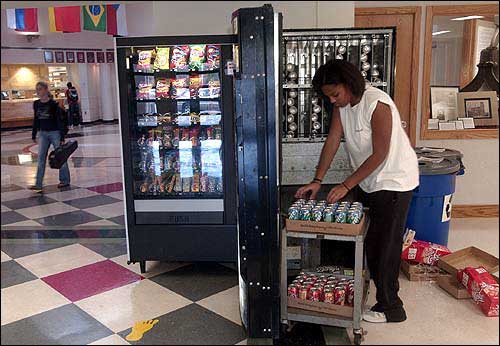
Aisha Hart, Lawrence High School junior and a store manager at the Lion's Den snack shop, loads up a Coca-Cola machine after school. The Lawrence school board unanimously approved a proposal for district-operated soft-drink machines at Monday's meeting.
Murrish said she would meet next week with Pepsi and Coke representatives to look at their products and the junior high and high schools’ beverage vending machines. She said she hoped the district could start accepting bids the first week of December.
The junior high and high schools’ vending contracts expired this summer, but the district extended those contracts on behalf of the schools until the board took further action, Murrish said. The district-operated vending could start at the beginning of second semester.
Nancy O’Connor, director of education and outreach for the Community Mercantile Co-op, 901 Iowa, said Monday night that she favored a district-operated beverage vending program. She brought a 20-ounce bottle and a 12-ounce can of Coke to Monday’s meeting.
She dumped 9 3/4 teaspoons of sugar into a glass to demonstrate to board members how much sugar is in a 12-ounce can of Coke.
“What’s even more distressing to me is kids aren’t buying this anymore,” she said of the 12-ounce can. “They’re buying this,” she said of the bottle.
She said she would oppose the district’s entering into a contract with one soft-drink company.

 6News video: Lawrence School Board moves forward with bond proposal
 District puts soda choice up for bids (11-25-03)
City Government
Algerian government invites Mayor Brad Finkeldei, Lawrence delegation for a visit
Construction on Wakarusa Drive to resume; city manager says KDOT’s secretary has apologized for delay
Evacuation drill planned Tuesday at Lawrence City Hall

Bond issue for water and sewer projects, bike plan, Wakarusa Drive update on Lawrence City Commission’s agenda
Opinion: Environmentally conscious Lawrence is not focused on the biggest problem with electric vehicles