Watching for birds
Water, shelter help lure feathered friends
Fall is a time when many people find themselves looking up at the sky to catch a glimpse of migrating birds flying south for the winter. It is also a time of year when gardeners contemplate how to attract more birds to their yard.
Bird-watching is a fascinating activity and worthwhile hobby for all ages. It is an excellent way to get kids involved and interested in the garden.
Bird-watching is educational, inexpensive and easy. Families may want to plan day trips to the zoo to learn more about birds. A family may even plan a vacation to an exotic location to discover a wider array of birds than the ones in their backyard. In fact, according to the Iowa State University extension office, “A government survey found that bird-watching is second only to gardening as the most popular leisure-time activity in the United States.”
So, how can a gardener attract more birds to the landscape?
Here’s a look at the four essentials:
Water
Water may be added to the garden space by a simple birdbath or any shallow dish that can hold 2 inches of water. The preferred spot is a shady area so water stays relatively cool. The container should be kept clean and the water replenished every few days. A birdbath should be in an area safe from predators. Keep the bath 2 or 3 feet off the ground and in an open area so birds can see predators such as cats. Water gardens can enhance an outdoor space and attract birds as well. Circulating water is ideal because it stays cleaner and does not freeze as easily during winter. Bird enthusiasts also can purchase water heaters for birdbaths.
Safety
While gardeners want to lure birds to the yard, they also need to consider how to keep a feathered friend and her young safe from predators. One way to help in a bird’s safety is to place bird feeders and houses in appropriate places. Birds often fly into windows, where they see their own reflection and the sky and trees and believe it to be a true landscape. A bird lover can practice a couple of precautions in an attempt to prevent injuries to birds. A feeder or birdhouse should be placed at least a foot away from a window. This will reduce the risk of accidents. Feeders need to be placed in an open space so predators cannot sneak up on birds and their young, yet have the feeders near some cover so birds don’t waste energy flying from a feeder to bushes. A cover 6 to 8 feet away is ideal for feeders. Keep feeders at varying heights and at least 5 feet off the ground. Try to have feeders and houses sheltered from the wind.
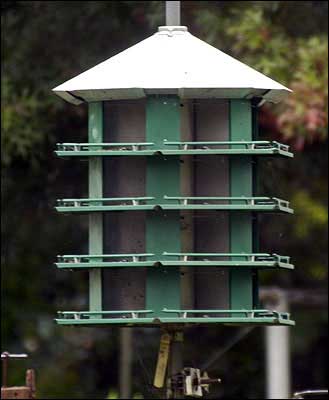
This four-level birdhouse is in North Lawrence. A birdhouse should be placed so entrance holes face away from winds.
Shelter
Setting a few well-placed birdhouses, used for shelter and nesting, may attract birds to the landscape. Look for something weather resistant, well-ventilated and placed so the entrance hole is facing away from winds. After each season, take down the birdhouses to clean. A bird will be more compelled to make shelter in a clean house at the beginning of the season than a dirty one. Natural shelters are evergreen trees and shrubs, where birds love to live. When discarding the old dried-up tree this holiday season, a bird enthusiast may consider leaving it somewhere in the yard. Birds love to make their homes in old piles of dead trees, limbs and leaves.
Food
According to the Iowa State University extension office, there are two main kinds of food for birds: preferred and persistent. Preferred are foods birds like the best. These foods may be provided by man in a feeder or by nature. Persistent foods are berries, fruits and nuts not eaten right away.
October is the time to start fall/winter feeding for birds. The birds are establishing “routes” that they will continue to keep and feed on until April or May, when nature will begin to bloom and provide much of the food they rely on. Providing suet this time of year will attract insect-eating birds, like nuthatches and woodpeckers.
| The U.S. Fish & Wildlife Service has compiled a list of 10 benefits that a gardener receives from landscaping with the intent to attract birds:¢ Increased wildlife population. Home owners could possibly double their population with a good plan.¢ Energy conservation. For example, conifers planted around the home reduce heating bills in the winter, and shade trees reduce cooling costs in the summer.¢ Soil conservation¢ Natural beauty¢ Wildlife photography¢ Bird watching¢ Natural insect control¢ Food production¢ Property value¢ Play area for children |
Most birds enjoy seed. Be sure to purchase commercially bought brands carefully. Many brands will have milo (sorghum) and wheat, seeds not preferred by any birds. Birds are known to throw these seeds onto the ground in search of preferred seeds like sunflower seeds. Iowa State University’s extension office claims a good mix is 50 percent black (oil-type) sunflower seeds, 35 percent white proso millet and 15 percent cracked corn. The all-black sunflower is preferred over the black-striped sunflower. This seed attracts a wide variety of birds. White proso millet is a favorite of mourning doves, dark-eyed juncos and most sparrows. Cracked corn is essentially filler. Peanut kernels (not hearts) are also a favorite among birds.
Before becoming too overwhelmed, novice gardeners should establish which birds they want to attract. Incorporating native plants is a good starting point for a landscaping plan and should prove to be a great long-term investment. A gardener should draw out a map of the property to get a feel for the space. With that map, establish the sunny and shady areas and draw the plants to scale so that when they are fully grown they won’t be overcrowding a space. Find spots that will make good observation points for bird viewing. Lastly, use plants (see box) important for a bird habitat.
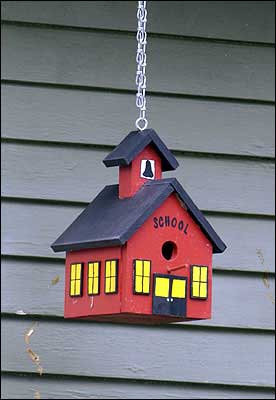
This birdhouse resembling a schoolhouse hangs in east Lawrence.
| According to the U.S. Fish & Wildlife Service’s “Homes for Birds,” there are seven types of plants important for a bird habitat:ConifersConifers, evergreen trees and shrubs that include pines, spruces, firs, arborvitae, junipers, cedars and yews. These plants are important in order for the birds to have some escape cover. They provide an excellent place for winter shelter and are great for summer nesting sites.Grasses and legumesGrasses and legumes provide cover for ground-nesting birds. Some grasses and legumes provide seed as well.Nectar-producing plantsPopular for attracting hummingbirds and orioles. Flowers with tubular red corollas are especially attractive to hummingbirds.Summer-fruiting plantsExamples are various species of cherry, chokecherry, honeysuckle, raspberry, serviceberry, blackberry, blueberry, grape, mulberry, plum and elderberry. Birds that are often attracted to summer-fruiting plants are brown thrashers, catbirds, robins, waxwings, woodpeckers, orioles, cardinals, towhees and grosbeaks.Fall-fruiting plantsThis landscape component includes shrubs and vines whose fruits are ripe in the fall. These foods are important for both migratory birds, which build up fat reserves prior to migration and as a food source for non-migratory species that need to enter the winter season in good physical condition. Fall-fruiting plants include dogwoods, mountain ash, winter-berries, cottoneasters and buffalo-berries.Winter-fruiting plantsWinter-fruiting plants are those whose fruits remain attached to the plants long after they first become ripe in the fall. Many winter-fruiting plants are not palatable until they have frozen and thawed often. Examples are glossy crabapple, snowberry, bittersweet, sumacs, American highbush, eastern and European wahoo, Virginia creeper and chinaberry.Nut and acorn plantsThis category includes oaks, hickories, buckeyes, chestnuts, butternuts, walnuts and hazels. The meat inside of broken nuts and acorns are eaten by a plethora of birds. In addition, these plants provide a good nesting habitat.ResourcesBooks“Attracting Birds to Your Backyard: 536 Ways to Turn Your Yard and Garden Into a Haven for Your Favorite Birds,” by Sally Roth, Rodale Books, $20.37″How to Attract Birds,” by Michael McKinley, Ortho Books, $10″Songbirds in Your Garden,” by John K. Terres, Harper & Row, $10.47Web sitesNorth American Native Plant SocietyLady Bird Johnson Wildflower Centerline ProductionsWhat to do when you find an injured bird and other bird information.Connecticut Audubon Society: provides a detailed list of plants birds love |
Home and Garden
Flower gardens endure hot, dry summers better if you choose these plants
Debunking common garden hacks, quick fixes and myths

Douglas County Master Gardeners invites public to annual native plant sale
How to mulch your garden beds without harming plants