

Campaign finance overhaul advised
State ethics commission wants more complete, quicker disclosures from special interest groups
Topeka ? Kansans for a Moderate Government, the Growth Club of Kansas, Americans for Prosperity.
These groups and others were active during the last election, trying to persuade voters by making donations to candidates, filling voters’ mailboxes with high-quality mailings and putting hard-hitting advertisements on radio and television.
But while they have inclusive-sounding names, their agendas are narrow — and much of their operations is generally hidden from public scrutiny because of the state’s campaign finance disclosure laws.
The Kansas Governmental Ethics Commission, which regulates campaign finance, has called for an overhaul of those laws and will be carrying its proposals to the Legislature in January.
The recommendations “are really aimed at full disclosure and making the information available to the public so that the voting public can have a more informed basis to evaluate the advertising materials to which they are exposed,” said Dan Sevart, a Wichita attorney who is chairman of the ethics commission.
Delayed reporting
For instance, Kansans for a Moderate Government has been financed almost entirely by an abortion-rights political action committee, Pro Kan Do, which was founded by Dr. George Tiller, a Wichita doctor who performs abortions. From July through the third week of October, Pro Kan Do contributed $38,330 to Kansans for a Moderate Government, which in turn produced mailings to help several legislative candidates.
But donations made by Kansans for a Moderate Government, the anti-tax Growth Club and every other political action committee and individual during the last 11 days of the election cycle will not be revealed until after January, the next deadline for reporting campaign finances.
This blackout period of campaign finance disclosure during the most active time of campaign donations and spending, in addition to other aspects of Kansas’ campaign finance law, has earned the state failing grades from public interest groups seeking more disclosure in campaign finance.
The ethics commission has recommended that contributions received by candidates during the last 11 days before primaries and general elections be publicly disclosed within 24 hours of the contribution, and that political action committees and party committees identify in their finance reports the candidates that receive contributions and how much was contributed.

 Ads can mislead, parties warn (10-28-04)
“Issue ads”
Some groups, such as Americans for Prosperity, another anti-tax group, with ties to the conservative Koch Industries family, don’t have to reveal where they get their money, how much they get or how they spend those funds, because the group produces “issue ads.”
Instead of urging voters to vote for or against a certain candidate, the group produces mailouts that praise a certain candidate for taking a stand against taxes, and urge voters to “thank” that candidate. Finances surrounding issue ads are exempt from the campaign finance disclosure law.
Sevart said groups like Americans for Prosperity should reveal their contribution and spending practices. “The ads are clearly intended to have an effect on the outcome of the election,” he said. “The Legislature should consider that the people have a right to know.”
Alan Cobb, director of Americans for Prosperity, said the group would comply with whatever law the Legislature adopted. “And we will continue to educate Kansas citizens on how they are being represented in the Kansas Legislature and we will continue to propose policy solutions to help invigorate our lagging Kansas economy,” he said.
Dialing for votes
The ethics commission recommendations also would require that recorded telephone bank messages include a statement on who is paying for the communication.
The use of recorded calls has proliferated in recent years but there is no requirement that the messages’ sponsors identify themselves, as they must on television, radio and print ads.
During the election, conservative Republican Kris Kobach’s campaign launched a telephone message that dialed up Catholic voters and alleged that U.S. Rep. Dennis Moore, a Democrat who eventually won re-election, did not share Catholic values.
“This type of campaigning is becoming much more prevalent,” Sevart said.
State Government
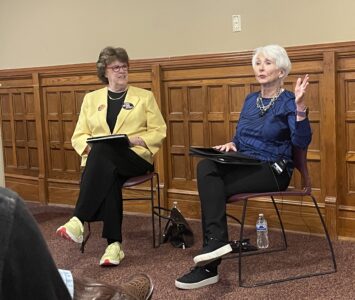
‘If it ain’t broke, don’t fix it’: Retired Judge Sally Pokorny tells residents why she opposes electing Supreme Court justices
KU professors would be limited in how they could present the idea of systemic racism in future classes
State legislators push back against federal energy regulators ending competitive bids
TOPEKA — Two Kansas legislators asked federal energy regulators to ensure competitive bidding occurs on ...
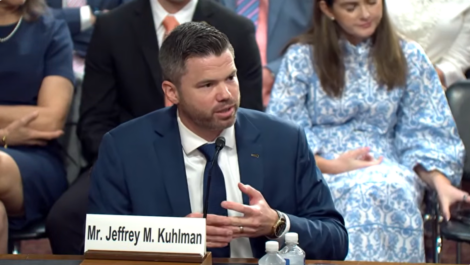
Senate confirms 1st of 3 Kansas nominees to U.S. District Court
Corporate income tax collections falling sharply in Kansas; Republican, Democratic leaders disagree on what it means
TOPEKA — Corporate income tax collections in Kansas have almost halved since last year, while other sources trend ...
Candidate’s campaign manager created website with documents used to attack rival
TOPEKA — Kansas U.S. Senate candidate Patrick Schmidt’s campaign manager left his digital footprint on ...