

Friends step in to create calendar
Fund-raiser aims to help Salina mother buy new prosthetic leg
Salina ? It’s “Calendar Girls” with a twist: A group of local women are showing off their legs to help a friend buy a new one.
In the popular 2003 movie, a group of middle-aged British women decide to pose nude for a calendar to raise money for a hospital charity. This inspired several Salina area women, ranging in age from 30 to 70, to create their own, albeit more subdued, calendar pictorial. It will contain black-and-white photographs of legs performing physical activities that include running, climbing stairs, riding bikes, performing martial arts and sliding out of bed in the morning.
The 2005 wall calendar, due to be released in late November, is part of the “Willow” project — a fund-raising effort to help Willow Leenders-Weaver, 46, who had her right leg amputated more than 30 years ago due to a malignant bone tumor, purchase a computerized prosthetic leg.
Weaver also posed for leg shots with and without her current prosthesis, which she has worn for the last 10 years. She envisions the calendar serving two purposes: helping to raise the $15,000 she needs to buy a new leg, and educating people about disabilities.
“In the photos, prosthetic legs will be mixed with sound, healthy legs to show how difficult it is for people like me to do ordinary things like climb stairs, get out of bed, walk while carrying children and take showers,” she said. “There’s a great shot where I’m in the shower while my prosthetic leg is sitting outside. It’s quite artsy.”
Some activities may be difficult for Weaver, but her disability hasn’t prevented her from leading an active lifestyle. Weaver is married and a full-time mother to three teenage boys and two stepsons. She also teaches creative drama classes to preschoolers and a writing class to home-schooled high school students.
Once, while visiting Maine, she hiked part of the demanding Appalachian Trail. In 1999, she earned a first-degree black belt in tae kwon do, the first awarded to an above-the-knee amputee in the United States.
“My leg slows me down, but it doesn’t stop me,” Weaver said.
During the past few years, Weaver’s youthful spirit has been limited by aging technology. The hydraulic knee unit in Weaver’s prosthetic leg has been rebuilt twice, and the manufacturer has informed Weaver it is beyond further repair. As the knee unit deteriorates, it locks up, causing Weaver’s gait to be slower and her limp more pronounced. The misalignment between her healthy and prosthetic leg puts painful pressure on her back when she walks.
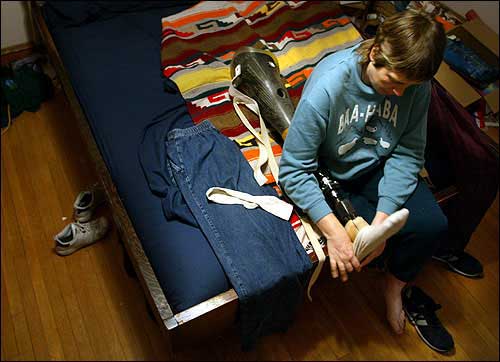
Willow Leenders-Weaver, 46, puts a sock on her prosthetic leg as she dresses for the day at her home in Salina. Leenders-Weaver and some of her friends are posing for a wall calendar to be released this month. It is part of the Willow project, a fund-raising effort to help Leenders-Weaver buy a new computerized prosthetic leg.
The new prosthetic unit, known as a C-Leg System, has a microprocessor embedded in the knee that is programmed to control leg stance and swing. This enables balance to be maintained between the healthy and prosthetic leg, especially on stairs and uneven terrain, and creates a secure, natural and efficient gait at various walking speeds.
At a pre-insurance cost of $67,000, the leg is more expensive than most cars and some homes, but Weaver wasn’t surprised.
“Any prosthetic with a knee unit is going to be a lot more expensive,” she said.
When Weaver eventually raises the money to purchase the C-Leg, she will visit a certified prosthesist who will customize it to fit Weaver’s individual gait pattern.
State Government
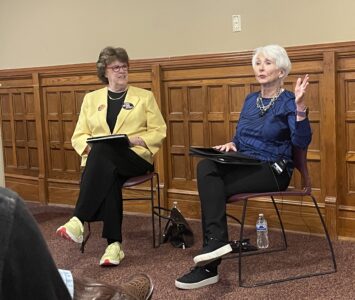
‘If it ain’t broke, don’t fix it’: Retired Judge Sally Pokorny tells residents why she opposes electing Supreme Court justices
KU professors would be limited in how they could present the idea of systemic racism in future classes
State legislators push back against federal energy regulators ending competitive bids
TOPEKA — Two Kansas legislators asked federal energy regulators to ensure competitive bidding occurs on ...
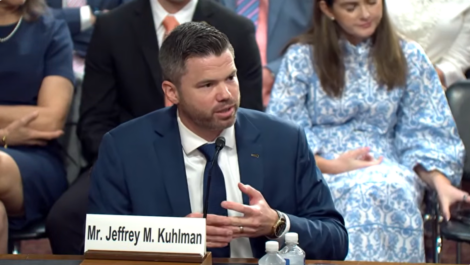
Senate confirms 1st of 3 Kansas nominees to U.S. District Court
Corporate income tax collections falling sharply in Kansas; Republican, Democratic leaders disagree on what it means
TOPEKA — Corporate income tax collections in Kansas have almost halved since last year, while other sources trend ...
Candidate’s campaign manager created website with documents used to attack rival
TOPEKA — Kansas U.S. Senate candidate Patrick Schmidt’s campaign manager left his digital footprint on ...