

Families drifting away from faltering Nebraska State Fair
LINCOLN, NEB. ? Becky Ferguson and her husband used to take their three children to the Nebraska State Fair every year to eat deep-fried candy bars, ride the Ferris wheel and look at the 4-H exhibits.
But the Fergusons, like many other families in Nebraska, have stopped going. They say the fairgrounds were no longer being kept clean, and tickets — $7 a person per day last year — had become too expensive.
Tradition in trouble
The Nebraska State Fair — a nearly 136-year-old tradition in the heart of America’s agricultural heartland — is in trouble.
It has been losing money and visitors, and its future may hinge on a Nov. 2 vote on whether to use $2 million a year in state lottery proceeds to repair buildings and make other improvements to the fairgrounds.
“It would be a very, very sad thing in the midwestern United States if we would lose a state fair,” said Iowa fair manager Gary Slater.
Across the Farm Belt, the farm economy has weakened, and competition for consumers’ entertainment dollars is tougher than ever. But the state fair in neighboring Iowa is thriving, as are similar summertime events in other states. Nebraska may have simply been slow to react to the pressures.
A committee appointed by Gov. Mike Johanns reported earlier this year that the fair would be forced into bankruptcy unless it got more money to add “glitz and pizazz” and spruce up the state-owned fairgrounds.
The report outlined a litany of problems at the fair, including poorly placed entrances and exhibit space, lack of beer sales outside designated areas, noisy grandstand events that interfered with other attractions, and poor marketing.
Dropping attendance
About $2 million is spent on the fair each year, but little of that comes directly from the state. The fair is largely supposed to pay for itself through admissions, parking, and vendor and carnival fees.
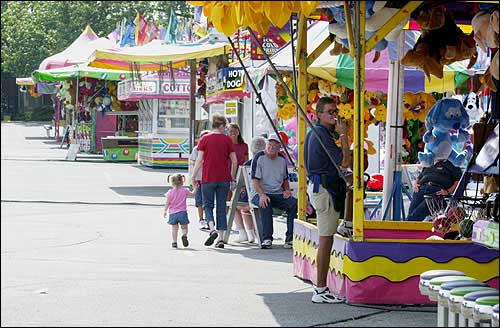
The midway at the Nebraska State Fair in Lincoln, Neb., is virtually deserted. This 2003 fair ended 50,000 over budget.
The fair ended 2003 about $650,000 in the red, and this year’s fair, which runs from Aug. 28 to Sept. 6, will be about $450,000 short, said interim fair manager Joe McDermott. Attendance has steadily dropped from 366,638 in 1999 to just 238,007 last year.
Urbanized state fairs
State fairs, which date to the 1800s, have long focused on livestock exhibits and competitions, canned goods, crafts and other agricultural attractions. But as the nation became more urbanized, so too did the fairs. Nebraska’s fair and many others boast rock concerts and high-tech exhibitions.
Nationwide, fair attendance is mostly steady or increasing, and fairs in states such as Iowa, Pennsylvania and Oklahoma have invested tens of millions of dollars in improvements, said Jim Tucker, president of the International Association of Fairs and Expositions.
Rock bottom
Nebraska’s fair, though, has not worked as aggressively as those in other states to line up corporate sponsors and other private sources of money.
“I don’t think they were trying to hide anything, I just think they were trying to deal with things internally,” said Kristine Gale, organizer of the campaign to pass the amendment that would steer lottery money to the fair.
Things hit rock bottom in Nebraska last year when the last state funding, totaling $293,000 for prizes, was taken away because of a budget crunch. This year the Legislature put back $153,000.
Ferguson, who lives in Lincoln and is an investment officer with no background in farming, said she would consider returning to the fair if it improved.
“I think coming to the state fair is a big treat for some of the farming families we have in the state,” she said. “Maybe if some of these issues were addressed people would come back.”
State Government
‘If it ain’t broke, don’t fix it’: Retired Judge Sally Pokorny tells residents why she opposes electing Supreme Court justices
KU professors would be limited in how they could present the idea of systemic racism in future classes
State legislators push back against federal energy regulators ending competitive bids
TOPEKA — Two Kansas legislators asked federal energy regulators to ensure competitive bidding occurs on ...
Senate confirms 1st of 3 Kansas nominees to U.S. District Court
Corporate income tax collections falling sharply in Kansas; Republican, Democratic leaders disagree on what it means
TOPEKA — Corporate income tax collections in Kansas have almost halved since last year, while other sources trend ...
Candidate’s campaign manager created website with documents used to attack rival
TOPEKA — Kansas U.S. Senate candidate Patrick Schmidt’s campaign manager left his digital footprint on ...