

Chaos reigned at plant during slayings
KANSAS CITY, KAN. ? As tables flew and shots rang out late Friday afternoon in a normally quiet break room in a Kansas City, Kan., food processing plant, only one person appeared to remain calm.
Elijah Brown, armed with two handguns that he had taken from his locker minutes earlier, considered his targets.
A shot rang out.
“This is what you get for messing with me,” he told one fallen co-worker.
“You’re good to go,” Brown told another, who was allowed to scramble away.
Employees described the scene in the 50-by 80-foot break room at the ConAgra Foods Inc. plant as pure chaos.
Before the bloody episode ended, Brown shot seven people, five fatally. He then turned the gun on himself.
Brown, whom police said had no criminal records, reportedly was upset by a series of problems in the workplace, either real or imagined. Victor Coggs, who was shot in the arm, said Brown may have been upset Friday because another co-worker, Travis Nelson, was using a pallet jack usually assigned to Brown. Witnesses said Nelson was the first man whom Brown shot.
But Coggs said Brown’s problems at the plant go back much farther. He was unhappy with one man who was doing a job that Brown had done in the past — a job that Brown preferred to his current production assignment. He also complained that other employees seemed to be crowding him on the job, Coggs said.
Police in Kansas City, Kan., said three of the dead victims — Ardell Edwards, 55, Lonnie E. Ellingburg, 46, and Travis Nelson, 23 — were related. Edwards was Ellingburg’s uncle, and Ellingburg was Nelson’s uncle.
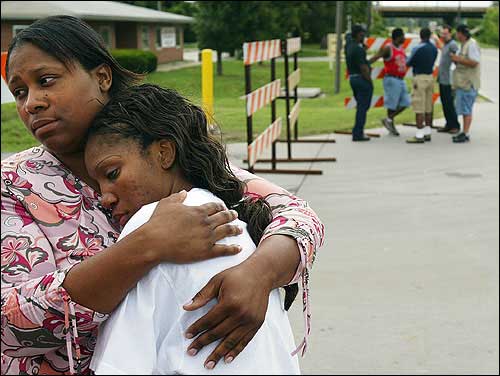
Denise Pledger, left, comforts her cousin Deya Barnett on Saturday outside the ConAgra Foods plant in Kansas City, Kan. Barnett's father, Lonnie Ellingburg, was among those killed Friday at a shooting in the plant.
The other men whom Brown shot and killed, police said, were 49-year-old Leonardo Rodriguez and a 45-year-old man whose name police had not released.
Coggs, 60, was treated at a hospital, and the other injured man, Juan Ramirez, 44, of Kansas City, Kan., remained hospitalized in fair condition Saturday.
This account of the evening’s events was compiled from interviews with shooting survivors, witnesses, plant employees, family members of victims and police.
Past troubles, teasing
At a morning news conference, Kansas City, Kan., Police Chief Ron Miller confirmed earlier reports that Brown had been the victim of teasing by other employees. Brown had been laid off previously but had been called back in recent weeks.
In a news release, police said Brown was 23, but at the news conference they said he was 21.
Miller said Brown used two handguns: A 9mm semi-automatic and an unknown-caliber revolver. Miller said police did not know how he smuggled the weapons into the plant. Miller said Brown’s selection of victims was not random, adding, “This person acted with purpose.”
Miller confirmed employee accounts that Brown spoke with some employees and allowed them to leave.
The shooting was preceded by an employee safety meeting, but there were no reports of arguments or problems during the meeting that could have precipitated the rampage. Miller said he did not know if all of those shot had attended the meeting.
Miller said that the police department would not release any information about Brown’s work record because he was employed by a private company.
Julie DeYoung, a ConAgra spokesperson, said the company had hired Brown last September. He was laid off earlier this year and called back about a month and a half ago. DeYoung said she could not release details of Brown’s employment record.
DeYoung also declined to discuss the company’s security procedures but said officials would be looking into the incident to determine what changes might be made.
‘Good to go’
Porter, who lives in Atchison, Kan., said he heard a “loud pop.” Like many other employees this day, he thought it was fireworks.
Then Porter saw Brown run past. He had a gun in his hand. Porter looked in the hallway and saw Nelson lying face down in a growing pool of blood.
Brown burst through the door of the break room holding two pistols, Coggs said. At least one shot rang out.
Coggs quoted Brown as saying, “That will teach you about … with me.”
Two or three more shots followed.
Brown, according to Coggs, said, “I bet you won’t … with me no more.”
Coggs said he was among the workers who overturned tables and scrambled for cover behind them. As Coggs dived for cover, he was shot in the left arm, just above the elbow.
“He was still shooting, talking, saying, ‘This is what you get for messing with me,”” Coggs said.
“The pain was really bad, but I was pretending I was dead,” Coggs said.
Then, Coggs said, Brown told a female worker, “Grace, you’re good to go, get … out of here.”
Brown also granted reprieves for at least two other co-workers, Coggs said, before he started walking toward him. “I thought he was going to kill me when he came over.”
Coggs said he thought about using his military training to defend himself if Brown came close to shoot him. “Then he said ‘Vic, you’re good to go. Get the … out of here,”” Coggs said. “I don’t think he knew he shot me” earlier.
Coggs said he got up and walked out, stepping over the body of Ellingburg, whom Brown had shot in the head.
Coggs started running when he hit the hallway outside the break room. Then he heard 10 to 20 additional shots.
Coggs made his way to the west loading dock, where co-workers found a chair for him to sit on. After a while, an emergency medical crew came to tend to him.
Deya Barnett, a daughter of Ellingburg, said she sympathized with Brown’s family. “We know they are grieving too,” she said.
State Government
‘If it ain’t broke, don’t fix it’: Retired Judge Sally Pokorny tells residents why she opposes electing Supreme Court justices
KU professors would be limited in how they could present the idea of systemic racism in future classes
State legislators push back against federal energy regulators ending competitive bids
TOPEKA — Two Kansas legislators asked federal energy regulators to ensure competitive bidding occurs on ...
Senate confirms 1st of 3 Kansas nominees to U.S. District Court
Corporate income tax collections falling sharply in Kansas; Republican, Democratic leaders disagree on what it means
TOPEKA — Corporate income tax collections in Kansas have almost halved since last year, while other sources trend ...
Candidate’s campaign manager created website with documents used to attack rival
TOPEKA — Kansas U.S. Senate candidate Patrick Schmidt’s campaign manager left his digital footprint on ...