

Insurance official seeks to ban costly inquiries
It was February 2002, after a powerful ice storm hit the area.
William Perkins of Lawrence said he heard some of his co-workers talking about making insurance claims because of their damaged trees.
So Perkins, who manages a group of software developers, said he called the toll-free telephone number for an agent printed on his homeowners’ policy to find out whether his policy covered such damage.
As it turned out, his Safeco Insurance Co. of America policy didn’t cover the damage, and Perkins thought that was the end of that.
Fast-forward to June 2002, when Perkins received his policy renewal from Safeco.
His annual premium rose from $1,023 to $3,554.
“It was very frustrating,” Perkins said.
Perkins said he was a victim of an insurance company treating an inquiry about coverage as a claim, a practice that Kansas Insurance Commissioner Sandy Praeger said was increasing around the nation.
Praeger said she would introduce legislation in the next couple of weeks to prohibit policyholders from being charged higher premiums for making inquiries about their coverage.
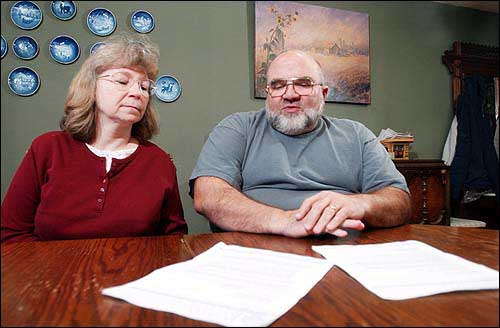
Mary and William Perkins, Lawrence, say an insurance company treated a question as a claim. Kansas Insurance Commissioner Sandy Praeger said she will introduce legislation to prohibit policyholders from being charged higher premiums for making inquiries about their coverage.
“This is common sense,” Praeger said. “We should be able to ask straightforward questions about our coverage or deductible without being penalized.”
Expensive request
Perkins said Safeco increased his premiums because he asked for information about a possible claim. The Seattle-based company has denied that happened.
“All claims closed without payment are not part of pricing strategy,” a Safeco official wrote after Perkins complained to the Kansas Department of Insurance.
But Perkins said the problem started as soon as he called the toll-free number on his policy. Though the number says it is for an agent, it was for the claims department, he said.

 Kansas Insurance Department
Right away, he said, a simple question about his policy started working through the claims pipeline.
An adjuster came to his property and told him the broken tree limbs had to hit the house for the damage to be covered, he said.
Safeco, in its letter to the insurance department, said Perkins’ premiums were increased because of two previous claims in 2000 — a $549 payout for hail damage to the roof and a payout of $314 for personal stolen property. The company also noted it didn’t know about a “significant” remodeling project going on at Perkins’ house.
But Perkins questioned why two small claims made two years earlier would have such a dramatic increase on his premium, and said Safeco must not have believed the remodeling job was that significant since it increased his dwelling coverage by only 3 percent.
Sara Britton, a Safeco spokeswoman, said the company would not respond to questions involving an individual policyholder.
But Britton said Safeco didn’t raise premiums based on claims without payments, and the company made that its official policy in 2003.
“We felt there was too much potential for customer confusion. Our goal is to have them (policyholders) talk to their individual agents,” she said.
Claims database
Praeger said insurance companies kept track of claims through databases such as the Comprehensive Loss Underwriting Exchange, or C.L.U.E.
She said some insurers required that when consumers called their agents with a question, the inquiry be placed as a claim in that database. Praeger said the insurance department had received about 30 complaints about the practice in the past year.
William Sneed, a lobbyist who represents insurance companies in Kansas, said “generically” he would support Praeger’s proposal, but added, “The devil is in the details.”
He added: “It really does hamper your claims reporting, if you make the law too broad. You have to know what your claims are.”
Perkins said he hoped Kansas would adopt a law that prohibits counting inquiries as claims. He said Safeco misled him into filing a claim that wasn’t covered so the company could use it to increase the premium.
“They should have told me right from the start. ‘No, you’re not covered,'” said Perkins, who has since dropped Safeco for another insurer.
State Government
‘If it ain’t broke, don’t fix it’: Retired Judge Sally Pokorny tells residents why she opposes electing Supreme Court justices
KU professors would be limited in how they could present the idea of systemic racism in future classes
State legislators push back against federal energy regulators ending competitive bids
TOPEKA — Two Kansas legislators asked federal energy regulators to ensure competitive bidding occurs on ...
Senate confirms 1st of 3 Kansas nominees to U.S. District Court
Corporate income tax collections falling sharply in Kansas; Republican, Democratic leaders disagree on what it means
TOPEKA — Corporate income tax collections in Kansas have almost halved since last year, while other sources trend ...
Candidate’s campaign manager created website with documents used to attack rival
TOPEKA — Kansas U.S. Senate candidate Patrick Schmidt’s campaign manager left his digital footprint on ...