

Legislators to tackle law and order issues
Push for concealed weapons law expected this session
Some people want to make it legal to carry concealed guns in Kansas.
Some want to add more prison beds. Others want to empty those beds by releasing nonviolent drug offenders.
Such issues — along with curbing elder abuse and increasing pay for appointed defense attorneys — are among the crime-related topics the Legislature is expected to tackle in the session that begins Jan. 12.
Here’s a look:
Concealed guns
Missouri lawmakers last year passed a concealed-carry law despite a governor’s veto, and several Kansas lawmakers said they expected a similar battle this year in Topeka. If such a bill were to pass, it faces a likely veto from Gov. Kathleen Sebelius, who supports concealed-carry permits only for retired law-enforcement officers.
People on both sides of the issue cite studies about concealed-carry laws’ impact on crime. Phil Journey, a gun advocate recently appointed to fill a vacant Senate seat in Wichita, said he didn’t want to get hung up on statistics.
“When it really gets down to the real issue, it’s whether Nancy the nurse or Mary the mom can get home at night,” Journey said. “If they’ re being stalked by an estranged, crazed husband, the peace of mind they get from having that means of self-defense is far more effective than a piece of paper called a protection-from-abuse-act restraining order.”
Opponents include Rep. Paul Davis, a Lawrence Democrat.
“I think that the best way to fight crime is through other avenues — treatment and incarceration for the people who need to be incarcerated, good economic policies. … Those are the ways you fight crime and not by allowing everybody to carry a gun,” Davis said.
The closest Kansas came in recent years to passing a concealed-carry law was in 1997, when Gov. Bill Graves vetoed a bill that would have allowed it.
Prison beds
A joint House and Senate committee studying prisons will recommend adding between 200 and 400 beds to El Dorado Correctional Facility at a cost of about $7.5 million, said Ward Loyd, a Garden City Republican and chairman of the House Committee on Corrections and Juvenile Justice.
Loyd said he didn’t know where the money would come from but that the plan is partly in response to projections that show the prison population will increase by 2,500, or about one-third, in the next 10 years.
Not everyone is convinced the new space is needed.

 State of the State
“I think there will be bills introduced this session to avoid having to build a new prison because, quite frankly, most legislators don’t want to spend $7 million or $15 million on new prison space if we don’t have to,” said Sen. John Vratil, a Leawood Republican who is chairman of the Senate Judiciary Committee.
One way to free up prison space, Vratil said, would be to expand the provisions of Senate Bill 123. Passed last year despite opposition from Atty. Gen. Phill Kline, the law required treatment and probation instead of prison for many nonviolent drug offenders. An early version was intended to apply to people already in prison, but that clause was dropped to get the law passed and signed by Gov. Kathleen Sebelius.
The law took effect Nov. 1.
“I think there’s a possibility that the Legislature would look at making 123 retroactive” to inmates, Vratil said.
Legislative estimates last year were that such a measure would free up about 300 beds in the 9,000-bed Kansas prison system.
Other issues
- Davis said he planned to introduce a bill that would increase hourly pay to $80 from $50 for court-appointed defense attorneys. The rate hasn’t increased since the late 1980s, and Davis and others worry it could result in poor legal representation for indigents.
- Davis said he also had talked with Douglas County Dist. Atty. Christine Kenney about introducing a bill that would create a felony category for financial abuse of senior citizens. Kenney said that if a senior citizen was bilked of thousands of dollars, prosecutors couldn’t charge the criminal with a felony theft because the crime is covered by the more specific statute: mistreatment of a dependent adult, a misdemeanor.
- Changes to the state’s criminal-sentencing guidelines — which resulted in sentences that prosecutors said were too short for the defendants in two recent Lawrence shootings — also could be on tap.
Atty. Gen. Phill Kline, who has criticized some of the state’s sentencing laws as too lax, has said he would recommend some changes in the laws to the Legislature based on the results of a series of statewide hearings that began in September.
 “State of the State: The Issues” is a 10-day series of Journal-World and 6News stories to help you understand the key issues facing the governor and Legislature. It leads up to our live 6News coverage and analysis of the governor’s State of the State address Jan. 12.Sunday: More than 2,000 disabled adults in Kansas are waiting for services. Will lawmakers be able to find the money to “take care of our own?”Monday: Expanded gambling could help the state cope with its budget crisis, and both sides are gearing up for a tough fight.Online: See earlier stories in the series, calendars, full texts of bills, contact information for legislators and more at www.ljworld.com. “State of the State: The Issues” is a 10-day series of Journal-World and 6News stories to help you understand the key issues facing the governor and Legislature. It leads up to our live 6News coverage and analysis of the governor’s State of the State address Jan. 12.Sunday: More than 2,000 disabled adults in Kansas are waiting for services. Will lawmakers be able to find the money to “take care of our own?”Monday: Expanded gambling could help the state cope with its budget crisis, and both sides are gearing up for a tough fight.Online: See earlier stories in the series, calendars, full texts of bills, contact information for legislators and more at www.ljworld.com. |
State Government
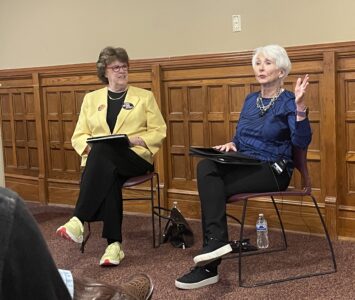
‘If it ain’t broke, don’t fix it’: Retired Judge Sally Pokorny tells residents why she opposes electing Supreme Court justices
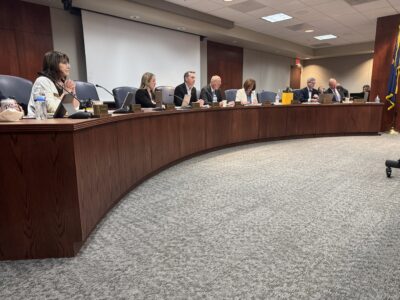
KU professors would be limited in how they could present the idea of systemic racism in future classes
State legislators push back against federal energy regulators ending competitive bids
TOPEKA — Two Kansas legislators asked federal energy regulators to ensure competitive bidding occurs on ...
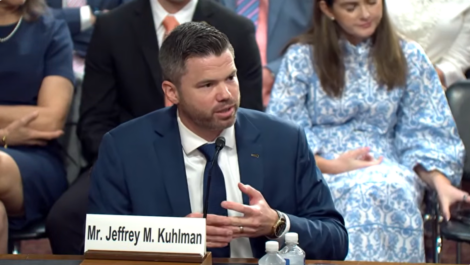
Senate confirms 1st of 3 Kansas nominees to U.S. District Court
Corporate income tax collections falling sharply in Kansas; Republican, Democratic leaders disagree on what it means
TOPEKA — Corporate income tax collections in Kansas have almost halved since last year, while other sources trend ...
Candidate’s campaign manager created website with documents used to attack rival
TOPEKA — Kansas U.S. Senate candidate Patrick Schmidt’s campaign manager left his digital footprint on ...