

Tax debate awaits lawmakers
Topeka ? There are signs of improvement in the Kansas economy, officials say, after an unprecedented dip in state tax revenue in the past two years.

Even so, demands on the state treasury will force Gov. Kathleen Sebelius and lawmakers to face the question of whether to raise taxes during the legislative session that begins this month.
Since mid-November, Sebelius has spent about three-fourths of her time working on a state budget she will propose to lawmakers when the 2004 legislative session starts Jan. 12. The governor has hinted she will propose a tax increase for education but has refused to discuss any details. On the spending side, Sebelius said she would present a bare-bones plan.
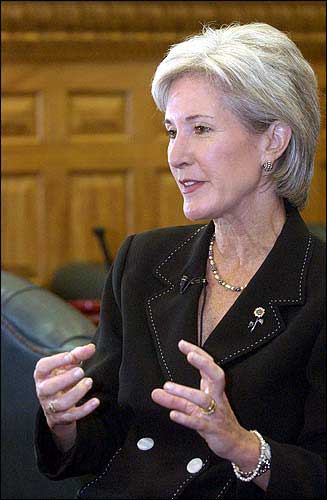
Kansas Gov. Kathleen Sebelius discusses her first year in office and what she hopes to accomplish in the future. Sebelius will propose a state budget on Jan. 12.
“We’re still working on the theory that outside of some priority services — health care, social services and education — we need to continue to kind of pare back on most of the other agencies,” Sebelius said in a recent interview.
Like many states, Kansas’ tax revenue grew steadily during the late 1990s. General tax fund receipts increased an average of 6 percent per year during the decade, and that even included years when lawmakers approved record tax cuts.
But from 2001 until now, Kansas has been pummeled by the drop in the stock market, the Sept. 11 terrorist attacks that devastated Wichita’s aircraft manufacturing industry and an ongoing drought.
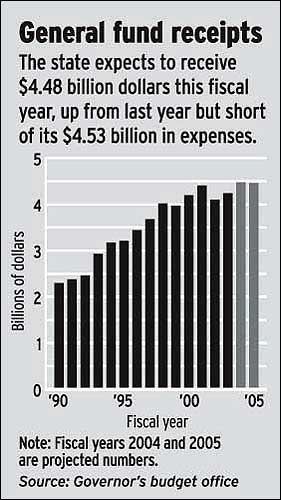
Tax fund receipts dropped a record 6.9 percent in 2001-02. The general fund has grown slightly since then, though much of that increase is due to payment delays, a sort of budget sleight of hand that accelerates tax collection and one-time revenues.
“It must have been fun to do this job when there was money because it is a very difficult assignment to look at the high-quality, good programs that really provide some benefit to citizens and make choices about which ones need to be cut back, which ones we can’t do at all. That’s not a very easy process,” Sebelius said.
Billion-dollar baby
The job of balancing Kansas’ books became even more difficult Dec. 2. That’s when Shawnee County District Judge Terry Bullock ruled the state system of funding public schools was in blatant violation of Kansas and federal constitutions by depriving students enough funding for an adequate education, specifically minority students who are on the short end of the achievement gap.
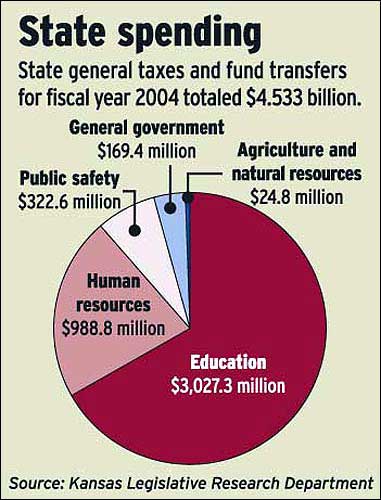
Bullock turned to a consultant’s report paid for by the Legislature that indicated Kansas needed to spend $1 billion more on schools, about a 37 percent increase from what the state now spends.
If Sebelius proposes a tax increase, it probably will be tied to boosting education spending.
“With the current budget situation, you can do almost nothing with enhanced funding of kindergarten through 12 without new revenue. The dollars required are so significant to change the money in the base or change the at-risk funding,” she said.
Senate President Dave Kerr, a Hutchinson Republican, said the only way the Legislature would consider a tax increase would be if Sebelius proposed it, though Kerr said the governor would have to explain “why she’s breaking her promise” of no new taxes in her 2002 campaign.
Some lawmakers have said they would rather wait out Bullock’s July 1 deadline, then appeal his decision to the Kansas Supreme Court. The issue of taxes comes at a dicey time politically since all legislative seats are up for re-election in November.
Other storm clouds
But even if Bullock’s order is ignored during the session, there are plenty of other budget issues needing attention:
- Three thousand elderly and poor Kansans are on waiting lists to receive in-home health care.
- The Kansas Public Employee Retirement System is in need of a long-term fix that will require increased contributions from the state.
- State employees are coming off back-to-back years of no pay raise and a 1.5 percent raise while their insurance costs have skyrocketed.
- In higher education, the Legislature has ignored for two years funding promises made in a sweeping reform bill, and a recent study said state universities were in need of $675 million for repairs.
Assessing the numbers at a recent revenue briefing, state Sen. Steve Morris, a Republican from Hugoton who is the chief budget writer in the Senate, summed up the situation, saying, “Our flexibility is pretty limited.”
|
Facing the most challenging budget situation in state history — capped by the question of how to adequately finance public schools — Kansas lawmakers this month will gather in Topeka to begin the 2004 legislative session.“State of the State: The Issues” is a 10-day series of Journal-World and 6News stories to help you understand the key issues facing the governor and Legislature. It all leads up to our live 6News coverage and analysis of the governor’s State of the State address Jan. 12. |
| Today: A tough budget situation got tougher with a December decision in a school-finance lawsuit.Saturday: From concealed weapons to prison crowding, crime and how to handle it will be a topic of dispute.Sunday: Cities and counties find their own budget situations worsening as state decisions push more responsibility to local governments.Online: For calendars, full texts of bills, contact information for area legislators and more, visit Kansas Legislature 2003-2004. |
State Government
‘If it ain’t broke, don’t fix it’: Retired Judge Sally Pokorny tells residents why she opposes electing Supreme Court justices
KU professors would be limited in how they could present the idea of systemic racism in future classes
State legislators push back against federal energy regulators ending competitive bids
TOPEKA — Two Kansas legislators asked federal energy regulators to ensure competitive bidding occurs on ...
Senate confirms 1st of 3 Kansas nominees to U.S. District Court
Corporate income tax collections falling sharply in Kansas; Republican, Democratic leaders disagree on what it means
TOPEKA — Corporate income tax collections in Kansas have almost halved since last year, while other sources trend ...
Candidate’s campaign manager created website with documents used to attack rival
TOPEKA — Kansas U.S. Senate candidate Patrick Schmidt’s campaign manager left his digital footprint on ...