

Dodge City teacher’s aide doggone effective with kids
Labrador retriever raises student enthusiasm
Dodge City ? Sheila Wagner, the librarian at Miller Elementary School here, is conducting a lesson on body parts, using Bear, her brown, 6-month old Labrador retriever, as an assistant.
“What are these?” she asks the gathered kindergartners, lifting Bear’s floppy ears.
“Ears!” the kids answer in unison.
“How many does Bear have?”
“Two!”
“How many do you have?”
“Two!”
And so the lesson goes, continuing on to Bear’s eyes, nose, tail and legs, focusing on the similarities and differences between the canine and her human counterparts.
Bear is the newest addition to Miller Elementary, serving as a teacher’s aide, of sorts, and “therapy dog.” It might seem an unusual blend, but Wagner says canines in the classroom help drive home lessons taught by more conventional means.
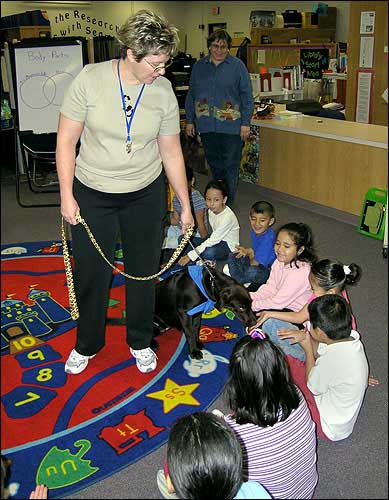
Sheila Wagner, the librarian at Miller Elementary School in Dodge City, introduces Bear, the school's newest teacher's aide, to a class of kindergartners. It might seem an unusual blend, but Wagner says canines in the classroom help reinforce lessons taught by more conventional means.
“Sometimes if I use Bear in a lesson, I think it sticks,” said Wagner, who is training Bear and studied classroom use of dogs at Friends University in Wichita. “I think it’s something they remember because a dog is involved with it.”
Moreover, studies show that dogs — used in hospitals and nursing homes, as well, to give comfort to patients and the elderly — can reduce human stress levels, Wagner said. Accordingly, Bear also is being partnered with timid and hard-to-reach children who might otherwise balk in a traditional setting at reading out loud, which is key in developing fluency and pronunciation.
“If they’re a real uptight, nervous kid, it relaxes them,” Wagner said. Reading to a nonjudgmental canine companion “boosts their self-esteem and lets them know it’s OK to read aloud.”
Teacher Shelly Debnam recalls the transformation of one withdrawn student who had a one-on-one reading session with Bear.
“He was so much happier when he came back,” she said. “He was all smiles.”
Debnam also notes that Bear’s presence, coupled with Wagner’s instructions on how to treat the dog, serve as a vital lesson in compassion and responsibility toward pets.
Back with the kindergartners, Wagner conducts a counting exercise. She has Bear take a few steps, then sit, the kids counting out loud each time the dog takes a rest.
The children eagerly watch Bear’s every move. At the end of class, Wagner leads the canine past the kids, who are instructed to put their hands out — not grab — so the animal can sniff and greet them in doggy fashion.
“She likes to lick people,” Brandon Hanks, a fourth-grader, later comments. “This is the first time I can remember having a dog in the school. It’s fun.”
State Government

‘If it ain’t broke, don’t fix it’: Retired Judge Sally Pokorny tells residents why she opposes electing Supreme Court justices

KU professors would be limited in how they could present the idea of systemic racism in future classes
State legislators push back against federal energy regulators ending competitive bids
TOPEKA — Two Kansas legislators asked federal energy regulators to ensure competitive bidding occurs on ...

Senate confirms 1st of 3 Kansas nominees to U.S. District Court
Corporate income tax collections falling sharply in Kansas; Republican, Democratic leaders disagree on what it means
TOPEKA — Corporate income tax collections in Kansas have almost halved since last year, while other sources trend ...
Candidate’s campaign manager created website with documents used to attack rival
TOPEKA — Kansas U.S. Senate candidate Patrick Schmidt’s campaign manager left his digital footprint on ...