

Bypasses bring blessings, problems to small towns
PLEASANTON ? Times was when there was an endless stream of big trucks rumbling down Main Street. But not anymore, and for that Willis Baker is very happy.
“We were glad to get rid of those 18-wheelers. They were dangerous,” said Baker, whose family has run a grocery in this Linn County town since 1869.
“The volume was more than Main Street was able to cope with. It’s easier to get in and out of the store now,” he added.
For six decades, Main Street was U.S. Highway 69 through the middle of town with a curve at each end, where trucks often would tip over if going too fast.
“They would be coming right at us sometimes. You would run to the back or somewhere,” recalled Bob Snow, who once ran a service station near one of the curves.
But those frightening moments ended in 1991 when the state completed the bypass that rerouted U.S. 69 to less than a mile east of the downtown.
Main Street became just Main Street lined with the usual mix of businesses, including Baker’s grocery, catering to area residents.
A dozen years after the bypass opened, Mayor Barry Walker said the town of about 1,400 had survived. “Wal-Mart hurts a hell of a lot more 30 miles from town than a bypass,” he said.
But the bypass did cause some changes.
Where once there were a half dozen service stations, now the main attraction is the convenience store on the bypass.
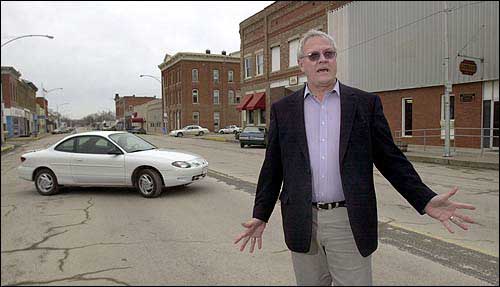
Pleasanton Mayor Barry Walker stands in what was once a busy highway running through downtown Pleasanton. A bypass routing U.S. Highway 69 around the town was completed in 1991 and has since been accepted as a positive change by the community.
“It was an awful place for travelers. You had to slow down to 20 miles per hour. I can’t blame them,” Snow said.
His station’s gasoline sales dropped by one-half, and Snow got out of the business after his four children, who helped out at the station, left home, he said.
For years there was the Tip-Toe Inn, a Main Street cafe that was a favorite among truckers. After the bypass, business dropped off and the cafe closed. The building now houses a beauty shop.
People in Pleasanton somewhat reflect conclusions in a recently completed Kansas State University study of nine towns, including this one.
It said travel-related businesses suffer because bypasses take away customers, while others in the towns view the bypasses as positive.
Michael Babcock, the Kansas State economics professor who directed the study, said the Pleasanton bypass was the oldest in the study, so those who had been upset at first either have left or adapted.
He suggested residents in other communities surveyed, such as Fredonia, Cherryvale or Sedan, remain upset because the bypasses are newer, completed between 1997 and 1999.
The study, paid for by the Kansas Department of Transportation, said bypass benefits included reducing traffic and promoting traffic safety.
It also concluded that while bypasses had negative effects on travel-related business, they didn’t hurt total city employment all that much.
State Government

‘If it ain’t broke, don’t fix it’: Retired Judge Sally Pokorny tells residents why she opposes electing Supreme Court justices
KU professors would be limited in how they could present the idea of systemic racism in future classes
State legislators push back against federal energy regulators ending competitive bids
TOPEKA — Two Kansas legislators asked federal energy regulators to ensure competitive bidding occurs on ...
Senate confirms 1st of 3 Kansas nominees to U.S. District Court
Corporate income tax collections falling sharply in Kansas; Republican, Democratic leaders disagree on what it means
TOPEKA — Corporate income tax collections in Kansas have almost halved since last year, while other sources trend ...
Candidate’s campaign manager created website with documents used to attack rival
TOPEKA — Kansas U.S. Senate candidate Patrick Schmidt’s campaign manager left his digital footprint on ...