

Train Town brings rail past to life
Blue Ridge Mall attraction presents grand history on a small scale
INDEPENDENCE, MO. ? A train rolls up the track carrying its load of coal to a power plant around the next bend, hauling a farm tractor destined for a small Midwestern town.
The next minute, it is chugging up the side of red rock cliffs into the Southwest, connecting the great landscape of America.
Sure, the landscape is constructed from foam and plywood and the coal car will fit in the palm of your hand. And, yes, the power plant is a cardboard construction with idle smokestacks. But, to the enthusiasts who make it run, it might as well be real.
“If it wasn’t for the railroads, America wouldn’t be what it is today,” said Terry Lynch, one of the builders of the new Train Town center at Blue Ridge Mall in eastern Kansas City. “Railroads brought farm products from the west to the east and people from the east to the west. It built this country.”
Lynch, a former history teacher, is the author of two books on railroad history and a longtime model train hobbyist. Like many train fans, he used to run his trains on isolated basement and garage set-ups with limited space and little exposure. Not anymore.
Four area model train clubs have combined forces to operate Train Town, a 12,000-square-foot display of track, train and landscape, designed and constructed by hobbyists. The displays are modular units, allowing one hobbyist to join his construction to the chain of others, making a circuit of vastly different landscapes.
Darren Hensley, of Grandview, is a member of The Weekend N’Gineers club, and the resident technical guru for Train Town. He runs N-scale trains, a standard model and track size equal to 1/160th of a real-life train.
“The object of the game is to operate without having to touch anything,” Hensley says. Physically picking up a piece and moving it is referred to as the “hand of God.”
Hensley’s display is one of the largest at Train Town with 11 modular units, part of a 13-piece set he’s been working on for many years. It includes a very complex rail yard, which, down its length, follows the history of trains from steam engines to high-power diesel locomotives.
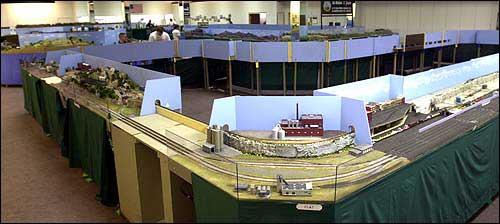
Days before it opened to the public, much detail work remained to be done on the Train Town display at the Blue Ridge Mall in Independence, Mo. The display opened July 20.
“This is a very unusual yard in the N-scale world because it has three cross-over tracks so you can enter or exit from either end,” Hensley explains. It also features an old-fashioned turntable and roundhouse that were used in the past to turn trains around.
“People get pretty excited to see that,” he said.
A few weeks ago, Hensley was scrambling to work out the kinks in the vast electrical system powering the different displays, getting ready for the grand opening. He is also starting the Train Town library and resource center, which will be open to the public.
Attention to detail
At the July 20 opening, visitors seemed delighted by the detail and accuracy of the displays. The hobbyists even set up a miniature camera on the front of one train, letting viewers see the landscape from inside.
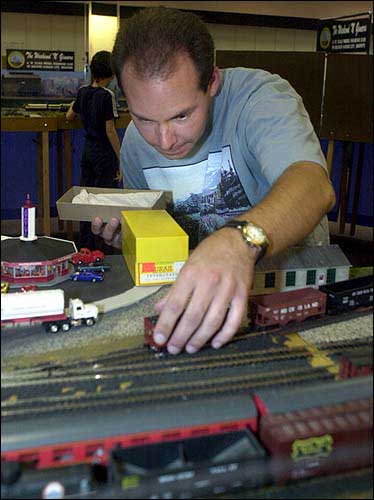
Ryan Hull of Raytown, Mo., adds another car to the track in his section of Train Town. The miniature train display is open every Sunday at the Blue Ridge Mall in Independence, Mo.
“I’m walking around hearing people say ‘Yeah, I remember that from when I was a kid.’ That’s what it is all about, preserving history,” said Ken Clark of Blue Springs, one of Train Town’s organizers.
Clark points out the timeline of history represented on the tracks from World War II-era troop transport cars to Desert Storm tanks on the beds of cargo trains.
One landscape recreates a 1950s Main Street with a neon-lighted movie theater and a circular drive-in restaurant. On down the line, another display is a modern landscape with high-rise offices and suburban homes.
Accuracy and detail, the pursuit of die-hard hobbyists, don’t come cheap. Depending on the scale, material and quality, engines run between $60 to $120 and cars are $12 to $25. Clark’s WWII-era transport train cost about $500.
“We could probably buy a house with the money represented on these tracks — a pretty nice house,” Clark said. “But, every hobby costs money.”
In addition to N-scale, hobbyists work in O-scale, the original modular standard, at 1/48-scale; HO-scale at 1/87; and G-Gauge, or garden scale, which are 18 to 36 inches in length and are typically displayed outside. All four styles are represented at Train Town.
Linking generations
For some, trains are a way to draw fathers and sons together. Or grandsons, for at least one visitor at the grand opening.
“My boys (grandsons) got me into all this with Thomas the Train books and toy sets,” said Greg Hoover of Raytown. “Anything that has to do with trains now, they love it.”
The boys, 6-year-old twins, happily wandered through the displays and picked out photos of real train engines and cars for sale at the opening.
The great landscape of Train Town is open to the public from noon to 5 p.m. Sundays. It is an ever-changing landscape, which like the story of trains, as Clark said, “is never really done.”
State Government
‘If it ain’t broke, don’t fix it’: Retired Judge Sally Pokorny tells residents why she opposes electing Supreme Court justices
KU professors would be limited in how they could present the idea of systemic racism in future classes
State legislators push back against federal energy regulators ending competitive bids
TOPEKA — Two Kansas legislators asked federal energy regulators to ensure competitive bidding occurs on ...
Senate confirms 1st of 3 Kansas nominees to U.S. District Court
Corporate income tax collections falling sharply in Kansas; Republican, Democratic leaders disagree on what it means
TOPEKA — Corporate income tax collections in Kansas have almost halved since last year, while other sources trend ...
Candidate’s campaign manager created website with documents used to attack rival
TOPEKA — Kansas U.S. Senate candidate Patrick Schmidt’s campaign manager left his digital footprint on ...