

Divided Kansas GOP falls short of goals
Nationally, the Republican Party has been partying since Nov. 5, when it won back control of the U.S. Senate and increased its previous advantage in the House.
But in Kansas, Republican in-fighting between so-called social conservatives and moderates continues to erode the GOP’s powerful advantage in numbers of registered voters.
“An analytical party would look at the national and state results and conclude that the Kansas Republican Party did not have a good year,” said David Miller of Eudora, a leading Kansas conservative.
True, Republicans control nearly every facet of Kansas government, but the GOP’s main objectives this election season were to retain control of the governor’s office and defeat Democratic U.S. Rep. Dennis Moore, whose 3rd Congressional District includes east Lawrence. On both counts, the GOP failed.
Gov.-elect Kathleen Sebelius, a Democrat, and Moore were able to lure moderate Republican voters to their side to win. Of Kansas’ 1.6 million registered voters, approximately 740,000 are Republicans; 440,000 are Democrats and 420,000 are unaffiliated.
Governor turncoat?
Among Republicans, the finger-pointing has stretched from Topeka to Washington, D.C. In a recent Washington Post article, powerful conservative operative Grover Norquist singled out Kansas Gov. Bill Graves, a moderate Republican, accusing him of being a Democratic collaborator. Graves was prohibited by term limits from seeking re-election.
Graves’ refusal for weeks to endorse Republican gubernatorial candidate Tim Shallenburger, a conservative, after the August primary probably hurt Shallenburger among moderate Republicans. Graves refused to endorse GOP attorney general candidate Phill Kline, who barely beat the late entry of Democrat Chris Biggs. In fact, Graves actively campaigned for Kline’s opponent in the GOP primary.
And some Republicans, including Norquist, say Graves failed to direct the redistricting process in the Legislature earlier this year in a way to make sure a Republican could win the 3rd District.
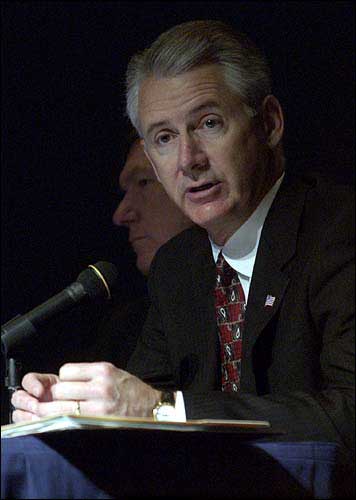
Gov. Bill Graves speaks at the Kansas Governors Roundtable at the 2002 Kansas Economic Policy Conference in October at Kansas University. In the background is former Gov. Mike Hayden.
Graves has dismissed the criticism, saying Norquist doesn’t know much about Kansas politics.
Kansas Republican Party Chairman Mark Parkinson said some of the back-and-forth is just natural finger-pointing after an election.
“I really wish the governor had endorsed Tim right away,” Parkinson said of the governor’s race, though he said he doubted that would have changed the election’s outcome.
Parkinson’s theory on the election is that voters in the U.S. Senate races were sending a message of support for President Bush and the war on terrorism. In the governor’s races, voters were going against the party that has been in power during the current recession.
“The economy and pocketbook issues were taken out on the gubernatorial candidates. Whichever party was in power got thrown out,” he said.
Redistricting roots
Parkinson said he thought both moderates and conservatives could be blamed for the failure of the Republican-dominated Legislature to draw a 3rd District that would have been impossible for Moore to defend. He said moderate-conservative battles, especially in the state Senate, laid the groundwork for the lack of cooperation between Republicans on congressional redistricting.

 More election information
Mel Kahn, a political science professor at Wichita State University, said it would be unfair to lay the defeat of Shallenburger and Adam Taff, the GOP nominee who challenged Moore, at Graves’ doorstep.
“There are two wings of the Republican Party and it’s just a fact of life,” Kahn said.
But, he said, having an enemy like Norquist, who carries considerable clout with lobbyists and conservatives in Washington, could bode ill for Graves in his next job.
Graves is leaving Kansas after his term expires to become president and chief executive of the American Trucking Assn. Much of Graves’ time will be spent lobbying Congress on behalf of the association.
Norquist told the Post: “When he takes over as head of the American truckers association, I doubt any member of the Republican leadership will return his calls. Let him get his calls returned by (Senate Democratic Leader Tom) Daschle.”
“I think Graves could be in for some difficulty,” Kahn said.
State Government
‘If it ain’t broke, don’t fix it’: Retired Judge Sally Pokorny tells residents why she opposes electing Supreme Court justices
KU professors would be limited in how they could present the idea of systemic racism in future classes
State legislators push back against federal energy regulators ending competitive bids
TOPEKA — Two Kansas legislators asked federal energy regulators to ensure competitive bidding occurs on ...
Senate confirms 1st of 3 Kansas nominees to U.S. District Court
Corporate income tax collections falling sharply in Kansas; Republican, Democratic leaders disagree on what it means
TOPEKA — Corporate income tax collections in Kansas have almost halved since last year, while other sources trend ...
Candidate’s campaign manager created website with documents used to attack rival
TOPEKA — Kansas U.S. Senate candidate Patrick Schmidt’s campaign manager left his digital footprint on ...