With $40M of planned projects, 2024 might be the year the city starts to grow west of the SLT
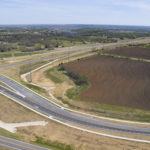
A view looking southeast shows the overpass where Bob Billings Parkway meets the South Lawrence Trafficway on Thursday, April 14, 2016.
It was August of 1994 when local dignitaries, a handful of reporters and other onlookers gathered in a hilltop pasture northwest of Lawrence for a groundbreaking ceremony of the South Lawrence Trafficway.
You could have won a lot of money that day if you would have wagered with the leaders on hand that nearly 30 years later, the site’s hilltop view still would be dominated by pastures and farm fields.
At the time, Lawrence was marching westward with 300 to 400 new single-family homes being constructed each year. Surely, by 2024, the land that dignitaries gazed upon with shovels in hand would be part of the Lawrence city limits, filling in with homes and businesses.
That hasn’t happened. Instead, 2024 may be the year that city leaders start getting serious about making it happen.
As part of its capital improvement plan approved earlier this year, the city has designated just more than $40 million worth of improvements that are pretty directly tied to opening up land west of the South Lawrence Trafficway for residential development.
The spending will start in 2024 and run through 2028. The spending on items like roads, sewers, water lines and other infrastructure is expected to set the table for thousands of new homes west of the SLT over next couple of decades.
Today’s economic development leaders say the spending is badly needed, and would be much welcomed if it comes to fruition.
“We are not yet where we want to be, but we have a good path to get there,” Rob Richardson, a consultant with the Economic Development Corporation of Lawrence and Douglas County, told a crowd of economic development stakeholders last week. “I’m not sure I could have said that at this time last year.”
As we reported in June, the EDC and the Lawrence chamber of commerce undertook a lobbying campaign during the summer to try to convince city commissioners to include more infrastructure money for the area west of the SLT. The campaign was successful to the tune of about $8 million.
After chamber members began reaching out to city commissioners, City Manager Craig Owens added funding for two key west of SLT projects that were not originally on his list of recommendations for the 2024-2028 capital improvements plan.
Owens added and commissioners approved the addition of $3 million to extend city utilities west of the SLT. That project will involve burying water and sewer lines underneath the SLT, which will be expanding to a four-lane road as part of a large state-funded project. City spending on the utility extensions is expected to begin in 2024 and be completed in 2025.
The second addition was $4.88 million to begin the extension of Bob Billings Parkway west of the SLT. Spending on that project also is expected to begin in 2024 and be completed in 2025.
The road and the utility extensions are considered prerequisites for any residential development to occur on the large amount of open land just west of the existing Bob Billings Parkway and SLT interchange.
The first version of the city’s Capital Improvement Plan didn’t have those projects listed, meaning they weren’t likely to occur until at least 2029. Economic development leaders were worried about that timeline because they contend the area west of the SLT will be critical in the city addressing its affordable housing issues.
While new single-family homes west of the SLT aren’t likely sell for less than $300,000, the theory is that a significant increase in the availability of new homes in Lawrence will help slow price increases on existing homes. In other words, people moving into the new homes may be leaving more modest homes in Lawrence, which in turn come onto the market and create more options for residents looking for a starter home.
But for that theory to work, it will require a significant amount of new home construction. Lawrence last year hit a new low for single-family home construction with just 79 building permits issued for the entire year.
What the land west of the SLT has going for it is that it potentially could accommodate lots and lots of homes. As a bonus, much of the land is outside floodplains that are problematic for construction, and the land — unlike large areas northwest of Lawrence — is in the boundaries of the Lawrence school district.
So, how many homes could be built there?
The best I can do is back-of-napkin math, at this point, but that will give you an idea of the potential scale. If Bob Billings Parkway were extended one mile to the west, the road would bisect about two square miles of land that is largely undeveloped.
Two square miles is equal to 1,280 acres. When I asked Richardson — the EDC consultant who is a former planning director in Wyandotte County — for an estimate on home numbers, he said three housing units per acre would be a very conservative estimate. (Individual neighborhoods certainly would be more dense than that, but when you account for existing development and undeveloped lands in the two square miles, you get a low number like three units per acre overall.)
That math yields sites for nearly 3,900 new homes in Lawrence. If you assume that Lawrence needs about 300 new homes per year to meet demand and stabilize prices, the two square miles would provide about 13 years worth of housing inventory. And, again, that is a conservative estimate. It is possible the number of houses would be greater, but unlikely it would be less.
But don’t unfurl the “Mission Accomplished” banner, and certainly don’t count on home prices to fall soon. It would seem we are still two years away from seeing home construction in that area, and there are several potential pitfalls that could derail those plans.
“The interest rates and construction costs are scaring a lot of people right now,” Richardson told me.
That could mean developers won’t immediately jump on the opportunity to build in the area, if those costs remain high. The developers will have large expenses beyond just building the homes in the area. For example, while the city pays for large streets like Bob Billings Parkway, developers normally are responsible for paying for smaller neighborhood streets. Those costs have been soaring.
The other pitfall is that the city doesn’t end up spending the money to open up the area west of the SLT. While the projects are now on the city’s five-year capital improvement plan, that is not a guarantee they will happen.
Future commissions could lose the political will to fund the projects, or the city could face a funding shortfall. The city’s five-year capital improvement plan is built on a financial assumption that sales tax revenues will grow by 5% per year. While that has been a safe bet the last couple of years, that is historically a high growth number. The city may not post 5% growth this year, which would create questions about whether it can reasonably expect such growth in future years. With 11 of 12 months in the book, the city has posted sales and use tax growth of 4.2% in 2023.
Any type of shortfall could be significant, because the dollar amounts involved to open the western lands are large. Here’s a look at other projects, in addition to the road and utility extensions, that will need to happen to develop the area.
• $18 million for southwest Lawrence sewer improvements, which are needed to serve the west of SLT area, but also are needed to reduce potential sewage problems in existing areas of town. The project is funded in the new CIP.
• $11.5 million to create adequate water pressure for areas west of the SLT. Funded in new CIP.
• $3 million in utility relocations to accommodate the expansion of the western leg of the SLT to four lanes. Funded in new CIP.
• $24.2 million for two new fire stations that would serve growing areas of town, with at least one of those stations presumably serving the area west of the SLT; $12.55 million is funded in the new CIP.
• $11.4 million to extend Sixth Street one mile west of the current city limits. The road currently exists, U.S. Highway 40, but it is not designed to city street standards. Not funded in the new CIP.
• $15.5 million to further extend Bob Billings Parkway west of the SLT. While the new CIP has $4.88 million in it for a Bob Billings expansion, that won’t be enough to extend Bob Billings a full mile west. The additional $15.5 million is not funded in the new CIP.
Town Talk column
Lawrence City Commission to weigh whether Costco should be included in STAR bond district

Thanks to a nonprofit that pairs artists and landlords, the Lawrence Potters’ Guild gets a temporary space of its own

After a brief bump during the World Cup, Lawrence is back to collecting less in sales taxes than it did a year ago
To make home construction easier and faster, Lawrence plans to experiment with a menu of pre-approved designs
Affordable apartment project in East Lawrence that escaped funding clawback shows new sign of progress