Plans filed for big self-storage project near Rock Chalk Park, but what happened to plan for 400 new homes?
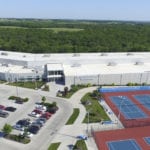
photo by: Journal-World
Sports Pavilion Lawrence, 100 Rock Chalk Lane, is shown in this file photo from June 2017.
Look for about 100,000 square feet of mini self-storage units to be built on vacant property north of Rock Chalk Park in the not-too-distant future. That project, though, raises an interesting question: Will there ever be any homes built north of Rock Chalk Park?
The area north of the Rock Chalk Park sports complex, at Sixth Street and Kansas Highway 10, is one of the more interesting ones in Lawrence. The city spent about $30 million to partially build the complex with a private partner who constructed facilities for use by Kansas Athletics.
Property to the south of the sports complex is some of the only ground zoned for big-box development in Lawrence, yet it hasn’t yet attracted any big-box store. One reason is that when you stand on the site and look around, it is far from surrounded by housing. The property to the east has developed with homes and apartments, but land to the north and to the west is still basically pasture land.
Earlier this month, the city recreation center at Rock Chalk Park — Sports Pavilion Lawrence — turned 8 years old. I think it is fair to say many people thought the area around Rock Chalk Park would look different than it does today. LMH Health has made a major investment in the area, with its large outpatient center adjacent to the park. One hotel has been built next to the park as well. But no restaurants, no stores, no other commercial amenities have located there.
Instead, the one development plan I do have information to report on is a self-storage complex. Plans have been filed to rezone about 11 acres of property in the 1700 block of East 902 Road to light industrial uses.
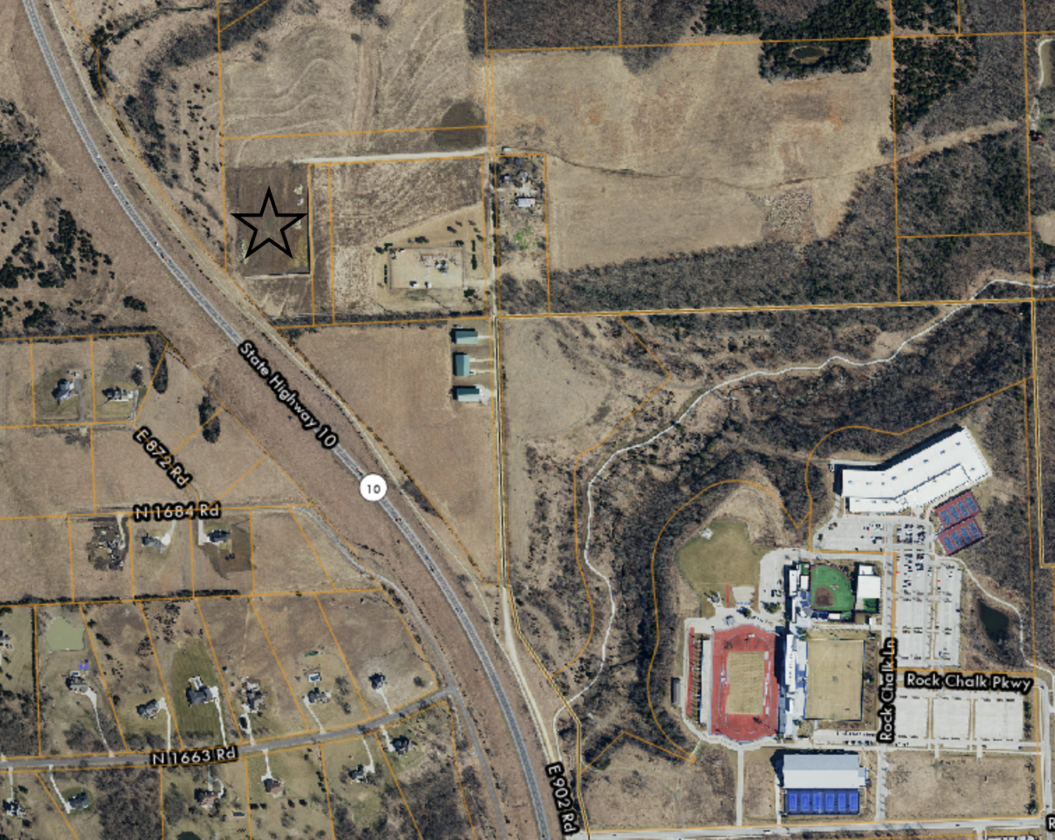
photo by: Douglas County GIS/Journal-World
The site marked with a star is the location for a proposed 100,000 square foot self-storage complex.
The zoning would allow for about six mini-warehouse-style buildings totaling about 100,000 square feet to be constructed on vacant land that abuts the South Lawrence Trafficway, which is also K-10, according to a conceptual site plan filed as part of the rezoning application. Look for a public hearing on the project in the coming weeks.
Lawrence-based Garber Enterprises is the developer for the proposed project. If some of this sounds familiar, you may recall a few years ago that Garber proposed self-storage units for the area. They never got built, although a big retaining wall visible from the SLT was built on the site. The approval for the project has expired.
If your memory is good, you also may recall that Garber was involved in another project in the area, which has piqued my interest because it gets back to that question of whether there ever will be any houses north of Rock Chalk Park.
Late last year we reported that Garber filed plans to develop 100 acres of vacant property north of Rock Chalk Park into a development that could accommodate about 400 new homes.
Right now, many members of the Lawrence real estate community would welcome the prospect of 400 new homes being added to the Lawrence market. All the local housing numbers indicate Lawrence has a very tight market, where buyers significantly outnumber sellers, which is putting a lot of upward pressure on home values — i.e., homes are becoming less affordable.
However, the 400-home development north of Rock Chalk Park isn’t moving forward currently. I had noticed in late January that the Lawrence-Douglas County Planning Commission, in a split vote, recommended denial of key parts of the project.
The Planning Commission, though, is only an advisory body, and I thought the development would make its way to the Lawrence City Commission where it might win approval. But weeks passed and then months without the project showing up on the City Commission’s agenda.
In reporting on Garber’s self-storage plan, I asked for an update on the housing project. David Hamby, an engineer with BG Consultants who is representing Garber, told me Garber has pulled the project from further consideration.
“He was pretty frustrated after that Planning Commission meeting, and he pulled the project,” Hamby told me.
Why? Several planning commissioners in January said they weren’t convinced the project — which would have required an annexation of land into the Lawrence city limits — would produce a “community benefit.”
This idea that land annexed into the city limit needs to create a specific community benefit is a relatively new part of the city’s approval process. It came to be when the city last year adopted the new Plan 2040 comprehensive plan. The Garber development in January was one of the first projects required to meet the test.
It became clear in listening to the January planning commission meeting that there are different philosophies on what should be considered a community benefit. Certainly, doing something to improve the affordability in housing is listed as a potential community benefit.
But what actions can improve affordability of housing in the community? Does that mean a developer has to work with established affordable housing groups — like Tenants to Homeowners — to donate or cheaply sell a certain number of lots in a development to be used for official affordable housing? Or, does adding 400 housing lots in a very tight market create a rebalancing of supply and demand that helps slow or reverse rising home costs?
At the January meeting, there were more planning commissioners who believed the former rather than the later. Garber didn’t like that answer, and the prospect of the 400 new homes disappeared, at least for now.
For what it is worth, the city’s planning staff believed Garber’s proposal met the community benefit standard under the code. At one point, the city’s planning director went through some math with commissioners. At 1% population growth per year, the city adds about 1,000 residents per year. Based on the average household size in Lawrence, that would require about 400 new homes a year. Lawrence probably will finish 2022 with about 75 single-family building permits and about 160 apartment permits. In the 1990s and 2000s, for comparison, the city routinely had more than 300 new single-family permits per year. Understanding that deficit math is important in understanding the affordable housing situation.
But that math wasn’t persuasive to enough commissioners in January. But, that also was many months ago. Hamby said Garber is evaluating his options for bring the project forward again. As the city’s housing issues get more attention, perhaps leaders have a different view of it now. Plus, remember, city commissioners never got the chance to weigh in on this project and the community benefit question that comes with.
Hamby, though, said Garber has not yet reached out to any of the affordable housing organizations to talk about a donation of lots to the project. Hamby said he’s not sure that is likely, as Garber plans to develops homes of a size and style that tries to meet some of the lower price points in the market.
It is anyone’s guess whether the project actually will develop. The property has challenges, including that any homes in it would be in the Perry-Lecompton school district rather than the Lawrence district. Plus, even if Garber won approval for the project, there’s no guarantee it would get built. The developer would have to pay to extend a road and other infrastructure to the site, which is not cheap.
But it is a project worth watching because it could be a canary in the coal mine of “community benefit.” What happens when a developer doesn’t want to donate or cheaply sell lots to an affordable housing organization? Can or should the city deny an otherwise desirable project due to that refusal?
It is not a surprise that a project in one of the most interesting areas of the county is creating such interesting questions.
Town Talk column
Lawrence City Commission to weigh whether Costco should be included in STAR bond district

Thanks to a nonprofit that pairs artists and landlords, the Lawrence Potters’ Guild gets a temporary space of its own

After a brief bump during the World Cup, Lawrence is back to collecting less in sales taxes than it did a year ago
To make home construction easier and faster, Lawrence plans to experiment with a menu of pre-approved designs
Affordable apartment project in East Lawrence that escaped funding clawback shows new sign of progress