
Rural-urban divide in Douglas County should create a new question: Why not a seven-member County Commission?
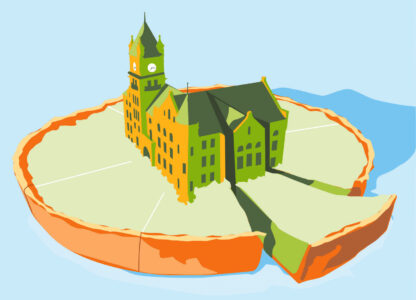
photo by: Sylas May
Some rural residents have been pushing for a Douglas County Commission with five districts, but there are other ways the commission could be sliced up, as well.
A few weeks ago, the Eudora School Board was close to publicly defying the mask mandate that had just been extended by the Douglas County Commission. There was serious consideration by multiple board members to simply tell Eudora’s schools to not follow the county’s mask rules.
The school board ultimately didn’t have enough votes to tell the county and its mask mandate to take a hike, but I mention it anyway because it is a good reminder about politics in Douglas County. At their closest point, Eudora and Lawrence are about 6 miles apart, but the distance on the political spectrum is often much greater.
It is that way in other parts of rural Douglas County as well, I suspect. That gap is at the heart of the movement to expand the size of the Douglas County Commission. Currently, the County Commission has three members. For the first time in a long time, all three are from inside the Lawrence city limits.
A group of residents, primarily from outside Lawrence, has suggested expanding the County Commission in the wake of this development. Last week, county commissioners tentatively agreed to include on a countywide ballot the idea of expanding the commission from three members to five.
County commissioners will have to take one more vote before that question is officially placed on a future ballot, and I’m suggesting that the county and its residents have one more conversation before it happens. It is this: Would it make more sense to expand the County Commission to seven members?
The answer depends a lot on what you are trying to accomplish.
If the goal is to guarantee that one non-Lawrence resident is on the commission at all times, then five may be your number. State law requires county commission districts to be roughly equal in population, meaning each district in Douglas County would need to be very near 23,757 people. Douglas County’s non-Lawrence population is 23,851, according to the Census. Theoretically, one of the five districts could encompass all of the non-Lawrence territory. That would guarantee one non-Lawrence resident would be on the commission at all times.
Of course, something else should be obvious about this math: It would virtually guarantee that the County Commission would always have four Lawrence residents on it. That may be fair, given that Lawrence makes up four-fifths of Douglas County’s population.
But it would be an odd development nonetheless. It largely has been rural residents pushing for a change in the County Commission structure. It is no coincidence the push began after three Lawrence residents were seated on the commission. At the risk of sounding crass, if they didn’t like three Lawrence liberals on the commission, surely they really won’t like four.
Such a scenario would mean a non-Lawrence voice would be present on the commission to inform decisions, which has some value. What it doesn’t have, though, is much voting power when there is an issue involving a rural/urban divide.
You could create a different type of five-member commission, though. It would consist of two city of Lawrence districts and three districts with a mix of Lawrence and non-Lawrence territory. Theoretically, those mixed districts would have 66% Lawrence residents and 34% non-Lawrence residents. A non-Lawrence resident with the right appeal could win one of those districts, or three non-Lawrence residents with the right appeal could win all three of those districts. But the math is uphill.
In fact, it is uphill enough to question why you would prefer this scenario over the current setup of a three-district commission. With a three-district commission you could have one Lawrence-only district and two mixed districts. Those mixed districts basically would be 70% Lawrence versus 30% non-Lawrence. Compare that to the 66% to 34% split above. Is a 4-percentage-point gain really worth the tradeoff of now having to win three seats to control a majority rather than two? If you are not a Lawrence resident, that seems like a bad swap.
But what about a seven-member commission? That’s a bigger change, but it potentially produces a different type of math.
There are several ways you can divide a seven-member commission. I’ll go over only one. It does not guarantee that any seat would be held by a non-Lawrence resident, but rather it gives non-Lawrence residents a real chance to win in three districts.
The scenario is this: four districts that are entirely within Lawrence, while the remaining three districts would be mixed. Theoretically, those mixed districts could be 53% Lawrence versus 47% non-Lawrence.
While that scenario could lead to seven Lawrence residents on the Douglas County Commission, it also could provide the best chance at creating a more moderate slate of candidates in future elections.
The biggest change that has happened in local politics doesn’t involve the structure of the County Commission. Instead, it involves the near-collapse of the local Republican Party. It simply struggles to field candidates at this point. As a result, there is not much to stop County Commission politics from drifting leftward. Rural residents could serve as that counterbalance, but you have to give them districts where they have a chance to win.
It is worth asking whether a seven-member County Commission is the best way to do that. I don’t know that it is. I talked to a couple of county commissioners about the idea. Concerns of costs related to a seven-member commission — both in terms of commissioner salaries and also potentially the need for more county staff — came up. Plus, it was argued that five makes more sense from a belief in incremental change.
But perhaps the biggest argument against a seven-member commission is also the biggest argument against a five-member commission. You can argue the easiest way for non-Lawrence voices to be heard at the County Commission is to find two non-Lawrence residents who know a lot of people in Lawrence. There are many such people who exist. Get them to run for the County Commission. There have been many years where that formula has worked to result in two of the three County Commission seats being held by non-Lawrence residents. It didn’t work the last time, but that may have more to do with who decided not to run rather than the size of the commission.
At this point, I suspect there are a fair number of Lawrence residents who find this conversation off-putting. Why are we trying to create division between Lawrence and the rest of the county? I share some of those concerns. Lawrence is 80% of the county’s population, and I do believe that Douglas County’s role in Kansas will be as an urban county.
But I also believe, if we aren’t careful, we are going to create structural disharmony in Douglas County that will hurt us in the prosperity department. If 20% of Douglas County’s people feel like they don’t have a chance for their voices to be heard and acted upon in the courthouse, that will create disharmony.
That disharmony will turn to disdain if this effort to reorganize the County Commission goes sideways. I fear it could. If this ends with a County Commission that locks in a 4-to-1 advantage for the city of Lawrence, we will have done much more than change the County Commission. We will splinter Douglas County in ways that could be very difficult to put back together.
Town Talk column
Lawrence City Commission to weigh whether Costco should be included in STAR bond district
Thanks to a nonprofit that pairs artists and landlords, the Lawrence Potters’ Guild gets a temporary space of its own

After a brief bump during the World Cup, Lawrence is back to collecting less in sales taxes than it did a year ago

To make home construction easier and faster, Lawrence plans to experiment with a menu of pre-approved designs
Affordable apartment project in East Lawrence that escaped funding clawback shows new sign of progress