
Lawrence sales tax collections on pace to set another record, but high inflation complicates the numbers
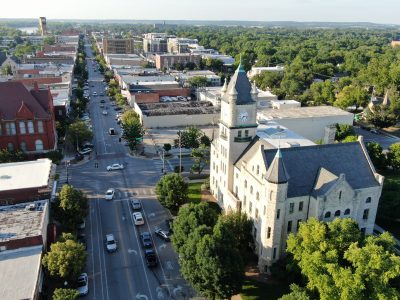
photo by: Jackson Barton/Journal-World File Photo
The Douglas County Courthouse and downtown Lawrence are pictured in an aerial photo Saturday, July 13, 2019.
When it comes to prices and retail sales, the start of 2022 has been anything but ordinary — unless you consider using a Brinks truck to transport your groceries home ordinary. With that said, Lawrence’s sales tax collections for the first four months of the year don’t look normal, but they also don’t look out of line with what’s going on elsewhere in the state.
After receiving its April sales tax check from the state, Lawrence’s sales tax collections for the year are up 12%. As perspective, Lawrence set a record in 2021 by posting a 9% increase in sales tax collections. Previously, an increase of 5% to 6% was considered an outstanding year, and increases of 2% to 3% were considered solid.
So, a 12% increase — if it holds for the year — would be another record setter. That, however, probably says more about the unusual times of the American economy than of a true boom in the Lawrence economy.
Of course, what I’m talking about here is inflation. If prices on most items have gone up by 7% or 8% over the last year, sales tax collections are going to increase regardless of whether people are actually buying more goods or services.
With a 12% increase, it appears a little bit of both may be happening in Lawrence; prices are going up, but consumers also have increased the amount of goods and services they are buying too.
For what it is worth, that is happening a little bit more in Lawrence than elsewhere. Local sales tax collections are up by 10.8% statewide, according to the latest report.
When you look just at the state’s 10 big retail markets, however, you see that Lawrence is closer to the middle of the pack. Here’s a look at how much sales tax collections have increased in those markets thus far in 2022 compared with the same period a year ago:
• Olathe: up 13.5%
• Overland Park up 13%
• Lenexa: up 13.1%
• Sedgwick County: up 12.7%
• Lawrence: up 12%
• Salina: up 10.8%
• Kansas City: up 8.7%
• Manhattan: up 7.9%
• Shawnee: up 7.7%
• Topeka: up 7.5%
As you can see, all the major retail markets are having record-type years in terms of sales tax collections. But it would be premature to say retailers are having record-type years. Higher prices produce more sales tax collections, but they don’t necessarily produce more profits, if the wholesale price of the goods retailers are selling also has increased. So, using sales tax collections as a measure of the overall health of Lawrence’s retail economy is a bit more fraught than normal this year.
Along those same lines, it also is a little difficult to measure the impact that sales tax collections are having on the city of Lawrence’s budget. The city relies heavily on sales taxes to pay a lot of bills. The city almost certainly is going to see a large windfall in sales tax collections, if collections stay on this current pace. The city did not budget for a 12% increase in collections.
But to know whether the city really is going to have a windfall of sales tax revenue to work with, we need to understand what impact inflation is having on the city’s general operations. For example, has inflation started causing the city’s expenses to come in well over budget? Or does the city have enough fixed expenses that it is not feeling the bite of inflation as much as many households?
If it is the former, then the city’s additional sales tax collections may well get eaten up by their additional expenses. But if it is the later, that creates an interesting scenario of how the city will manage its budget for the rest of this year and how it prepares for next year.
I’ve got a call into the city’s finance manager to get an update on that front. I’ll pass it along when I get it. Until then, just know that the city’s sales tax collections currently are historic but also in line with what is happening elsewhere in the state.
One other item to keep in mind is that Lawrence may indeed see a true windfall, thanks to KU’s national championship and all the feel-good spending that has resulted from that win. While this report is labeled the April report, it didn’t capture any of the spending around the Final Four and national championship games. Due to normal delays in sales tax reports, the April report largely tracks sales made in February. It will be the May and June sales tax checks the city receives that could show big jumps in spending related to the NCAA celebrations.
Town Talk column
Lawrence City Commission to weigh whether Costco should be included in STAR bond district

Thanks to a nonprofit that pairs artists and landlords, the Lawrence Potters’ Guild gets a temporary space of its own

After a brief bump during the World Cup, Lawrence is back to collecting less in sales taxes than it did a year ago

To make home construction easier and faster, Lawrence plans to experiment with a menu of pre-approved designs
Affordable apartment project in East Lawrence that escaped funding clawback shows new sign of progress