Douglas County Judge Carl Folsom chosen as a finalist for Kansas Supreme Court seat
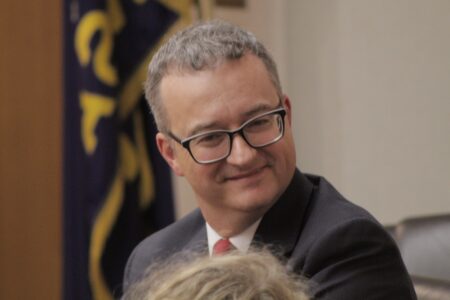
photo by: Chris Conde/Journal-World
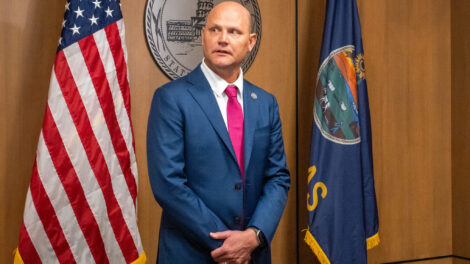
Judge Carl Folsom III is pictured at his judicial swearing-in ceremony on Dec. 2, 2022, in Lawrence.
Updated at 4:40 p.m. Thursday, May 21
One Lawrence resident’s name — out of three considered — will be submitted to Gov. Laura Kelly as a finalist for the open seat on the Kansas Supreme Court.
Douglas County District Judge Carl Folsom III made it into the final round of voting Thursday by the Supreme Court Nominating Commission. He will be joined by two other finalists: District Judge Krishnan Christopher Jayaram, of Lenexa, and District Judge Robert James Wonnell, of Olathe.
Kelly will pick one of the three to fill the seat of retired Justice Marla Luckert.
Attorney Meryl Carver-Allmond and Douglas County District Judge Amy Hanley, both of Lawrence, were also in the running but were eliminated after the first and second rounds of voting, respectively.
The nine-member commission, composed of a chairman, four attorneys from each Kansas congressional district and four nonlawyers from each district, interviewed seven candidates Thursday, then participated in three rounds of balloting to come up with three names to send to the governor for consideration.
The top three vote getters in the final round were Jayaram with nine votes, Folsom with seven, and Wonnell with five.
Attorney Molly McMurray Gordon, of Wichita, and attorney Kristen Diane Wheeler, of Wichita, tied in the final round with three votes each.
Folsom was sworn in as a Douglas County judge in December 2022. A graduate of Tonganoxie Public Schools and a 2005 graduate of the University of Kansas School of Law, he previously served as public defender at both the state and federal levels, as well as being an attorney in private practice for a period.
During his swearing-in four years ago, Folsom cited his mother and her nursing career as inspiration.
“I’ve spoken many times about the impact that my mother had. The most important thing that she did for me was to allow me to witness her success,” he said.
He said his parents divorced when he was 8, and his mother raised him and his sisters in an old farmhouse that had one heated room and no indoor running water. His mom worked as she put herself through college, eventually becoming a nurse.
“She raised our family out of poverty and I got to see that firsthand. She showed me the power of that hard work, but mostly the power of education and how it can transform lives,” Folsom said.
Then-Chief Judge James McCabria, who swore in Folsom, said some of Folsom’s career highlights included being honored in 2019 by the Kansas Association of Criminal Defense Lawyers with the Clarence Darrow Award for outstanding criminal defense performance, and being honored in 2021 by the Kansas Bar Association with the Courageous Attorney Award, which recognizes a lawyer who has displayed exceptional courage in the face of adversity.
Folsom made national news recently when he temporarily barred the State of Kansas from enforcing provisions of its new law banning gender-affirming care for minors. The law went into effect after the Legislature overrode Kelly’s veto of it.
Folsom said during his interview Thursday that if he were selected by Kelly he would likely be required to recuse himself from the gender-care case should it be appealed to the Kansas Supreme Court.
In 2021, Republicans in the Kansas Senate rejected Kelly’s nomination of Folsom to the Kansas Court of Appeals twice in eight months, despite support for him from the state’s top federal prosecutor and other attorneys.
The Associated Press reported at the time that an array of lawyers, prosecutors, public defenders and others wrote supportive letters backing Folsom’s nomination. Then-U.S. Attorney Stephen McAllister, an appointee of President Donald Trump, wrote saying he was confident Folsom would not be driven by an agenda, nor would he be “political” as a judge.
State Government
Opinion: The Lawrence man seeking to break the power of Republican, Democratic parties this election
State tax receipts top estimate by $147M for quarter
TOPEKA — The state of Kansas collected $147 million more in taxes than anticipated during the first quarter of ...
Rep. Tracey Mann to skip candidate forum in Lawrence; spokesman scarce on details

Kobach, Mann debate criminal justice priorities at Tuesday event as they campaign in attorney general race
Kansas must count mail ballots that arrive three days after November election, appeals court rules