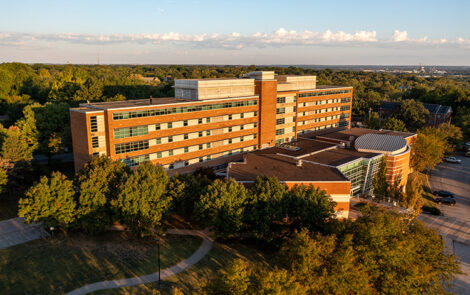
A University of Kansas program is helping teachers navigate the AI revolution
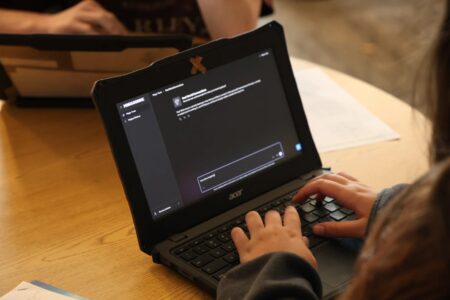
photo by: Rachel Schnelle/Kansas News Service
A junior at Bonner Springs High School uses MagicSchool to type in how they can use slope-intercept form for their future careers on Monday, Aug. 31, 2026.
On a Tuesday afternoon, Heather Campbell’s algebra class at Bonner Springs High School is lively, with students walking in to start their lesson. They’re learning about the inputs and outputs of slope intercept form, a math problem that uses a graph of negatives and positives.
After Campbell explains how to use slope, the students spend the rest of the class time using a program called MagicSchool — an artificial intelligence program that can translate the math equations to their future careers.
Campbell inputs jobs like “electrician” or “anesthesiologist” to demonstrate how her math lesson could translate to real life.
This type of AI program in the Bonner Springs school is possible because they received money from the University of Kansas Center for Reimagining Education, or CRE. The money is supported by private donors.
Bonner Springs is one of 11 schools to receive the $7,000 stipend in the cohort model this year. That funding allows the districts to dedicate staff time to the program.
There are two levels of recipients of the center’s grant. There’s a cohort level, with a fixed dollar amount of $7,000. Then there’s the online module level, which is at no cost to the participating districts.
The CRE focuses on helping teachers and school districts reimagine what teaching looks like in the age of AI. There’s been an effort at the federal level to prioritize the use of AI in classrooms. A memo from the U.S. Department of Education earlier this year laid out the priority of using AI in classrooms across the country.
Campbell spearheads the effort at Bonner Springs High School. Her goal this year is to prevent her students from becoming “AI robots where they just copy and paste.”
“Anybody can do that,” she said. “But that thinking, and the going back and forth between AI, enhancing your voice, is the part that my goal is for this year.”
Campbell said the district has been slowly implementing the stoplight method — which describes the level of AI that can be used in an assignment. The method has four colors – red, orange, yellow and green. Red means no AI, orange is AI at the end of the assignment, yellow is AI as a study buddy and green is AI as a co-pilot.
The district’s been working with CRE for three years.
The center offers guidance and frameworks on how to use AI in schools. There are three recommended lenses through which to consider AI use — developing innovation, starting small to grow big and involving families and students.
The center’s growth officer, Bart Swartz, said financial support and guidance creates sustainability for the districts. The center helps through coaching and professional development. They can start where they are comfortable.
“There are so many times that districts start on an initiative and they either start with the whole building or the whole district trying to take on something new and it often fizzles out because people don’t have buy-in,” Swartz said.
The cohorts meet and discuss what they’ve done over the course of three years once they’ve received the stipend or the modules.
Another member of the program is Circle Public Schools in Towanda. Superintendent Don Potter said the district has started using AI for projects.
One of the projects involved pairing kids from kindergarten to sixth grade into “F.A.B” families — which stands for family activity building. The students in the families created their own character and asked AI to develop the storyline for a book.
Potter said the students had supervision and were able to make feedback on the stories.
“AI in some respects,” Potter said, “it’s a scary thing. To be able to have professional development around the resources and what can be used is crucial.”
The online module level is at no cost. Smaller, more rural Kansas districts like USD 417 Morris County started using the program this school year.
Valerie Gehrer is the district’s director of teaching and learning. She said the program focuses on reimagining the work and projects that teachers already do.
“That whole reimagining piece is really powerful to put that in the hands of our teachers and say, how would you make this better?” Gehrer said.
— Rachel Schnelle reports for Kansas News Service.
KU
KU’s center for eating disorders invites public for open house
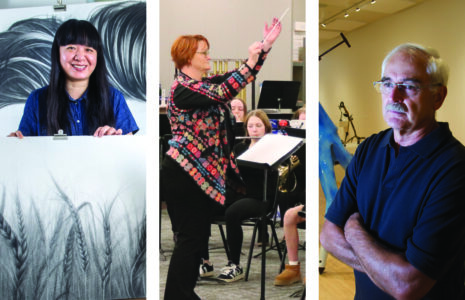
KU professors, middle school band director, radio personality among this year’s Phoenix Award honorees: ‘It’s a cool mix’
Hilltop childcare center has been losing money for at least two years, records show

Turnstile rocks KU campus as Day on the Hill returns after two-decade absence

UPDATE: Closure of Hilltop childcare center is final, but the building seems likely to stay