

‘The whole system in rural Kansas is broken’: Former state rep makes case for data centers as driver for economic growth
Former state Rep. Josh Svaty said data centers could serve as a remedy for struggling rural counties, but time is of the essence.
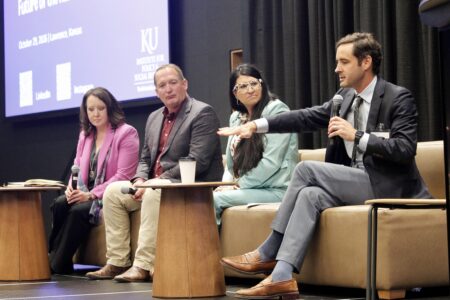
photo by: Dmitry Martirosov/Journal-World
From left to right, Shonda Anderson, director of the Kansas Office of Registered Apprenticeship, Scott Sproul, president and CEO of Northwest Kansas Economic Innovation Center, Deb Minkler, executive director at the Northwest Planning and Development Commission, and Josh Svaty, a former Kansas state representative and principal at Gencur Svaty Public Affairs. The four participated at a panel discussion at the 2026 Kansas Economic Policy Conference at the University of Kansas Conference Center on Thursday, Oct. 29, 2026.
Could data centers save Kansas’ rural economy?
That question was posed Thursday during a panel discussion on the health of the rural economy in Kansas, with one panelist making the case that data centers could be the answer to sustained economic growth in areas that have long suffered from population decline.
Data centers could serve as injections of capital, said Josh Svaty, a former state representative from Ellsworth. But the window of opportunity might close sooner than most realize, he warned.
Svaty — whose public affairs business works with data centers and energy producing companies for wind, solar and battery, among other energy generators — argued that rural counties with smaller populations could see a substantial boost to their economies if they let data centers in. Communities could see an increase to their budgets as well as lowered tax bills for property owners.
“It’s finally the thing that doesn’t just sort of dance around helping everybody’s residential property taxes, but fundamentally alters what that county can do,” Svaty said at the 2026 Kansas Economic Policy Conference at the University of Kansas.
“So, do you take advantage of that or not?” he asked.
Rural counties in Kansas have seen their populations shrink for years. Of the state’s 105 counties, 80 have lost population since 2020, according to the U.S. Census Bureau, while 77 experienced a decrease during the previous decade.
Svaty said continued population decline has been putting “an enormous amount of stress” on current government models to generate revenue, which are largely based on revenues from property taxes. And the property owners who pay those taxes are dwindling.
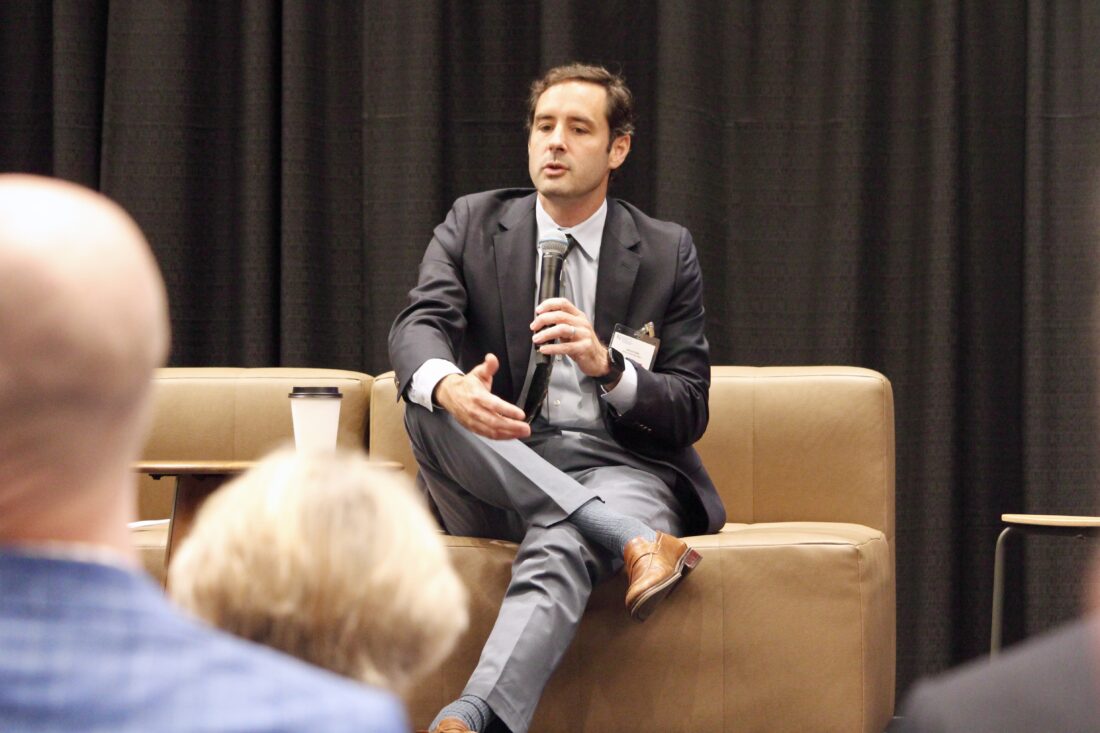
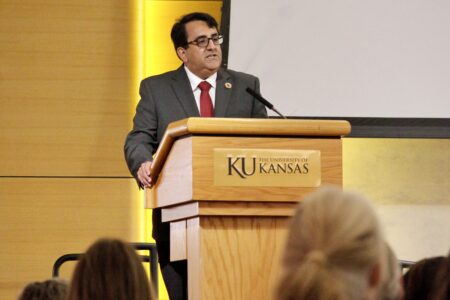
photo by: Dmitry Martirosov/Journal-World
Josh Svaty, a former Kansas state representative, speaks during the 2026 Kansas Economic Policy Conference at the University of Kansas Conference Center on Thursday, Oct. 29, 2026.
Two factors are frequently cited for population decline: the lack of childcare and affordable housing.
Family size is another, especially in western Kansas, said Scott Sproul, president and CEO of Northwest Kansas Economic Innovation Center. The Centers for Disease Control and Prevention said that the number of births and fertility rates in the U.S. have been declining in the past two decades, with the latest report showing a 1% drop in both between 2024 and 2025.
Sproul, whose business serves 26 rural counties in northwest Kansas, said childcare is an essential service — just as water and utilities are. He said it is the second-most common question he gets from people considering moving in to a rural community. The first is about housing.
He noted that cost is often associated with the lack of childcare. Ninety percent of the childcare centers in his region are in-home care providers, with the majority operating as for-profit businesses, he said. That makes them ineligible for grant money.
“It’s an ongoing challenge to get people to go into (childcare) because the financial model is just broken.”
Svaty agreed, saying childcare and housing are probably the biggest obstacles that are preventing rural counties in Kansas from growing. But he offered a simpler explanation.
“I think the whole system in rural Kansas is broken,” he said, “in the sense that our model, our government model, to pay for all of these services is based on growth.”
And matters could get worse, he said: Declining populations could lead to degraded services and, as a result, an inability to generate enough revenue to pay for subsequent repairs.
“You’ve got to spread that across 400 households or less? It’s a non-starter,” he said.
But while the people may be declining, the revenue collected from property taxes has been steadily growing in Kansas and now makes up more than 30% of all revenues collected from state and local taxes. It is the largest combined state and local tax revenue source in the state, generating more than $6 billion annually.
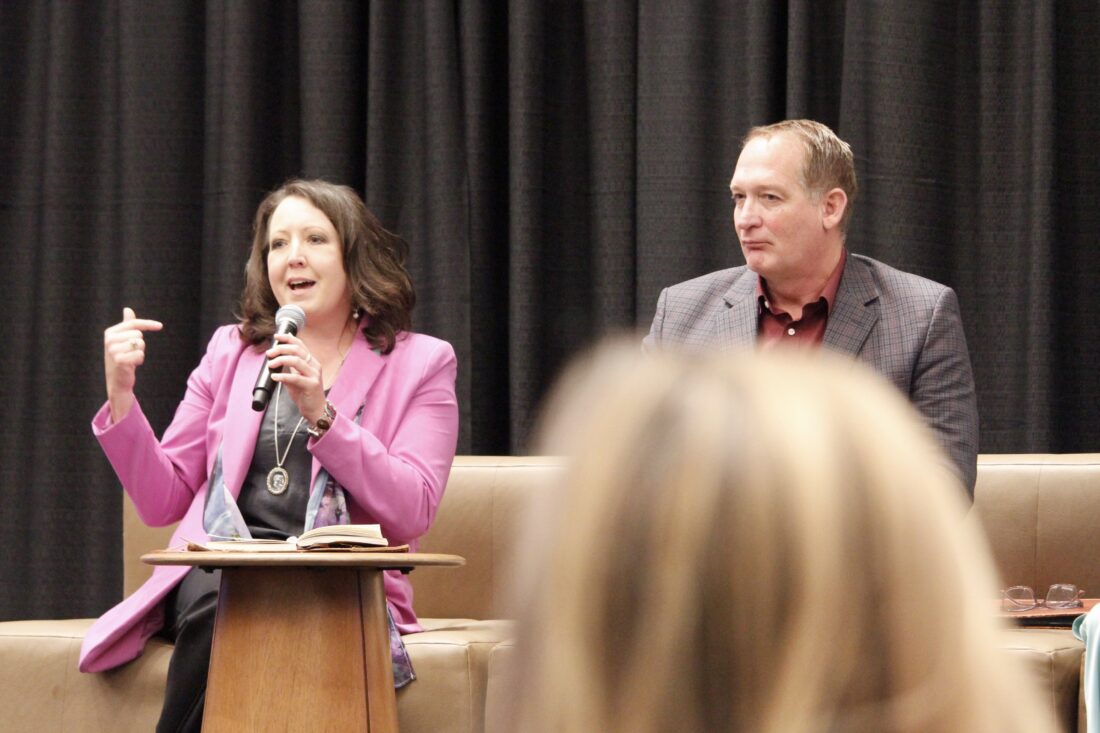
photo by: Dmitry Martirosov/Journal-World
Shonda Anderson, director of the Kansas Office of Registered Apprenticeship, speaks at the 2026 Kansas Economic Policy Conference at the University of Kansas Conference Center on Thursday, Oct. 29, 2026, with Scott Sproul seated to her left.
Shonda Anderson, director of the Kansas Office of Registered Apprenticeship, said that one way to boost growth in rural areas is to embrace a new approach around the state’s talent pipeline, especially among young college graduates. That would help reduce debt, improve retention and get employees out into the workforce faster, she said.
As for data centers, they have been hotly debated around the country in recent years. People have complained about how noisy they are, the amount of land they take up, and even their appearance. Most central to their arguments, however, people have objected to their energy consumption, especially water and electricity that they say will jack up the cost of their utilities.
There are 19 data centers in Kansas and 20 more are currently being developed, according to the Kansas Department of Commerce. A recent survey found that the majority of Kansans view them unfavorably.
Sproul attributed the resistance to data centers to a possible lack of information. He said bridging that gap might help move the conversation forward.
“I think we, as Kansans, really need to look at it as an opportunity and try to figure out how you can best fit it in your community,” Sproul said. “It could change the economic development trajectory of a county or tri-county forever.”
KU
‘The whole system in rural Kansas is broken’: Former state rep makes case for data centers as driver for economic growth

Opinion: A 20-year streak and an ode to the excellence of Lawrence’s world-renowned Allen Fieldhouse
Gov. Kelly talks property taxes, AI, data centers in conference on Kansas economy
‘We will respond with steadiness, not retreat’: KU’s Mafi highlights unprecedented times in higher ed in first State of Campus address
Former FDIC chair warns of AI bubble, another financial crisis during Lawrence visit