Jury finds ‘citizen journalist’ guilty of interfering with police officer, rejecting claim that case was about 1st Amendment
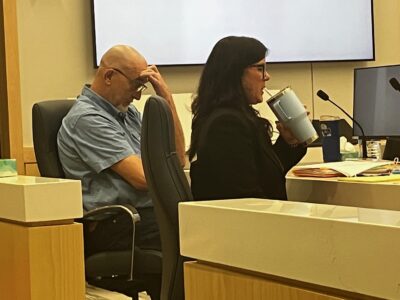
photo by: Kim Callahan/Journal-World
Phillip Michael Eravi is pictured with defense attorney Angela Keck on Thursday, Aug. 27, 2026, at his trial in Douglas County District Court.
Updated at 2:20 p.m. Thursday, Aug. 27, 2026
A Douglas County jury has found a Lawrence YouTuber guilty of felony interference with a law enforcement officer after deliberating for about one hour.
Prosecutor Eve Kemple had described the case as a very simple one, and apparently jurors agreed; they began deliberating right after 11 a.m., when their lunch was ordered, and reached a verdict right around noon, before the food was even delivered.
Phillip Michael Eravi’s trial in the long-running, low-level felony case, now more than three years old, started on Monday and ended with a conviction on Thursday. Judge Amy Hanley set sentencing for Oct. 27.
The case concerned an early-morning incident on May 20, 2023, when Eravi, a 56-year-old local tow truck operator and YouTuber who calls himself a “citizen journalist,” went to the scene of an armed standoff on Heatherwood Drive, where he was arrested for interfering with the duties of a police officer.
The defense had framed the case as being about the First Amendment’s right to a free press and constitutional due process, with attorney Angela Keck describing Eravi as “a free human being trying to do his job to inform the citizenry” with his journalism, but the state dismissed that characterization as a smokescreen, saying the case concerned one thing and one thing only: Eravi’s failure to obey a lawful police order to leave an area where police were dealing with an armed standoff.
Keck tried many tactics to engender reasonable doubt in jurors, including disputing the existence of a police perimeter and claiming that police instructions to her client were so confusing that he simply didn’t know where to go once he was told to leave.
“I don’t think any citizen would understand that,” she said of a police officer’s statement to Eravi to “stop right there” and “you can’t be here.”
She also said that the officer, David McShane, was on a break when he spotted Eravi and therefore was not engaged in any duty that could be interfered with.
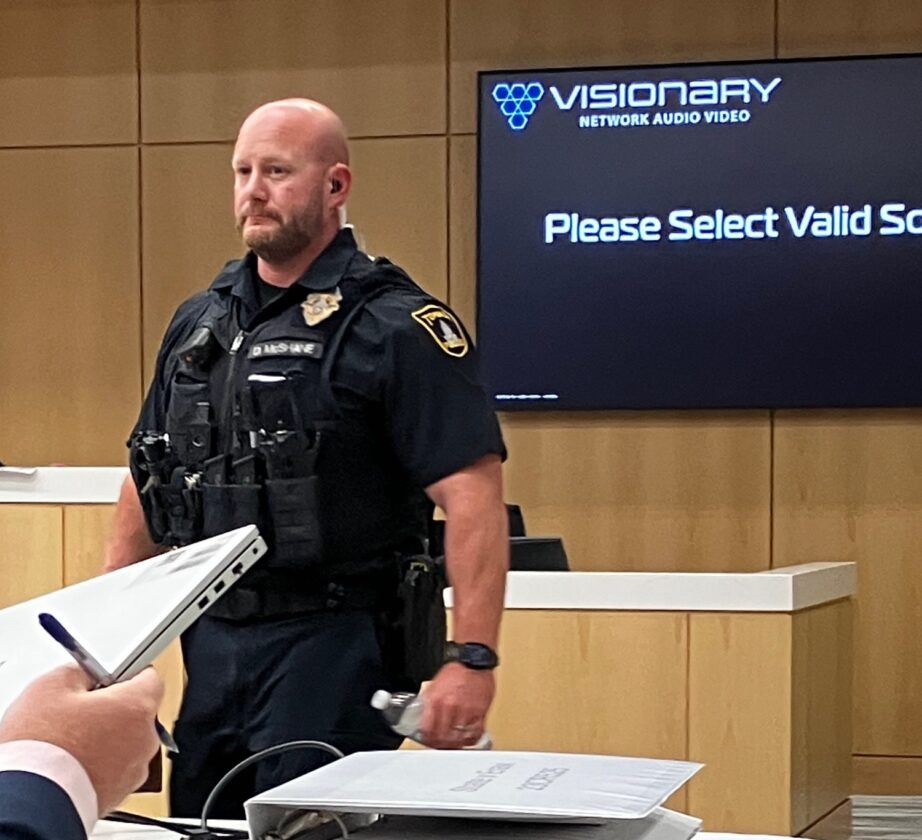
photo by: Kim Callahan/Journal-World
Officer David McShane leaves the stand after testifying at the trial of Phillip Michael Eravi on Tuesday, Aug. 25, 2026, in Douglas County District Court.
Eravi, she claimed, had been to dozens of police scenes and had never had any issues with police or sought to interfere. She argued that police were out to get him and “kept knowledge from him,” and she asked jurors why he was being treated “differently” from everyone else.
“Because he’s a journalist. That’s why,” she told them.
Keck also said that the standoff situation maybe was not as serious as police had said and suggested to jurors that they had “reverse-engineered” the supposed danger to work to their benefit in retaliating against Eravi.
At the conclusion of her closing argument, Keck invoked lofty quotes from America’s Founding Fathers about how a free press was crucial to democracy, and she situated Eravi in the company of news gatherers holding government actors accountable.
Kemple, however, told jurors that none of those issues were in play at all. No one, she said, was disputing Eravi’s speech or press freedoms or claiming that it was illegal for him to enter a police perimeter. He wasn’t arrested for what he said or for recording police at work, but simply for not following McShane’s lawful command.
McShane’s having been on a short break did not mean he wasn’t still on duty, and he was under a direct order from a superior to arrest Eravi after informing his supervisor that Eravi wouldn’t move, Kemple said.
She pointed out that if Eravi had been confused about where to go he simply had to ask McShane, who she noted was calm and polite to Eravi throughout their interaction — recorded on video that jurors saw — as Eravi called him obscene names and yelled “leave me alone!” multiple times.
In response to Keck’s contention that police had a duty to explain to Eravi why he couldn’t be in the zone of danger, Kemple told jurors that no such duty existed and that, additionally, Eravi was well aware of serious police activity in the area, including an armored vehicle, flashing lights, a heavy police presence and a loud speaker telling the standoff suspect to come out of the house.
McShane’s instructions to Eravi “couldn’t be more clear” and Eravi knowingly disobeyed them, she said, not because he didn’t understand them but simply because he didn’t want to follow them.
According to the Legal Guide for Journalists put out by the Reporters Committee for Freedom of the Press, “Journalists should comply with requests from law enforcement but can calmly discuss their rights if they feel a request violates those rights. Journalists should remain respectful when interacting with police and avoid acting in a manner that incites violence, creates danger, or interferes with law enforcement.”
Judge Hanley earlier this year described Eravi’s case as unprecedented in her legal career given the amount of time and resources it had taken up — more than three years of delays, motions, discovery orders and lengthy hearings.
Related to the current case, Eravi filed a lawsuit claiming that Lawrence police violated his civil rights when they arrested him at the scene, but a federal judge tossed that lawsuit last year. Judge Daniel Crabtree ruled that officers acted reasonably and with reasonable force when they removed Eravi from the scene.
Crabtree did not order Eravi to pay attorney fees in that case, but such fees were ordered in an Elk County case, where a judge ruled that Eravi will have to pay the cost of litigation and reasonable attorney’s fees after his suit against a public official there was thrown out. Eravi is appealing that decision.
Eravi has other criminal cases pending in Douglas County, including battery on a law enforcement officer and various instances of alleged trespassing.
He has been a frequent public commenter at local government meetings for years, during which at various times he has been banned from attending school board and City Commission meetings in person, as well as being banned from the Lawrence Public Library. His public commenting has included yelling obscene names and the N-word at officials, including the police chief and elected office holders.
Eravi has also sued numerous local governments, claiming they violated his civil rights. Some of those suits, filed by the same attorney who represents frequent public commenter Justin Spiehs, who also “audits” government activity with his phone’s video camera, are still pending, while others have been thrown out.
Public Safety
Man accused of selling wristbands to enable minors to drink at time of Hawk shootings is sentenced to probation

36-year-old Lawrence man confessed to raping 13-year-old girl, affidavit says
Evacuation drill planned Tuesday at Lawrence City Hall
Douglas County’s newest pro tem judge sworn in

Woman has renewed hope for justice 17 years after reporting rape in Lawrence