Long-delayed trial begins for ‘citizen journalist’ accused of interfering with police during armed standoff
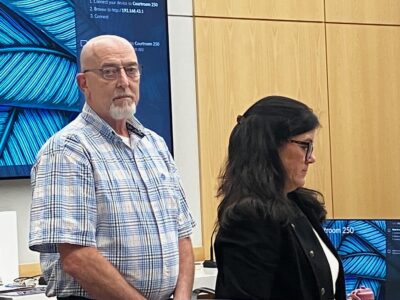
photo by: Kim Callahan/Journal-World
Phillip Michael Eravi appears at his trial in Douglas County District Court on Aug. 24, 2026, with his attorney, Angela Keck.
A Lawrence police sergeant testified for hours on Monday about her order to arrest a so-called “First Amendment auditor” who is charged with felony interference with law enforcement in connection with an armed standoff between police and a shooting suspect more than three years ago.
A Douglas County jury over the course of a weeklong trial will weigh the credibility of the sergeant, Meagan Shipley, and multiple other witnesses — most of them police officers — as they hear the case of Phillip Michael Eravi, a local tow truck driver who has a YouTube channel and calls himself a “citizen journalist.”
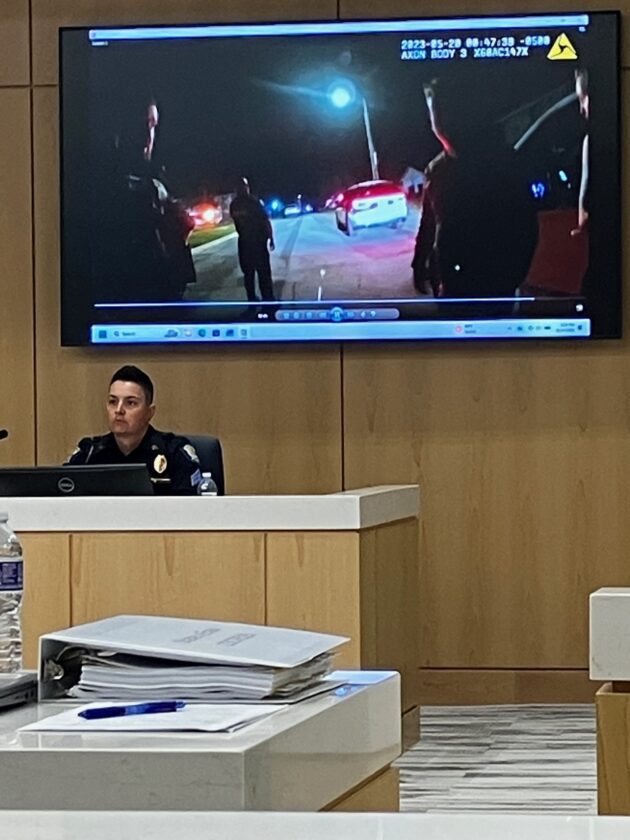
photo by: Kim Callahan/Journal-World
Lawrence Police Sgt. Meagan Shipley testifies in Phillip Michael Eravi’s case in Douglas County District Court on Aug. 24, 2026.
The charge against Eravi, an avid police critic, stems from an early-morning incident on May 20, 2023, when officers were responding to a shooting call in which a man had barricaded himself in a duplex in the 1900 block of Heatherwood Drive.
The state maintains that Eravi walked “directly into the middle” of an area that police were trying to keep clear because it was in the line of fire from the suspected shooter’s residence and that Eravi refused to leave when ordered repeatedly to do so.
The defense, however, claims that Eravi had a right to be where he was and characterized the case to jurors as an important “intersection” of the First Amendment, due process rights and police conduct.
Shipley was the state’s first and only witness Monday and will take the stand again on Tuesday. She testified that she was working patrol the night of May 19, 2023, and was called to assist at the standoff scene as a member of the Crisis Response Team, which she likened to a SWAT unit.
She said that when she arrived she established an inner perimeter around the home, the purpose of which was to keep the suspect from escaping and to keep people from entering the zone of danger. She acknowledged that it was not an “ideal” perimeter because of a lack of equipment and officers that particular night, and she acknowledged that no crime scene tape marked the area to specifically define where people could and couldn’t be. Residents who lived nearby were asked to evacuate, with police assistance, or to shelter in place, she said.
Shortly before 2 a.m. someone entered what she regarded as the inner perimeter, despite the flood lights, sirens, loudspeaker, drones, armored truck and other obvious indicators of serious police action occurring. Shipley, affirming that she was familiar with Eravi, was “fairly certain” that that someone was he because of “how he was dressed [a reflective top alternately described as bright green or yellow] and the time of the day.”
She said she was concerned that he was in the line of fire — around 60 feet behind the armored vehicle, she later measured — if the barricaded suspect chose to shoot through a large picture window.
Two officers went to intercept Eravi, but one of them — David McShane, who is the specific victim listed in the interference charge — reported that Eravi was arguing and wouldn’t move. Shipley then ordered that he be arrested, which did not go smoothly. She said that a “tug of war” ensued and that Eravi did not “go willingly.” She also said that the arrest took several officers off the original call and likewise put them in the line of fire.
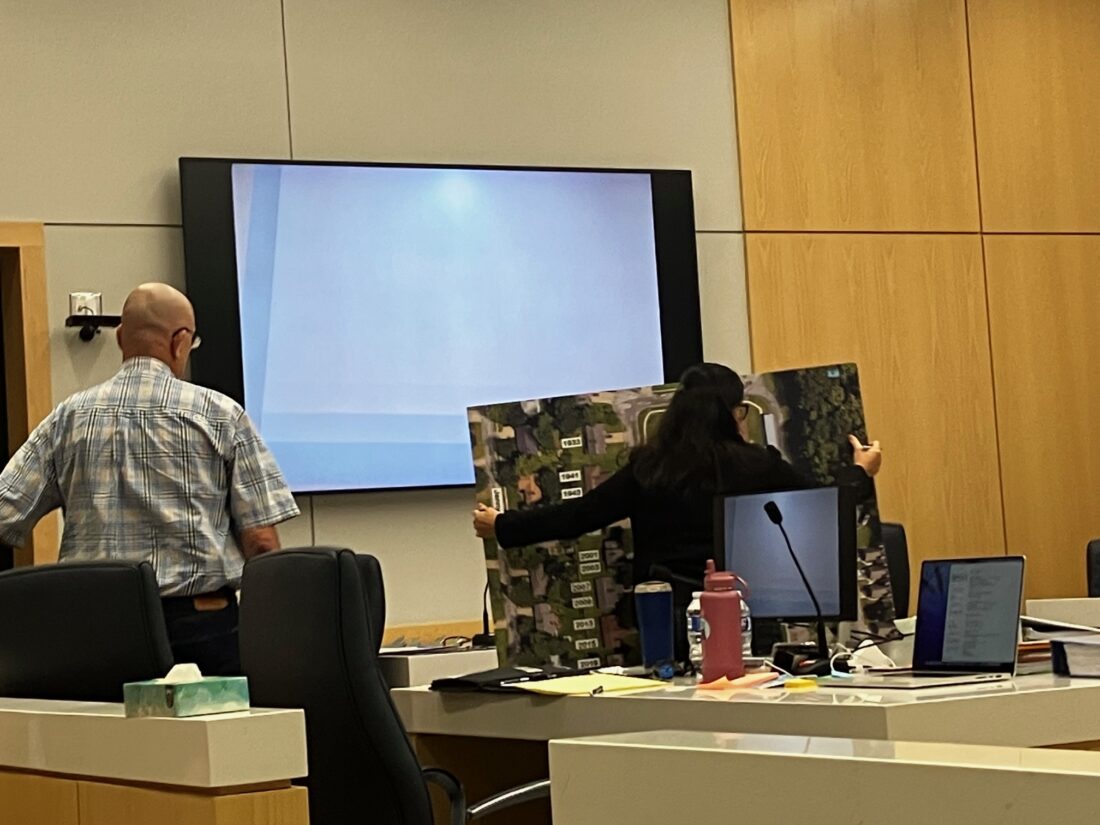
photo by: Kim Callahan/Journal-World
Phillip Michael Eravi assists attorney Angela Keck with an enlarged map at his trial in Douglas County District Court on Aug. 24, 2026.
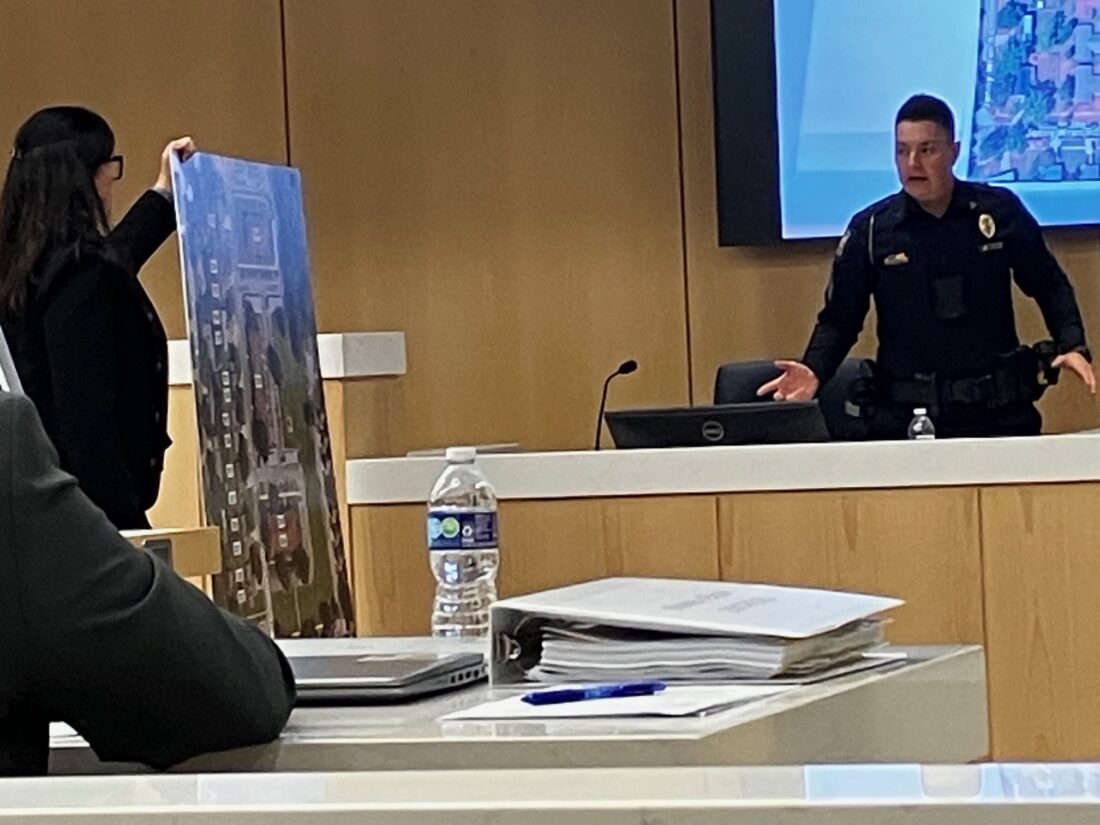
photo by: Kim Callahan/Journal-World
Lawrence Police Sgt. Meagan Shipley testifies in Phillip Michael Eravi’s case in Douglas County District Court on Aug. 24, 2026. Eravi’s attorney, Angela Keck, is at right.
Defense attorney Angela Keck conducted a lengthy cross-examination of Shipley, as she had at earlier hearings in the case. Keck implied through her questioning that Eravi was given conflicting instructions by police, and in addition to no police tape being in place, she also got Shipley to acknowledge that police department policy to secure inner and outer perimeters was not followed that night; nor did Shipley specifically tell officers on scene where precisely the inner perimeter was.
“Civilians would have no notice they were walking into a perimeter?” Keck asked.
“Correct,” Shipley said.
Prosecutor Adam Carey, in his opening argument, characterized the issue not as Eravi walking into the perimeter, however, but as Eravi refusing to comply with officers who implored him repeatedly to leave. Eravi, he said, told officers “leave me alone” at least eight times.
Carey also said that Eravi, who lived nearby, called officers “mother[expletive]s” for waking him up with the standoff commotion, told them to get their flashlights out of his eyes, and insisted “there’s no line” and “don’t touch me.”
“I’m a free human being,” Eravi told them.
Keck, in her opening argument, said that McShane’s duty as a police officer was not being interfered with because he was taking a short break at the time and wasn’t performing a specific duty during those minutes. She also questioned officers’ professed concern for Eravi’s safety, suggesting that his being behind an armored police truck at a crime scene was actually “the safest place” for him to be — a suggestion that Shipley took issue with.
Keck also highlighted to jurors that in order to find Eravi guilty they would have to find that he interfered knowingly.
But all he knew, she said, was that “he was a free human being trying to do his job to inform the citizenry” with his journalism.
Shipley will resume her testimony at 9 a.m. Tuesday. Judge Amy Hanley, who is presiding, has previously said the amount of time and resources that have gone into the low-level felony case, which has been pending for years and which has seen numerous delays, cancellations and pretrial motions, have been unprecedented in her legal career.
Related to the current case, Eravi filed a lawsuit claiming that Lawrence police violated his civil rights when they arrested him at the scene of the armed stand-off, but a federal judge tossed that lawsuit last year. Judge Daniel Crabtree ruled that officers acted reasonably and with reasonable force when they removed Eravi from the scene.
Crabtree did not order Eravi to pay attorney fees in that case, but such fees were ordered in an Elk County case, where a judge ruled that Eravi will have to pay the cost of litigation and reasonable attorney’s fees after his suit against a public official there was thrown out. Eravi is appealing that decision.
In addition to the current matter, Eravi has other criminal cases pending in Douglas County, including battery on a law enforcement officer and various instances of alleged trespassing.
He has been a frequent public commenter at local government meetings for years, during which at various times he has been banned from attending school board and City Commission meetings in person, as well as being banned from the Lawrence Public Library. His public commenting has included yelling obscene names at officials, including the police chief and elected office holders.
Eravi has also sued numerous local governments, claiming they violated his civil rights. Some of those suits, filed by the same attorney who represents frequent public commenter Justin Spiehs, who also “audits” government activity with his phone’s video camera, are still pending, while others have been thrown out.
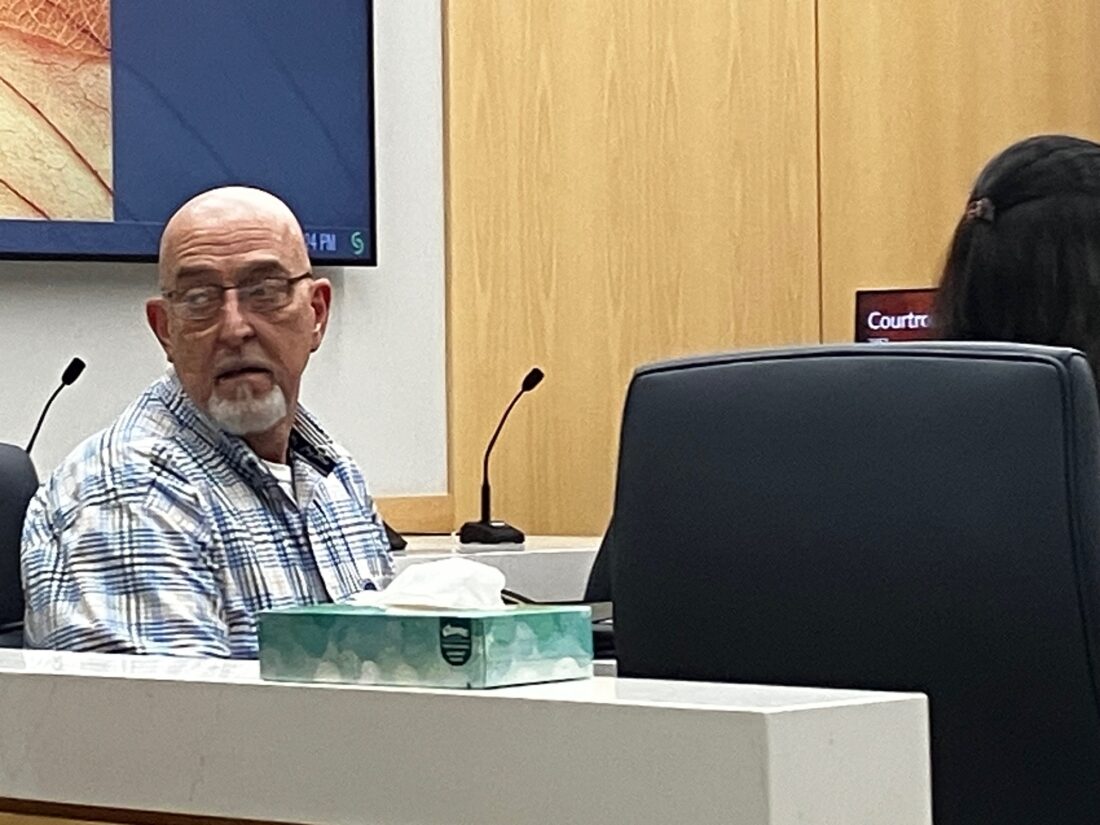
photo by: Kim Callahan/Journal-World
Phillip Michael Eravi appears at his trial in Douglas County District Court on Aug. 24, 2026.
Public Safety
Man accused of selling wristbands to enable minors to drink at time of Hawk shootings is sentenced to probation

36-year-old Lawrence man confessed to raping 13-year-old girl, affidavit says
Evacuation drill planned Tuesday at Lawrence City Hall
Douglas County’s newest pro tem judge sworn in

Woman has renewed hope for justice 17 years after reporting rape in Lawrence