Albert Wilson, failing to show actual innocence in rape case, loses wrongful conviction and imprisonment lawsuit

photo by: Chris Conde/Journal-World
Albert Wilson appears at a hearing on Jan. 29, 2024, in Douglas County District Court.
A Douglas County judge has ruled against a man who was suing the State of Kansas for wrongful conviction and imprisonment in a 2016 rape case.
Judge Carl Folsom III in an order filed Monday found that Albert Wilson, who was convicted of raping a 17-year-old, did not meet his burden of showing actual innocence as required by state law.
Wilson, of Wichita, was convicted of rape in 2019 and sentenced to more than 12 years in prison. After an appeal, however, Wilson won the right to a new trial when Douglas County Judge Sally Pokorny determined that he had not received effective assistance of counsel at his trial.
Douglas County District Attorney Suzanne Valdez in 2021 said that she would not retry the case and dismissed it with prejudice, meaning that it could not be brought again. Wilson had served more than two years in prison.
Four months later Wilson sued for wrongful conviction and imprisonment, seeking compensation from the state. During the course of that suit, the Kansas Supreme Court released its opinion in the Doelz case, which found that a person in Wilson’s position cannot prevail in his claim for wrongful conviction and imprisonment under the state’s wrongful conviction statute unless he can prove that his conviction was reversed because he was actually innocent or unless he can prove that the state dismissed his criminal case because he was actually innocent.
In Wilson’s case, Valdez, in a March 2025 deposition, said that she did not believe that Wilson was innocent and that her decision to dismiss his case was simply because the alleged victim did not want to testify again and had agreed instead to participate in a restorative-justice process, the gist of which she had also said in 2021, when she dismissed the case.
Folsom, prior to the Doelz decision, expressed a different view of Wilson’s case. He had ruled in 2023 that the prosecutor’s reasons behind the dismissal were not relevant; all that Wilson had to do under the wrongful conviction statute, in his view, was prove by a preponderance of evidence that he was innocent.
But after Doelz, Folsom acknowledged: “The Supreme Court unanimously disagreed with me.” He then reopened discovery in the Wilson case, leading to the deposition of Valdez. In that deposition she was asked, “Do you believe that Albert Wilson was actually innocent of the crime at the time you dismissed the charges?”
“No,” she replied.
Folsom in his Monday order said, “Despite this Court’s earlier disagreement with this interpretation of (state law), this Court is required to follow the binding case law of the Kansas Supreme Court.”
As the Journal-World has reported, the alleged victim in the case met Wilson at The Hawk, a popular bar near the University of Kansas campus. She testified that she was drunk and that Wilson, then a 20-year-old KU student, lifted her skirt and assaulted her at the bar and then walked her to his house a couple of blocks away, raped her, then walked her back to the bar. Wilson was convicted of rape for the incident at the house, but the jury hung on the incident at the bar.
Pokorny, in ordering the retrial, said defense counsel could have raised questions based on thousands of text messages, which had not been used as evidence in the trial.
“It is my firm belief that if a jury knew of the information contained in the 2,000 text messages taken from the victim’s phone, there is a substantial likelihood the outcome of this case would have been different,” she said.
Wilson’s case became something of a cause célèbre for social activists who believed that Wilson was prosecuted based on his race. Celebrities like Kim Kardashian shared news articles and petitions that criticized his conviction, and activists went after his white teen accuser online.
In her March deposition, Valdez said that the way the girl was treated played a decisive role in her dismissing the case.
“[T]he complaining witness, the victim in the case, was having a very difficult time being trolled, being doxed, being bullied, being harassed,” Valdez said. “Her psychological state of mind was very, very fragile, and I am a trauma informed prosecutor. I did not want to put her through that again, and that was the reason that I decided not to … I needed her to testify and I could not put her on the stand again to be put through this.”
The Supreme Court’s decision in the Doelz case, with its actual innocence requirement, is also at the heart of another lawsuit in Douglas County — that of Carrody Buchhorn, who was convicted of murdering a baby in 2016 at a Eudora day care. Buchhorn’s conviction was overturned, and she has been involved in a yearslong battle to clear her name and get financial compensation from the state for her conviction and incarceration. As in the Wilson case, Valdez said she would not retry the case, though she has asserted that dropping it was not due to a belief in Buchhorn’s actual innocence.
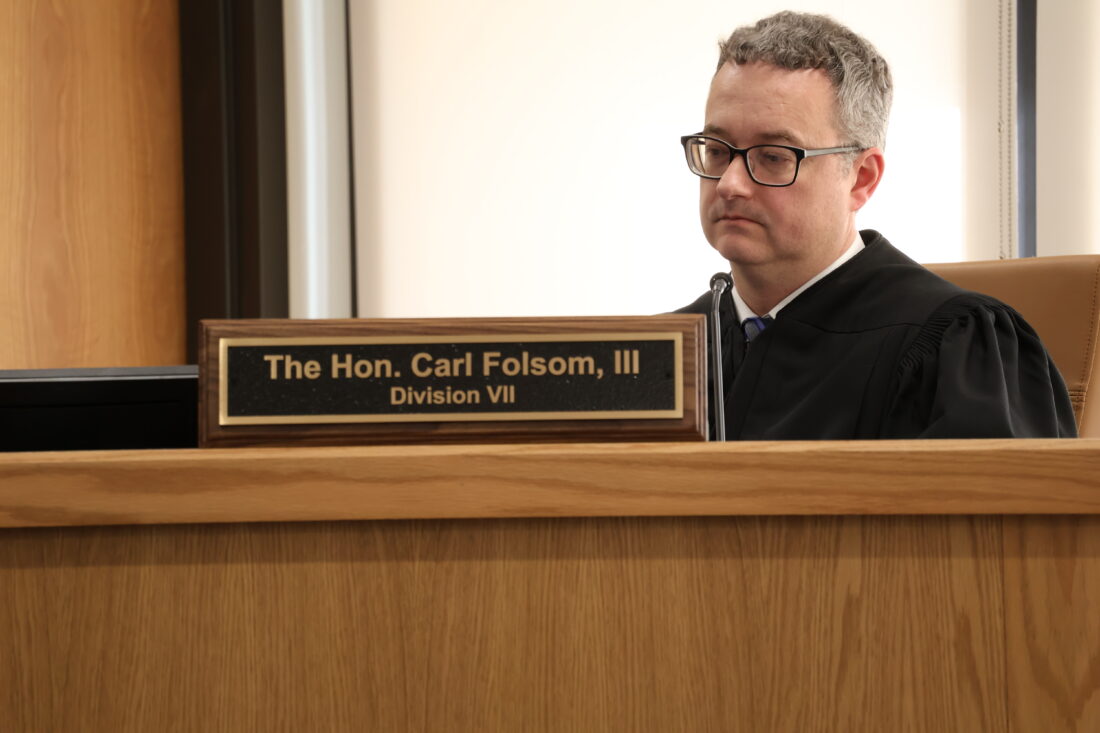
photo by: Chris Conde/Journal-World
Judge Carl Folsom III presides over the Albert Wilson trial for wrongful conviction on Jan. 30, 2024, in Douglas County District Court.
Public Safety

He won big at the K-9 Games, but the biggest thrill for Lawrence police dog Shadow is just doing his job
Frequent public commenter loses another federal lawsuit; county officials did not violate his civil rights, judge rules

Lawrence businessman sentenced to 18 months in prison for selling aviation technology to Russians
Defendant facing felony charge after allegedly bashing man in the head with a thermos outside Lawrence grocery store
Driver accused of killing actor on South Lawrence Trafficway waives preliminary hearing in unrelated DUI case