
KU enrollment grows for third straight year, achieving a new record
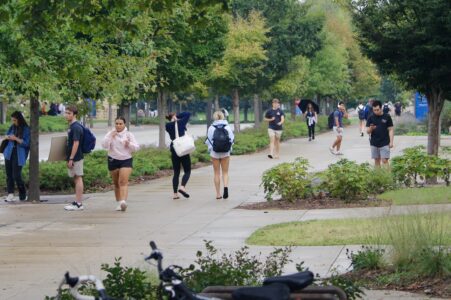
photo by: Dmitry Martirosov/Journal-World
Students walk along Jayhawk Boulevard at the University of Kansas campus on Wednesday, Sept. 30, 2026.
Story updated at 3:39 p.m. Wednesday, Sept. 30.
Student enrollment at the University of Kansas just broke another record.
KU’s overall enrollment for fall 2026 increased to 31,464 students, nearly 300 more than the previous year, according to figures released Wednesday by the Kansas Board of Regents.
This is the third straight year that KU has posted gains and set a new enrollment high.
“Three consecutive years of record enrollment reflect the strength of our work to recruit students and, just as importantly, to help existing students succeed once they arrive at KU,” Chancellor Doug Girod said in a press release. “We’re proud that students continue to see the value of a KU education and that more of them are staying on track to earn their degrees.”
Like last year, KU’s enrollment grew both across its main campus — which includes the Edwards Campus in Overland Park — and the KU Medical Center in Kansas City. Enrollment at the main campus grew by 0.5% to 27,352 students, while the Medical Center saw an enrollment increase of 3.9% to 4,112 students. The Medical Center’s growth rate this year more than doubled from last year and continues an upward trend that has largely been consistent over the last decade.
KU’s enrollment at its main campus has increased from last year, but the pace at which it grew slowed, and the university’s freshman class has also slightly declined.
Last year, KU reported a 1.2% growth rate at its main campus, with enrollment increasing from 26,887 students in 2024 to 27,212 in 2025. In the two years preceding those numbers, KU saw even bigger leaps — 5.5% in 2024 and 6.7% in 2023, respectively. This year, however, KU’s enrollment grew by 0.5%, or 140 students.
KU’s freshman class has also dropped this year compared with last year, from 5,040 students in 2025 to 4,834 students. The change marks a 4% decline, but the figure is still the university’s fourth-largest freshman class in history. KU attracted its largest freshman class in 2024, when 5,323 students became the newest Jayhawks.
Among the state’s six public universities, Emporia State saw the largest percentage increase in enrollment this year, while Wichita State saw its first decline since 2019.
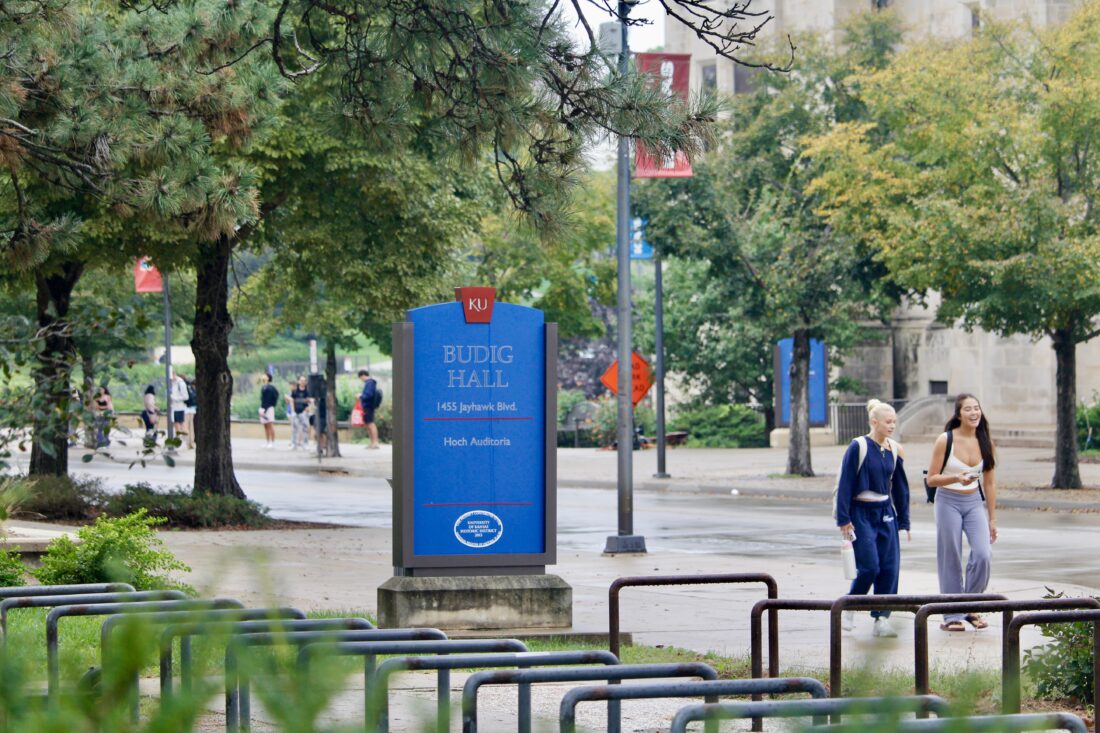
photo by: Dmitry Martirosov/Journal-World
Students walk along Jayhawk Boulevard at the University of Kansas campus on Wednesday, Sept. 30, 2026.
Here’s a look at enrollment totals for the six Regents schools and their one-year growth rates.
• KU: 27,352 students, up 0.5%
• Kansas State: 20,789, up 0.3%
• Wichita State: 18,003, down 2.5%
• Fort Hays State: 13,359, up 4%
• Pittsburg State: 5,766, down 0.6%
• Emporia State: 5,110, up 6%
KU this year has also seen a decline in its number of international students, with nearly 150 fewer enrolled than the previous year, or a 7.5% drop. KU’s international student enrollment had been on an upward trend starting in 2020, but that ended last year. Since 2025, KU has seen a more than 11% drop in international students. The numbers are in line with a broader national trend of international students who have had their legal status jeopardized by the Trump administration’s crackdown on immigration, causing many to have their visas revoked or choose to remain in their countries of origin out of fear.
Higher education in the U.S. is facing other challenges, too, and in a message on Wednesday Girod related some of them to university faculty and staff.
“We should take a moment to celebrate this achievement, but we also know that the higher education landscape continues to change,” Girod said. “Demographic trends are expected to put increasing pressure on enrollment nationally in the years ahead. That makes it especially important for KU to remain proactive and intentional in how we recruit and support students.”
Specifically, the nation’s birthrate decline is putting acute pressure on colleges and universities, which are beginning to feel the impacts through smaller high school graduating classes. The number of births in the U.S. between 2007 and 2023 declined by 16%, or 725,000, according to the Centers for Disease Control and Prevention.
Students have also been growing skeptical of the value of a college education — especially with rising tuition — with many instead opting to try their luck in the trades.
But despite all these challenges, KU still managed to grow its enrollment over time. Among the state’s six public universities, KU and Wichita State continue to see the largest five- and 10-year growth rates.
Here’s a look at the five-year and 10-year growth rates of each of the universities.
• KU: five-year up 14.2%; 10-year up 9.9%
• Wichita State: up 11.8%; and up 24.4%
• Kansas State: up 5.2% and down 10.8%
• Pittsburg State: down 4.2% and down 18.8%
• Fort Hays State: down 5.3% and down 8.9%
• Emporia State: down 9% and down 13.2%
Enrollment across the state’s public higher education system — including the six public universities, community and technical colleges — has declined by 0.8% this year, standing at 177,768 students. This is the first systemwide decline in three years.
“After three years of growth, our system is experiencing flat enrollment this fall, with uneven results across sectors and institutions,” Regents Chair Alysia Johnston said in a press release. “The Board remains focused on ensuring that education beyond high school remains affordable and accessible for Kansans and that students who enroll in our system achieve success in college and after graduation.”
Other highlights from Wednesday’s release include:
• Enrollment at the state’s community colleges has dropped by 1.9%, from 64,851 students in 2025 to 63,605 this year. The decline is the first in four years. Johnson County Community College continues to have the largest student enrollment among its peers. This year, the school saw a 1.1% increase in enrollment compared to last year, or 212 more students.
• Enrollment at the state’s technical colleges has dropped by 6.8%, from 12,239 in 2025 to 11,412 this year. The decline is the first since 2020.
• KU retained a record high 88.1% of last year’s freshmen and also achieved record high four-year and five-year graduation rates.
• Fewer nonresident students enrolled at KU this year than last. The change marks a less than 1% difference, but it’s the first such decline since 2020.
• KU freshmen this year achieved their second-highest average GPA score of 3.69. The previous record, of 3.71, was achieved last year.
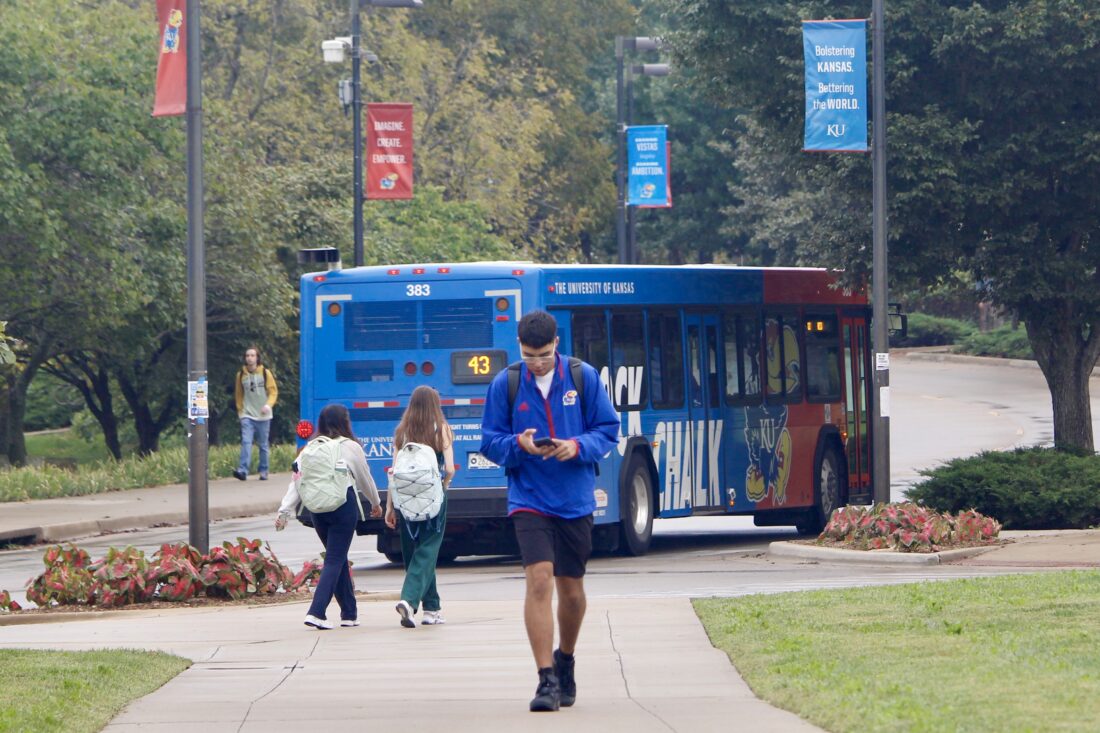
photo by: Dmitry Martirosov/Journal-World
Students walk at the University of Kansas campus on Wednesday, Sept. 30, 2026.
KU
‘This isn’t just childcare’: Hilltop closure brings community together to brainstorm solutions

KU researchers win $1.8M grant to study program designed to help parents who adopt children
KU’s homecoming parade returning to campus after hiatus
KU’s center for eating disorders invites public for open house

KU professors, middle school band director, radio personality among this year’s Phoenix Award honorees: ‘It’s a cool mix’