
KU’s center for eating disorders invites public for open house

photo by: University of Kansas
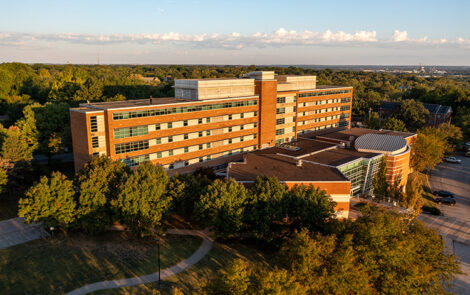
Youngberg Hall at the University of Kansas.
The University of Kansas research center on eating disorders will host an open house next week to bring awareness to a condition that affects millions of Americans each year.
KU’s Center for the Advancement of Research on Eating Behaviors, or CARE, which studies eating disorders and how they affect individuals, will host the event. It be held from 3:30 to 5 p.m. Oct. 23 at Youngberg Hall, 2385 Irving Hill Road.
The open house — the first of its kind to be hosted by CARE — will allow participants to interact with scientists and graduate students who are leading the research, as well as attend short presentations, according to a university press release. The event will feature community partners who will have information on medical care, nutrition, wellness and mental health. Screening for eating disorders will also be available along with a referral.
Registration for the event is encouraged and is available at this link.
Phillip Kroh, an administrative assistant with CARE, told the Journal-World on Thursday that the idea for the open house came after Kelsie Forbush, the center’s director, was inspired by a similar event at KU’s Center on Disabilities. He said she attended an open house hosted there last year and thought it would be a good idea to host their own event. Forbush has been conducting research on eating disorders for more than 25 years, according to her university profile page.
Another reason for hosting the event, Kroh said, is a relocation of CARE’s labs into Youngberg Hall last year.
“With a new location and with that inspiration, (that) kind of put those things together to have the open house,” Kroh said.
CARE has been a part of KU for roughly a decade, said Sierra Bilyeu, a project coordinator at the center. She said it offers several screening tests for folks who are unaffiliated with KU.
The center is currently studying a measure called the Eating Pathology Symptoms Inventory, or EPSI, which was created by Forbush and screens eating disorders among a wide variety of populations. The center is studying the measure by testing it on children ages 10-18, Bilyeu said.
The center is also currently running a study for eating disorders among the Black population, Bilyeu said, which is open to the public. People of color, including Black and Indigenous people, are affected by eating disorders at a similar rate as white people, but they are about half as likely to be diagnosed with one, according to the National Association of Anorexia Nervosa and Associated Disorders, which is the oldest organization in the U.S. to study eating disorders.
A serious mental illness, eating disorders are “marked by severe disturbances in a person’s eating behaviors,” according to the National Institute of Mental Health, a center within the National Institutes of Health. The American Psychiatric Association lists several forms of eating disorders as among the most common, including binge eating, anorexia and bulimia.
A 2020 study by Harvard University’s School of Public Health found that almost 29 million Americans will develop an eating disorder at some point in their lives, with women being at a much higher risk than men. Women — particularly between the ages of 20 and 29 — are nearly four times as likely as men to develop an eating disorder, the study found.
KU
KU’s center for eating disorders invites public for open house

KU professors, middle school band director, radio personality among this year’s Phoenix Award honorees: ‘It’s a cool mix’

Hilltop childcare center has been losing money for at least two years, records show

Turnstile rocks KU campus as Day on the Hill returns after two-decade absence

UPDATE: Closure of Hilltop childcare center is final, but the building seems likely to stay