

‘Honor of my life’: Retiring Regents leader reflects on higher education and the challenges it faces
Athletic spending, right-sizing of universities among the big issues to tackle
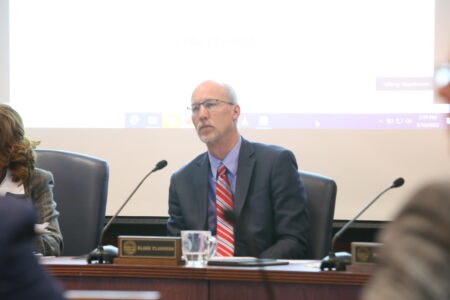
photo by: Chad Lawhorn/Journal-World
Blake Flanders, president and CEO of the Kansas Board of Regents, participates in a board meeting on March 17, 2022.
There were only a few ticks left on the clock until retirement officially began.
Blake Flanders, president and CEO of the Kansas Board of Regents, had agreed to do a 2 p.m. interview with the Journal-World on June 30, the last day of the state’s fiscal year. That also meant it was the last day — the last couple of hours — of his more than 20-year career with the state agency responsible for overseeing higher education in Kansas.
Flanders had announced his retirement months ago, but now it was essentially here, so you could not blame the man for choosing to talk about sports. Such leisure activities go hand-in-hand with retirement.
But this wasn’t a fan talking. This was a man worried about what college athletics may end up doing to the world of higher education that he had devoted a career to. As the Journal-World reported last month, Flanders raised his concern about the financial problems athletics may create for university budgets as part of his comments at his final Board of Regents meeting.
During this interview, he raised it again, not waiting for a question to be asked about it.
“It is a very big concern,” Flanders said of universities diverting money for general operations to athletic departments. “As our universities try to stay competitive, I look at the resources in some other states, and we are not going to have those resources. How is this going to work going forward?”
At Kansas’ three Division I athletic programs — KU, K-State and Wichita State — the answer isn’t clear, but the temptations to pull money from general university operations are expected to grow. It already has started to happen. As the Journal-World has reported, all three programs have made adjustments for monies that once were earmarked for general operations to now be used by their athletic departments.
The other temptation is for universities — especially those in major conferences like the Big 12 — to essentially sell a portion of their future athletic revenue streams to private equity companies in a way to generate cash for the departments here and now.
Flanders has expressed worries about both scenarios, but has particularly been raising a red flag about the private equity possibilities. He used his CEO comments during the Regents’ June meeting to highlight the issue, and did so again in last Tuesday’s interview.
Flanders’ main point has been that any decision for a university to partner with a private equity firm should be made by the Board of Regents, rather than the university itself or its athletic conference.
“I think board members appointed by the governor to serve the state should make those types of decisions that could really impact that state asset for a number of years,” Flanders said.
Flanders said such a partnership with private equity firms essentially would be the equivalent of selling off a state asset, and that should not be the decision of “any one individual leader.” Whether that is the consensus among university leaders isn’t clear. Do the chancellor and university presidents think they should, or already have, the power to make those decisions for their institutions?
In response to a question of whether there were disagreements or tensions over that issue among Regents and university CEOs, Flanders only said: “I haven’t spoke directly with every university leader to know what their opinion is on that.”
Flanders, though, has strong opinions about how the process should happen moving forward.
“I think if that is going to occur, or if that is considered, it should be considered by the full board and voted on by the full board in a public setting that every Kansan can observe because those are decisions that are going to have a very long tail and will last a long time,” Flanders said. “And it is a concern.”
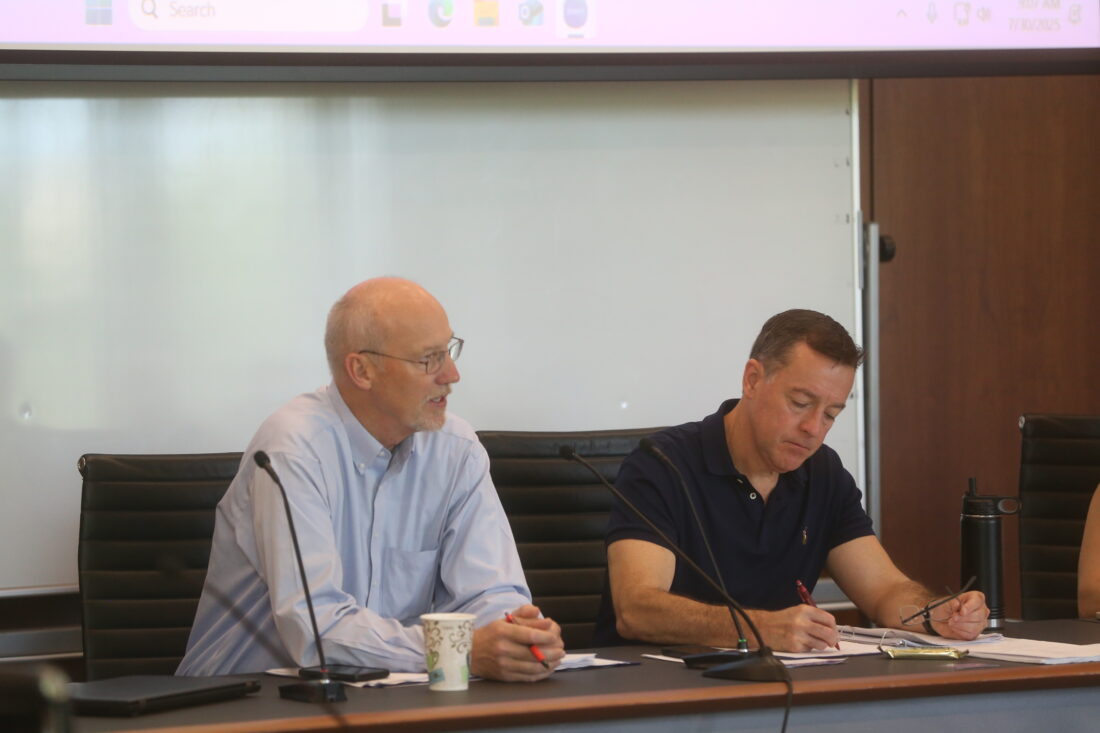
photo by: Chad Lawhorn/Journal-World
Blake Flanders, president and CEO of the Kansas Board of Regents, and Blake Benson, chair of the Regents, are pictured at the organization’s annual retreat on July 30, 2025 at Kansas State University.
•••
Flanders has served as president and CEO of the Regents — the top professional executive for the state’s higher education system — since 2015, but has been an administrator at the Regents’ headquarters since 2004.
Prior to that, he served in various administrative or faculty roles at technical and community colleges in the state, in addition to working as a leader in workforce development with higher education and the Kansas Department of Commerce.
With more than 30 years working in state government in his native state, Flanders said he’s convinced that the Regents staff is the “envy of all state government,” and that it is the “highest performing team I’ve ever been around.”
He said serving as the organization’s leader “has been the honor of my life,” and said he was confident the Regents would provide good leadership and direction for the state’s higher education system for years to come. The Regents are conducting a national search for the president and CEO position. The Regents’ general counsel, John Yeary, has been named as the interim president and CEO while the search is conducted.
Flanders, in a wide-ranging interview, shared thoughts on several issues facing higher education. Here’s a look at several topics.
DECLINING REPUTATION
National polls have repeatedly shown a decline in the public’s appreciation for higher education. A late 2025 Pew Research Center poll found nearly 70% of Americans think higher education is headed in the wrong direction.
Political commentators are quick to point to the issues of “woke” policies and faculties dominated by liberals as primary causes for diminishing views of higher education. The Pew poll, however, noted that both Republicans and Democrats now are solidly unhappy with higher education, with 77% of Republicans and 65% of Democrats saying higher education is going in the wrong direction.
While cultural battles are playing a role in the public’s view of higher education, Flanders said there is one issue that really cuts across all political lines — the cost of attending college.
“The costs are not that much different today,” Flanders said. “It is just who is paying that cost.”
Students, versus state governments, are now paying a higher percentage of their cost to attend public universities, compared to decades ago. That is significant, Flanders said, because it hasn’t just made college more expensive but also has made pursuing a college degree a more fraught proposition.
“When I went to college, retention rates were not very high,” said Flanders, who has degrees from Colby Community College and Kansas State. “There were many students who were experimenting and just kind of looking to see if college was going to be for them. But the cost was relatively low, and so that experimentation didn’t have as much risk.”
Now, starting college and leaving without a degree can create a financial situation that may take years for an individual to overcome, given the prevalence of student loan debt. Without a degree to boost their earnings, paying off that debt can leave some former students feeling like they may be worse off than if they hadn’t gone to college at all.
While Flanders said he thinks the Regents have done an excellent job of limiting the amount of tuition increases at state universities, he said the issue of costs to students deserves more consideration.
“Where we need more work is in price transparency,” Flanders said. “What’s difficult is to tell a student exactly what it costs. It is not just the cost of tuition. There’s obviously books, there’s maybe a residence hall payment, there might be some fees at the college level and some fees at the university level. If a student is unsure of what it costs, I think people are much less likely to buy.”
GETTING SMALLER
By national standards, Kansas is a slow-growing state, which makes it tougher for universities to grow their enrollments. Out-of-state students have helped produce some growth, but now demographics are starting to catch up with the industry.
Beginning with the Great Recession in 2008, families started having fewer children. Even as the economy has improved, birthrates largely have not. Now — 18 years after that downturn began — the result is a decline in high school graduates across the country.
The impacts of that downturn on college enrollments haven’t yet fully been felt in Kansas, but already the state has some low-enrollment universities. The state’s smallest four-year public university, Emporia State, has enrollment that is at about 4,800 students. The state’s smallest community college, Independence Community College, has an enrollment of just more than 700 students.
Numbers such as those create questions about whether the state will have to close some universities or colleges over the next decade. Flanders stopped short of making any such prediction, but said the state’s higher ed system clearly has some budget reckoning to come.
“I think you can have a fine institution and have 4,500 students,” Flanders said. “You’ll see a number of those throughout the United States. What you can’t have is an institution with 4,500 students with a budget for 6,000 students.”
Cutting budgets most likely will involve cutting employees. Tenured faculty members shouldn’t be exempt from those cuts, Flanders said. If a university has seen a decline in enrollment for a particular program, the university needs to be prepared to cut that program, even if it involves layoffs of tenured faculty, Flanders said.
“If your program is not in demand, and we have worked to market the program and done our due diligence there, we probably need to eliminate the offering and move on,” Flanders said. “That’s been very difficult for institutions to do.”
THE EMPORIA EXPERIMENT
Flanders’ tenure as CEO included a time period where one university president in the state sought to do that aggressively. Ken Hush was an unconventional hire by the Regents when he was selected to serve as president of his alma mater, Emporia State University. He had never been a university administrator, but rather was an experienced business executive with Koch Industries.
Hush did cut programs amid declining enrollment and also during a time when the university was impacted by the pandemic. Hush took advantage of a temporary policy change by the Regents that made it easier to eliminate tenured faculty members. He was the only university CEO that used the temporary policy. Flanders last week said the Regents probably had expected more universities to take advantage of that policy.
The result at Emporia State was protests, tensions between faculty and administration and a federal lawsuit over the dismissals.
“You know, I think President Hush was very courageous for leading those efforts at Emporia,” Flanders said of the ESU president who has since retired.
Flanders said he thinks the Regents will have to take a hard look at what degree programs truly are in demand in the state.
“I think the board needs to be more aggressive there,” Flanders said. “I think we need to seek those efficiencies, and not just for the sake of being efficient. If the market doesn’t demand the program, then we need to move on.”
But leaders also need to be prepared to hear the concerns and the protests that will come with those decisions, because they most assuredly will come, Flanders said.
“The way you know you’re closing programs is when the noise level increases,” Flanders said.
State Government

GOP’s highest profile figures are on rescue mission in once-reliable Kansas

In debate, Marshall says the Ukraine war, not the Iran war, has caused high diesel prices
Candidates lean on their prominent supporters in District 2 race
TOPEKA — Democrat Don Coover and Republican Derek Schmidt stood with partisan allies as their congressional race ...
Funding for new Chiefs stadium moves forward, setting sales tax revenue district
TOPEKA — State officials answered a key question this week underpinning the complex financing of the Kansas City ...
Voters Guide: A look at the candidates seeking to become Kansas Insurance Commissioner
The Kansas Department of Insurance regulates insurance companies that sell policies in Kansas. Voters will decide ...
Voters Guide: A look at the candidates seeking the job of Kansas State Treasurer
In the Nov. 3 election, Republican Kansas Treasurer Steven Johnson faces two challengers for his job as the chief ...