

Questions and answers about the Supreme Court selection amendment
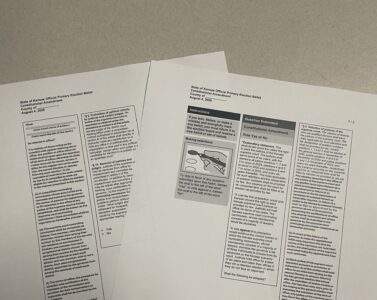
photo by: Sylas May/Journal-World
Language of a ballot question about whether Kansas Supreme Court justices should be elected is shown on July 16, 2026.
Kansas ballots this year will be full of contests for county commissions, the Legislature and statewide offices. But in August, voters will have to decide whether they want another kind of contest on the ballot in the future: contested elections for Supreme Court seats.
On the Aug. 4 primary ballot is a question that, if voters approve it, would change the way justices are selected for the Kansas Supreme Court. Currently, they’re nominated by a panel of attorneys and laypeople and then chosen by the governor, but the ballot question asks whether Kansas voters should elect them directly instead.
Supporters of the amendment have said that the current process prioritizes the voices of attorneys above those of other Kansans, and that other Kansans should have more of a say in the selection process. “We believe the quality of justices will improve with additional transparency and the voice of Kansas voters,” Christie Kriegshauser, of the Kansas Chamber of commerce, told the Journal-World via email this week.
Opponents, meanwhile, say the amendment is an attempt to politicize the court and would allow campaign money and the wishes of constituents to undermine the judiciary’s independence. Micah Kubic, executive director of the American Civil Liberties Union of Kansas, told the Journal-World it would “undermine our fair and impartial Supreme Court” and replace it with “one made up of politicians who can be bought and paid.”
Here are answers to some questions about the amendment, and arguments that have been made for and against it.
What would the amendment do?
The amendment would create contested elections for Kansas Supreme Court justices starting in 2028.
All Kansas voters would be able to vote in these November elections, which would be staggered every two years. Three positions on the seven-member court would be elected in 2028, two in 2030, and two more in 2032, and those elected would serve six-year terms on the court.
The text of the amendment does not specify what, if any, qualifications would be required to run for the Supreme Court, nor whether the elections would be partisan. It says that “The rules applicable for such elections and the designation of position numbers shall be provided by law.” (“Position numbers” refers to which specific seats would be up for election in which years.)
If the amendment were to pass, it would get rid of the current system, in which applicants for the Supreme Court are evaluated by a nonpartisan commission of attorneys and laypeople.
The commission consists of a chair, who is an attorney and elected by attorneys statewide; four more attorneys, one from each Kansas congressional district, elected by other attorneys in their districts; and four non-attorneys, one from each congressional district, appointed by the governor. Together, they vet the applicants for Supreme Court positions, conduct public interviews with them and then forward a list of three nominees to the governor, who chooses one of them to fill the vacancy.
The current system also includes eligibility requirements for someone to be considered for a Supreme Court appointment. Applicants must be at least 30 years old, admitted to practice law in Kansas, and engaged in the practice of law for at least 10 years.
What does a “yes” vote or a “no” vote mean?
A “yes” vote is a vote for a system where justices would be elected by Kansas voters.
A “no” vote is a vote to keep the current system that uses a nonpartisan nominating commission.
Do other states use merit-based selection, or do they elect their justices?
Some of each. According to the Brennan Center for Justice, 14 states, including Kansas, currently have a merit-based system. Fourteen other states elect justices in nonpartisan races, and seven states have partisan races. All other states have some other method of choosing justices, such as appointment by the governor or legislature.
Aren’t justices already on the ballot?
You may have seen justices’ names on the ballot in Kansas before, but these elections aren’t for choosing justices. They are retention elections, where justices don’t face an opponent and the vote is just on whether to keep them in office or remove them.
Who supports the amendment, and why?
Among those who have voiced support for the amendment are the Kansas Republican Party; multiple prominent Republican politicians, including gubernatorial candidate and Senate President Ty Masterson and Attorney General Kris Kobach; the Kansas Chamber of commerce; and the conservative advocacy group Americans for Prosperity.
The state Republican Party’s platform for 2026 includes support for the amendment: “Kansas should change its judicial selection process by adopting direct elections of the Kansas Supreme Court Justices and Judges statewide.”
During legislative hearings on the proposed amendment in 2025, both Kobach and Masterson gave testimony in favor of it.
Kobach has said he believes the merit-based selection process doesn’t actually lead to more qualified justices on the court. In his testimony, he cited a paper published in the Journal of Law, Economics and Organization about the performance of elected vs. appointed judges. That paper said, “The empirical results do not show appointed judges performing at a higher level than their elected counterparts.”
Kobach also argued that it was “embarrassing” to see decisions from the state Supreme Court overturned by the U.S. Supreme Court, and he claimed that Kansas had “the most-overturned state supreme court in the country.” As an example, he mentioned the capital murder cases of the Carr brothers. In 2014, the Kansas Supreme Court voted to vacate their death sentences, concluding that the district court erred by not separating their sentencing trials. But the U.S. Supreme Court later reversed that decision.
“The U.S. Supreme Court used the following words in describing the shoddy reasoning of the Kansas Court: ‘untenable’ and ‘[based on] only the most extravagant speculation’ and ‘beyond reason,'” Kobach said in his testimony. “This kind of language is rarely used to describe the reasoning of another court.”
Supporters of the amendment have also repeatedly argued that the merit-based system is elitist or that it introduces political biases.
Both Masterson and Kobach thought it was a problem that Kansas’ selection system uses a panel where attorneys elected by other attorneys make up the majority of members.
“Presently, Kansas has an opaque system dominated by gatekeepers, the majority of whom are lawyers selected by other lawyers,” Masterson said in testimony to the Legislature. “It has guaranteed the vast majority of the justices on the court will hold the same judicial philosophy held by those lawyers.”
(The Journal-World reached out to both Masterson and Kobach for comment, but neither had responded to questions as of 5 p.m. Friday.)
The Chamber says it’s also concerned about the quality of Kansas’ Supreme Court justices and about the nominating attorneys introducing their own biases.
Kriegshauser, the Chamber’s vice president of political affairs, told the Journal-World that the Kansas Supreme Court “has been reversed or vacated 90% of the time when appealed to the United States Supreme Court since 1990.” She said that “Currently, there is a lack of transparency and information around the selection of the Kansas Supreme Court that allows out-of-touch, ideologically motivated attorneys to pick favorites at the expense of Kansans.”
“It is clear the Kansas Supreme Court is picking favorites, and Kansans and the Kansas economic climate are suffering,” Kriegshauser said.
Kriegshauser also characterized the current judicial retention elections as a “rubber stamp” and said that they weren’t transparent, because money spent in them didn’t have to be reported.
Who opposes the amendment, and why?
The opponents of the amendment include the Kansas Bar Association; the Kansas Association of School Boards; and a variety of other advocacy groups, including the American Civil Liberties Union of Kansas and Planned Parenthood Great Plains’ political arm.
In its testimony to the Legislature when the amendment was being discussed in 2025, the Bar Association said the merit selection process was put in place to prevent political corruption.
The process was enacted in response to the 1950s political scandal in Kansas known as the “Triple Play.” Basically, a governor lost his reelection bid, then resigned before the end of his term. This allowed his lieutenant governor to be elevated to the governor’s office and to immediately appoint him to fill a Supreme Court vacancy.
Kubic of the ACLU of Kansas told the Journal-World that the Triple Play was about corruption and about individuals trying to guarantee power for themselves.
“All of that is what is in play again here,” he said.
Essentially, Kubic believes the amendment would let wealthy political players “buy and sell justice and guarantee outcomes in advance” at the high court. He said that other states with elected justices have seen big political spending, including money from billionaires who live outside the state. The best and most recent example, he said, was the race for a Wisconsin Supreme Court seat in 2025, on which donors spent over $100 million.
In its testimony to the Legislature, the Kansas Appleseed Center for Law and Justice had concerns about how such elections would affect justices’ work. “Courts are unique in that they interpret the law,” deputy director Mike Fonkert wrote then. “They cannot impartially consider the interpretation and application of those laws if they are concerned with public opinion, campaigning, fundraising, and backroom political deals.”
Fred Logan, giving testimony on behalf of the Bar Association in 2025, wrote that the merit-based process leads to better justices, for multiple reasons. First, he said the selection process is intended to select only candidates who have “the legal skill and temperament to honorably serve Kansans.” And, second, he said more attorneys would seek judicial positions in a merit-based system than in one with contested elections.
“A qualified attorney not wishing to participate in partisan politics would be encouraged to seek a judicial position in a merit-based system,” Logan wrote.
(The Journal-World reached out to the Kansas Bar Association for comment, but had not heard back as of 5 p.m. Friday.)
Some opponents have pointed to specific issues that they believe the amendment would jeopardize. One of those is abortion.
In 2019, the Kansas Supreme Court ruled that access to abortion is a “fundamental” right under the state’s Bill of Rights, and in 2022, voters statewide rejected a proposed constitutional amendment that would have done away with the right to abortion in the state.
Planned Parenthood Great Plains Votes, the political advocacy arm of Planned Parenthood Great Plains, has argued for more than a year that the amendment is intended to reshape the court to be more favorable to abortion restrictions. Its written testimony to the Legislature in 2025 read: “It is clear this proposed change is targeting the provision of abortion.”
In an email response to questions from the Journal-World on Friday, Emily Wales, president and CEO of Planned Parenthood Great Plains Votes, said that voters “overwhelmingly reaffirmed” the right to abortion in the state in 2022, and that the Supreme Court amendment should be seen in that context.
“After that vote, Attorney General Kris Kobach zeroed in on a new plan to interject politicians into private medical decisions: change how justices are selected to ‘slowly and quietly’ place anti-abortion judges on the court,” Wales wrote. “… Voters also deserve an honest conversation from politicians who put this on the ballot about what this amendment is really about: undermining the will of Kansans to ban abortion.”
Schools advocates have also voiced opposition to the amendment, noting the Supreme Court’s role in past school funding fights. Multiple times, the court has ruled that the Legislature’s school funding plans didn’t meet constitutional requirements and ordered lawmakers to increase funding for public schools.
Leah Fliter, of the Kansas Association of School Boards, told the Journal-World that “KASB supports the role of an independent judiciary in enforcing policy and funding for K-12 public schools.”
Kubic said that it was more important to note why those issues were decided the way they were. The reasons the court ruled the way it did on abortion and school funding, he said, was that the Kansas Constitution included a right to bodily autonomy and a mandate that schools be equitably and adequately funded.
He characterized the amendment’s supporters as people who were displeased with certain Supreme Court rulings and were looking to do an “end run” around the process to get the outcomes they wanted. There are times when Kubic himself doesn’t “personally agree with the court,” he said, but the important thing to him is that the court follows the Kansas Constitution.
“What the court has done is protect the constitution,” he said.
When is the election?
In-person advance voting began on Wednesday and runs through noon on Monday, Aug. 3, and mail ballots have already been sent out.
The primary election is from 7 a.m. to 7 p.m. on Tuesday, Aug. 4. You can find your polling place at the Douglas County elections website, dgcoks.gov/county-clerk/voting-and-elections.
All Kansas voters, regardless of party affiliation, are able to vote on the amendment.
State Government
Marshall camp settles unpaid bakery bill after 6 years
HUTCHINSON — The owner of a south-central Kansas bakery did not expect a Facebook post she made last Thursday to ...
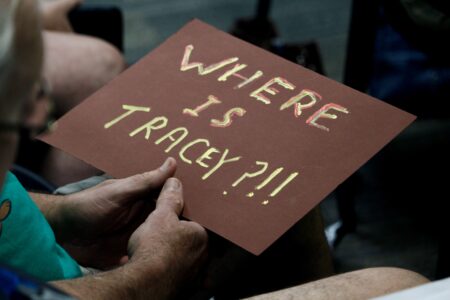
Opinion: Lawrence deserved more from its Congressman at Saturday’s candidate forum
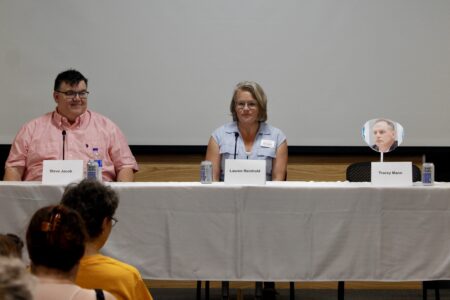
Candidates for ‘The Big First’ Congressional district talk affordability, immigration, Iran in Lawrence forum
US Rep. Sharice Davids introduces healthcare reform package
TOPEKA — U.S. Rep. Sharice Davids introduced healthcare legislation intended to benefit families grappling with ...

Opinion: The Lawrence man seeking to break the power of Republican, Democratic parties this election
State tax receipts top estimate by $147M for quarter
TOPEKA — The state of Kansas collected $147 million more in taxes than anticipated during the first quarter of ...