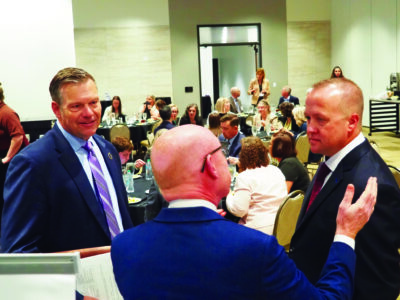
With a Trump endorsement, Masterson posts big win in GOP race for governor; Holscher prevails in Democratic race
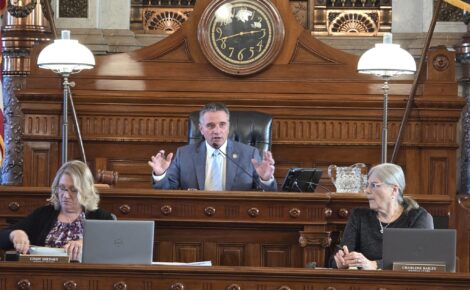
photo by: Morgan Chilson/Kansas Reflector
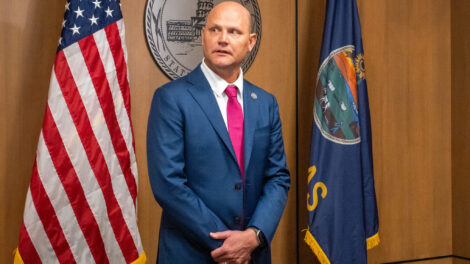
Senate President Ty Masterson says a 25-foot boundary protecting law enforcement and emergency personnel from interference by the public will keep Kansas experiencing what Minnesota did when Immigrations and Customs Enforcement officers arrived in that state. He is seen here during the Jan. 12, 2026, opening of the legislative session.
Updated at 11:05 p.m, Tuesday, Aug. 4, 2026
Republican Ty Masterson rode President Donald Trump’s endorsement to victory Tuesday in a volatile and expensive seven-candidate gubernatorial primary, while Democrat Cindy Holscher shrugged off Gov. Laura Kelly’s blessing of a rival candidate to win the party’s nomination.
Masterson, the Andover resident and president of the Kansas Senate, built an early lead with 43% of the GOP vote as results began rolling in from precincts statewide. He ran away from businessman Phil Sarnecki, Kansas Insurance Commissioner Vicki Schmidt and Secretary of State Scott Schwab. Sarnecki had no previous political experience, Schmidt was vulnerable to attacks for a series of moderate votes on abortion as a member of the Legislature and Schwab never found his footing in a crowded field of conservatives. With incomplete, unofficial results, Sarnecki was at 22%, Schmidt at 14% and Schwab at 11%.
“Tonight belongs to the people of this great state,” Masterson said. “Kansans said loud and clear: We want lower taxes, safe communities, educational freedom and an economy that creates opportunity for every family.”
Masterson tipped his hat to Trump for “friendship and his support throughout this campaign,” invited Republicans who voted for other candidates to “join us” and pledged to be “the governor of every Kansan.”
The roster of other Republicans in the race included former Johnson County Commissioner Charlotte O’Hara of Olathe, Nick Reinecker of Inman and Wichita businessperson Stacy Rogers. The large field, diminished slightly by departure of former Gov. Jeff Colyer, consumed millions of dollars in a quest to find the winner.
Democratic ledger
Democratic voters taking part in selecting a gubernatorial nominee made it possible for Holscher and Corson — both state senators from Johnson County — to fulfill expectations for a close race as the polls closed. As the evening wore on, the outcome became clear. Holscher was able to broaden her advantage to 48% as Corson slipped to 39%. The third option, Overland Park Mayor Curt Skoog, earned 13% of the vote.
While Corson secured the outgoing Democratic governor’s endorsement and spent heavily on television ads, he struggled to connect with voters concerned about his electability in November. There was a sense among some Democrats that Holscher’s mix of public policy positions and a combative campaign style were better suited for challenging the GOP nominee.
“I’m deeply honored and grateful to have earned the trust of so many voters across Kansas,” Holscher said. “People are sick and tired of the politics of the past and are ready for a fighter who won’t bow down to special interests or extremists. People want their leaders to stand up to the corporations that are ripping people off and making things more expensive.”
Holscher, of Overland Park, offered herself as an anti-establishment candidate dedicated to funding K-12 public education, protecting communities from the data center craze, legalizing cannabis and restraining use of tax breaks to drive economic growth. She has repeatedly warned of the state returning to policies of former GOP Gov. Sam Brownback.
“This victory belongs to everyone in our people-powered movement,” she said. “From this moment forward, we are united, and as we turn our attention to November, the stakes couldn’t be higher. Our state cannot afford another extremist like Ty Masterson. The Brownback years are still fresh in our memory — we can’t afford to go back to serving an extremist partisan agenda at the expense of crumbling roads, failing schools and gutted police departments. We need to move forward, not backwards.”
Corson said he congratulated Holscher on her victory and “wish her well in November.” He expressed gratitude for those who worked on his campaign and shared his vision for Kansas.
“While tonight’s result is disappointing, I could not be prouder of what we built together,” he said.
Political feedback
Kentucky Gov. Andy Beshear, chair of the Democratic Governors Association, said Holscher had a strong record in the Legislature of working to solve problems for Kansas families. He said she was a significant advocate for fully funding of public schools, advancing the cause of Medicaid expansion and reducing taxes.
“She also has a record of winning tough races, including defeating an extremist incumbent and becoming the only Democratic state senator to represent a GOP district,” Beshear said. “Kansans are looking for a bipartisan, middle of the road leader, and Cindy has proven that she will bring people together to get things done for Kansas as governor.”
Montana Gov. Gret Gianforte, who chairs the Republican Governors Association, said Masterson was a “results-oriented conservative” who could provide meaningful property tax relief and reduce government overreach in Kansas.
“He’s ready to take Kansas back after eight years of failure under a Democrat governor,” Gianforte said. “Cindy Holscher is an extreme liberal who has stood in the way of property tax relief, parental rights and Kansas values. With Holscher as the new leader of Kansas Democrats and a record that puts her further to the left than Laura Kelly, this race comes down to a simple message: It’s about common sense versus crazy.”
Jeanna Repass, chair of the Kansas Democratic Party, said Masterson was a far-right extremist focused more on pushing Washington’s cost-raising agenda than getting things done for Kansas families. She said Masterson limped out of one of the most expensive and chaotic Republican primaries in Kansas history. Outside groups poured over $20 million into the race, she said.
“Kansans aren’t looking for a far-right extremist,” Repass said. “They want a middle of the road governor who keeps the focus on lowering costs, funding our schools and keeping rural hospitals open, and who puts this state ahead of a political agenda. That’s the choice this November.”
State Government
Opinion: The Lawrence man seeking to break the power of Republican, Democratic parties this election
State tax receipts top estimate by $147M for quarter
TOPEKA — The state of Kansas collected $147 million more in taxes than anticipated during the first quarter of ...
Rep. Tracey Mann to skip candidate forum in Lawrence; spokesman scarce on details

Kobach, Mann debate criminal justice priorities at Tuesday event as they campaign in attorney general race
Kansas must count mail ballots that arrive three days after November election, appeals court rules