KU details COVID quarantine protocols; standards reward those who are vaccinated, wear masks

photo by: Conner Mitchell/Journal-World
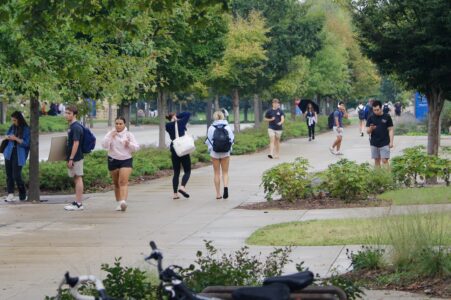
A social distancing sign sits at a bus stop on the University of Kansas campus.
There’s one test you can pass at the University of Kansas this semester that still won’t do you much good — a COVID test if you are an unvaccinated student.
Students who are deemed to be a close contact of someone who has COVID will be required to quarantine, even if they can show proof of a negative COVID test, according to protocols that KU highlighted to faculty and staff on Friday.
That’s a different situation than what some K-12 students are facing. Last month, the Kansas Department of Health and Environment released guidelines that would allow K-12 students who are unvaccinated to continue going to school after being deemed a close contact, as long as they are free of symptoms and they pass daily COVID tests for the 10 to 14 days that they otherwise would have been in quarantine.
But it is not clear that program is even available to universities — the state received federal funding for the K-12 testing program, but hasn’t detailed any such funding for universities — and a KU spokeswoman said unvaccinated students should be prepared to quarantine if they are deemed a close contact.
“Whenever possible, we want a medical professional to determine if a quarantine is required for an individual,” Erinn Barcomb-Peterson, a spokeswoman for KU, said via email.
If you are a vaccinated student, though, the world looks different. KU officials said Friday that vaccinated students — as long as they aren’t exhibiting COVID-like symptoms — aren’t required to quarantine if they are deemed a close contact. That is consistent with Centers for Disease Control and Prevention standards.
“If a student is vaccinated and is not showing symptoms, they do not have to quarantine,” J. Christopher Brown, vice provost for faculty development, and Andrew Foster, emergency management coordinator for KU, said Friday in an email to faculty and staff. “This is a reason to encourage all students to get vaccinated.”
The information shared by KU on Friday also highlighted how the university’s indoor mask mandate is expected to reduce the number of people who are deemed close contacts. In short, KU believes that if you are in a classroom sitting next to someone who ends up testing positive, you likely won’t be deemed a close contact because of the protection that the masks offer.
“You and your students are unlikely to be considered close contacts due to the fact that masks are required indoors,” the pair of KU administrators said in their email to instructors. “Therefore, you may not be notified by the Douglas County Health Department, Watkins or any other medical agency as part of a contact tracing effort.”
Contact tracing last year resulted in many lost days of in-person instruction at many institutions due to the inability to have desks in classrooms more than 6 feet apart in many instances. That would mean that a single positive case in one classroom could lead to multiple students needing to stay home to quarantine.
Barcomb-Peterson said quarantine decisions ultimately remained in the hands of Lawrence-Douglas County Public Health officials. That agency will be responsible for doing the investigative work and reaching out to people who are close contacts of people who have tested positive.
However, KU also may do some “exposure notification” to students or staff “who we believe may have been at least partially exposed to someone who is COVID-positive.” In fact, Brown and Foster said in their email that instructors are allowed to send an email to their class if they have learned a student in the class has tested positive. Instructors are not authorized to identify the student who has tested positive, and instructors are not required to send a notice at all. KU is providing a form notification letter for instructors to use.
Barcomb-Peterson said students who receive an exposure notification letter won’t be required to quarantine. Instead, the letter will ask students to monitor for COVID symptoms and to get tested two times — once three to five days after potential exposure and again seven to 10 days after exposure.
KU is directing students and staff to take advantage of testing at Watkins Health Services on the Lawrence campus. Information provided by KU indicated that KU was not heavily relying on the rapid-result COVID tests, which can produce results in a few minutes. Barcomb-Peterson said both the saliva PCR tests and nasopharyngeal swab PCR tests that are being used at Watkins normally produce results in about 24 hours, although wait times can be a bit longer for tests administered over the weekend.
“We have lots of testing capabilities and encourage everyone in the KU community to seek out testing as often as they wish or after any potential exposure that occurs, on or off campus,” Barcomb-Peterson said.
KU
Hilltop childcare center has been losing money for at least two years, records show

Turnstile rocks KU campus as Day on the Hill returns after two-decade absence

UPDATE: Closure of Hilltop childcare center is final, but the building seems likely to stay
KU to lead national effort to address special education needs and tackle industry’s pressing concerns

Opinion: KU faculty, staff should be nervous about the new spending rules proposed for college athletics