

Opinion: With new president in place, now is the time for Lawrence to invest in Haskell Indian Nations University
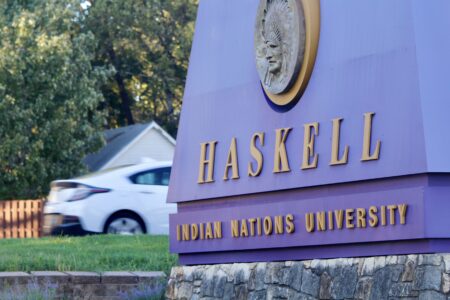
photo by: Dmitry Martirosov/Journal-World
Haskell Indian Nations University is the oldest continually running university serving American Indian students.
I’m a believer in the potential greatness of the University of Kansas.
With expertise in topics as varied as cancer treatment to cybersecurity, KU has the chance to grow its research enterprise to new heights. With a central location that is an easy drive from so many metro areas, it has a chance to grow its enrollment, even as the country produces fewer high school graduates.
But when it comes to higher education in Lawrence, I’m also a believer in something else: The here-and-now uniqueness of Haskell Indian Nations University.
Opinion

Chad Lawhorn
Editor & Publisher
Have your own take? Send 250 words or less to letters@ljworld.com.
Have a column idea or a tip for Chad to investigate?
Send a message to clawhorn@ljworld.com.
“Unique” is not a synonym for “great,” but being unique can be a path to great success. Haskell undoubtedly has the unique part down. It is the only four-year university in America that is open exclusively to members of federally-recognized Native American/Alaska Native tribes.
It also charges no tuition to any of its students, and on-campus housing and other fees often total only a few hundred dollars per semester. Ask the parent of a traditional college student if that sounds unique.
That tuition-free model is a substantial building block for Haskell’s new president, Alex Red Corn. He’s a true academic with a doctorate in education and professional experience in major universities like KU and Kansas State. Too often, the Bureau of Indian Affairs, which funds Haskell, has turned to people rooted in the world of bureaucracy rather than universities to provide leadership at Haskell. Congratulations to BIA leadership on breaking that pattern, and wishes of much success to Red Corn.
Still, Haskell is the “other” university in Lawrence. Argue otherwise, if you want, but the difference in connections the community has with KU versus Haskell are stark.
“Other,” though, is not a synonym for “lesser.”
Plus, here’s the great thing: KU and Haskell aren’t racing. They aren’t competitors. Instead, they are the two pillars of Lawrence’s most important industry — higher education. KU’s status as a pillar is largely self-evident. Haskell’s status as a pillar, I suggest, needs to be self-fulfilling. And, yes, it can be.
I believe Haskell is the most overlooked economic development opportunity in Lawrence. It could bring hundreds — if not more than a thousand — new jobs to the community, and generate tens — if not hundreds — of millions of dollars in new revenue for the local economy.
Here’s some of my math: Haskell currently has about 950 students. That’s about 2% of the 50,000 registered tribal members ages 18 to 24 who attend a school of higher education. (An admittedly rough estimate based on BIA tribal membership data and Census demographic data regarding Native Americans.) Is 2% the right number for the only four-year institution that offers zero-dollar tuition and offers an education grounded in Native culture?
Further, only about 25% of Native Americans aged 18 to 24 pursue higher education. That is the lowest rate of any racial or ethnic group in America, according to the U.S. Census Bureau. The national average is 39%. If Native populations could reach that number, nearly 30,000 additional Native students would be attending universities each year. With the right strategy and commitment, Haskell and Lawrence could be well-positioned to attract many of them.
How many? Any number uttered would be a guess. But consider this: Haskell — unlike KU, even — was designed to be a national university. Given that, is it unrealistic to believe a university with a national footprint and zero-dollar tuition could have 5,000 students? There are approximately 2 million people enrolled in federally recognized tribes, after all.
It sure seems like 5,000 students at Haskell could be a reasonable goal. What type of economic development opportunity would that be for Lawrence? Today, Haskell has about 200 employees, according to its employee directory. Emporia State — the smallest Regents university in Kansas — has about 5,100 students. ESU has more than 700 employees. The increased employee totals would add $20 million to $30 million in payroll alone, and there would be the increased spending of 4,000 more students in town.
A lot will have to change at Haskell for any of this to become remotely true. Haskell needs to be operated more like a university and less like a federal bureaucracy. Direct federal funding, though, will remain critical. A much more active, truly national endowment association also is a must.
Local support also will be key. Douglas County, Lawrence and KU should consider providing economic development funds to Haskell. What could $300,000 — $100K from each entity — do to boost Haskell’s national student recruitment efforts? Local leaders should never forget that growing student enrollments is bread-and-butter economic development in a town like Lawrence.
If you want to think even further outside the box, let Haskell start using some of KU’s world class athletic facilities. That could be a recruitment tool for Haskell. Track and soccer — maybe even football — at Rock Chalk Park? A few Haskell nights at Allen Fieldhouse?
Ah, listen to me, laying out what Haskell needs. Perhaps I also should state I’m pretty sure I know what Haskell doesn’t need: Another white guy telling Haskell what it needs. That’s worked out so well.
As I stated earlier, Haskell’s rise to an economic pillar in Lawrence must be self-fulfilling. We are not the “self.” It is the native community near and far that must set the path. But Lawrence does have a role. It starts by saying we care, which the earliest pages of Haskell’s history shows has not always been the case. The caring shouldn’t be about dollars and cents. We should feel blessed to share a community with such strong and proud people.
That said, we also should put some dollars and cents to the effort. Let’s grab the economic opportunity in front of us and grow Haskell and grow our economy with it. Lots of work and cooperation would be needed, but the payoff for Haskell and the community could be beyond great.
It could be uniquely great.
Other News
Opinion: With new president in place, now is the time for Lawrence to invest in Haskell Indian Nations University
Douglas County commissioners to review new financial policies, including changes to reserve fund rules

Douglas County explores new permanent supportive housing project after Bert Nash proposal falls through
Bert Nash announces new medical director for county’s Treatment & Recovery Center

Lawrence Schools Foundation reports nearly $4.9 million in assets after 40 years of supporting district