

Federal official overseeing Haskell Indian Nations University says she is confident in school’s success despite challenges
Efforts to bring Haskell to local control are still ongoing, Sen. Jerry Moran said
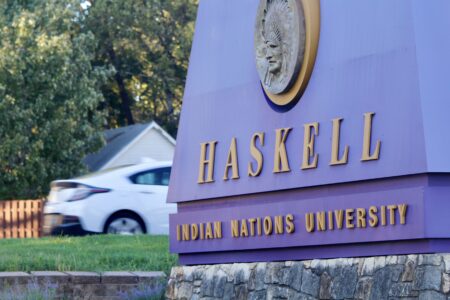
photo by: Dmitry Martirosov/Journal-World
Haskell Indian Nations University is the oldest continually running university serving American Indian students.
A Bureau of Indian Education official last week expressed confidence that Haskell Indian Nations University’s accreditation status, which was placed on notice last year, would be reinstated following a visit by the Higher Learning Commission at the end of the month.
The official also said proposed budget cuts by the Trump administration were not likely to move forward, and there are some early signs in Congress that Haskell possibly could see an increase in funding for the first time in years.
Stephanie Conduff, the bureau’s associate deputy director of post-secondary education, told the Journal-World in an interview that she believes that Haskell’s “on notice” status regarding its accredication will be lifted after the Higher Learning Commission concludes its two-day visit on Nov. 30 and Dec. 1.
“The (Haskell) faculty and staff and leadership team have been working extensively to address every single one of the concerns that the HLC had,” Conduff said, adding that the school has “an incredible plan forward.”
The Higher Learning Commission, which historically has served as the main accrediting body for universities in the central United States, changed Haskell’s accreditation status to “on notice” in June of last year after determining that the school was at risk of being out of compliance with the agency’s accrediting criteria. The “on notice” status does not revoke Haskell’s accreditation as a higher education institution. Instead, it gives the university a period of up to two years to address the commission’s concerns.
“(Haskell has) been locally led by the faculty and staff, and I think that they have taken all the necessary means,” Conduff said.
The change of status, which included concerns related to faculty and staff, came shortly after the Trump administration ordered massive layoffs across federal agencies and departments. As a federally-operated university, Haskell saw nearly 40 of its employees laid off, a decision that was later reversed by a district court judge. Several of the fired Haskell employees have since been rehired, as the Journal-World reported.
Threats from the Trump administration toward tribal colleges and universities, however, including Haskell, have not subsided, and now the school’s financial model could change if the administration’s proposed budget request for next year were approved — which is not a certainty, given the pending changes in Congress and lawmaker resistance to past proposals to cut funding.
In April, the U.S. Department of Interior, which oversees the Bureau of Indian Education and the Bureau of Indian Affairs — the two main funding sources for Haskell — released its budget request for fiscal year 2027, proposing an $8.2 million cut to Haskell and the Southwestern Indian Polytechnic Institute, the second of the two tribal colleges directly operated by the Bureau of Indian Education.
The proposal — which has to go through Congress for approval — could amount to nearly 17% in reductions to Haskell’s roughly $30 million annual budget, or a $5 million cut. Haskell typically receives 60% of the amount allocated by the Bureau of Indian Education, while the remaining 40% goes to the Southwestern Indian Polytechnic Institute, according to Conduff.
More broadly, the budget proposal seeks to cut nearly $200 million — or roughly 85% — of funding allocated across the country for tribal school construction projects, which includes everything from repairs and improvements to existing facilities to employee housing. The 31 other tribal colleges and universities that th Bureau of Indian Education partly funds would receive no funding at all under the proposal.
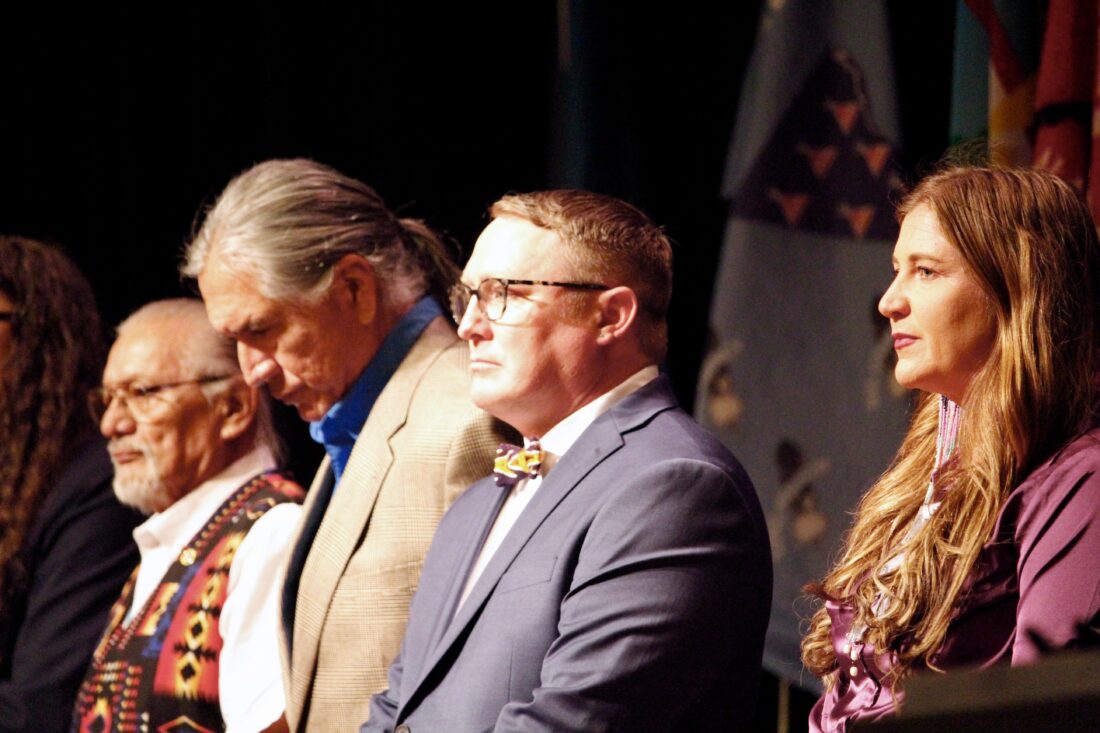
photo by: Dmitry Martirosov/Journal-World
Alex Red Corn during the presentation of colors at his presidential inauguration at the Haskell auditorium on Tuesday, Nov. 10, 2026. Stephanie Conduff, the Bureau of Indian Education associate deputy director of post-secondary education, is standing to his left.
The Trump administration has previously sought such cuts going back to the president’s first term, but has not been successful in winning support for the cuts. In 2019, for example, the administration proposed a $3.1 million cut to Haskell and the Southwestern Indian Polytechnic Institute. And last year, it proposed the same cuts it is seeking in the current budget proposal.
The two schools, however, have remained consistently funded at the same levels through the last four budget cycles. Conduff said she was confident it will remain so.
“Historically, the president’s proposed (cuts were) not enacted,” Conduff said. “And so Haskell continues to remain flat funded, just like they were in the last year when they did the president’s proposed (budget).”
Haskell’s roughly $30 million annual budget comes from the Bureau of Indian Education and Bureau of Indian Affairs. The school received $18.1 million in the 2023-2024 academic year from the Bureau of Indian Education and $5.7 million from the Bureau of Indian Affairs, according to the school’s most recent annual report. Haskell also collects about $1 million in student fees and receives between $5 million and $15 million in grants. The school does not charge tuition to its roughly 950 students.
Meanwhile, the U.S. House Appropriations Committee also appears to be rejecting the president’s proposals. According to its most recent updates on the 2027 fiscal year budget, the committee is recommending $146.3 million in funding for post-secondary education programs, which is nearly $19 million more than what was allocated in fiscal year 2026 and $124.2 million above the Trump administration’s current proposal. The committee also recommends $36.2 million to be allocated to Haskell and the Southwestern Indian Polytechnic Institute, an 18% increase from last year and more than $14 million above the Trump administration’s proposal.
School construction would also receive a funding boost under the committee’s recommendations, with more than $304 million allocated toward replacement school construction and $25 million toward facilities repairs and improvements for tribal colleges.
The committee noted in its report that it acknowledged the “significant funding needs across Indian country” and that investments in tribal colleges and universities “are essential to ensuring that students have access to safe, modern, and academically appropriate learning environments.”
It also called on the Bureau of Indian Education to better coordinate with Haskell’s Board of Regents.
“The Committee expects BIE to engage the Board in a consistent and substantive manner on matters affecting institutional governance, academic programs, and campus well-being,” the report read.
Several of Kansas’ congressional delegation members have long sought to bring control of Haskell to a local level. U.S. Sen. Jerry Moran has been advocating for “systemic overhaul” within the Bureau of Indian Education and the Bureau of Indian Affairs. Last summer, he filed the “Haskell Indian Nations University Improvement Act,” which would wrest control from the Department of Interior and let Haskell govern itself, but the measure did not advance.
On Wednesday, Moran told the Journal-World in an email that he continues to work with the different stakeholders, including the Bureau of Indian Education, in pushing for Haskell to be governed by its Board of Regents.
“I remain committed to advancing these efforts to make certain Haskell is positioned to best serve the needs of its students and honor Native Americans in Kansas and across the country,” Moran said.
Other News
Federal official overseeing Haskell Indian Nations University says she is confident in school’s success despite challenges

Lawrence community pays tribute to veterans at downtown parade

A sharp legal mind and a big sense of humor; judges formally – and funnily – welcome newest colleague to the bench

FAA says airplane departures can resume following nationwide ground stop

Go, See, Do: Cat Video Fest, pancakes, pretzels and more events