

Douglas County commissioners to review new financial policies, including changes to reserve fund rules
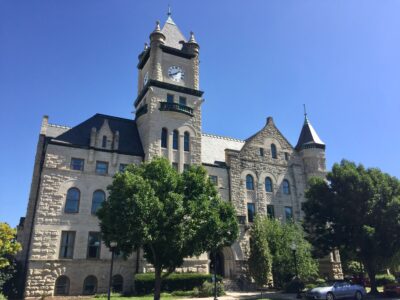
photo by: Journal-World
The west side of the Douglas County Courthouse, 1100 Massachusetts St.
Douglas County commissioners will review a series of proposed financial policy changes Wednesday, including new rules for how much money the county should keep in reserve and how excess funds can be used.
Douglas County has been in the process of rewriting its finance policies after a review by the Government Finance Officers Association identified gaps in the county’s existing financial framework. The goal of the changes are to strengthen financial oversight, improve transparency and consistency and prepare the county for a future upgrade to its enterprise resource planning software.
The work also comes after a Journal-World investigation found that several county funds have had balances above amounts allowed under the existing fund balance policy for years. The current policy — approved in January 2023 — limited the amount of money that was held in a type of account called a “fund balance.”
These accounts act as savings accounts — or reserves — that Douglas County maintains to set aside money for future expenses, unexpected costs or specific needs. The money comes from revenues the county receives, but does not spend during a budget year. The current policy says the accounts can’t have fund balances that are more than 25% of their revenues.
To bring the county into compliance of its fund balance policy, staff presented drafted changes to commissioners in December 2025, as the Journal-World reported.
Those changes didn’t sit well with a few members of the public after the county shifted toward establishing minimum targets for fund balances, ranging from 20% to 25% of total operating expenses, and it didn’t set a cap on those funds. It also didn’t spell out what to do in the event that a fund significantly exceeds or falls below the 20% to 25% level.
In response, county commissioners decided to wait and vote on any changes with larger rewrites to the finance policy — where they will get updated on that progress on Wednesday.
Based on recommendations from the GFOA, the county will be expanding its single finance policy into 12 separate policies covering different areas of financial management. The county commissioners will only review five of those with the most significant policy gaps during Wednesday’s work session, and they will not take any action.
FUND BALANCE POLICY
Similar to what was presented to county commissioners last year, the drafted reserve policy establishes minimum reserve levels for several county funds to ensure the county has enough money available to maintain operations, respond to emergencies and manage unexpected revenue fluctuations.
The draft sets a general target of maintaining reserves equivalent to 20% to 25% of total operating expenditures.
Specifically, it establishes a minimum reserve of 20% of annual operating expenditures for the general fund, motor vehicle operations fund, road and bridge fund and Consolidated Fire District No. 1. However, the target for the general fund and Consolidated Fire No. 1 is 25%, and the employee benefits fund would have a minimum reserve of 25%.
Unlike previously, the draft outlines what happens when reserves fall below or exceed those targets. If the county were to use reserves below the minimum levels, it would need to be for emergencies, one-time capital or infrastructure needs, significant revenue shortfalls or other circumstances approved by county commissioners.
Then, the county would develop a replenishment plan, generally aiming to restore the balance within one to three fiscal years when practicable.
Meanwhile, excess reserves could be redirected towards one-time capital projects, reducing long-term obligations or strengthening other funds. The policy does not define how far above the target qualifies as significant. Any of those changes would require approval from the county commissioners.
The drafted policy says the general fund “may accumulate reserves in excess of the adopted minimum and target levels when doing so supports future financial flexibility, mitigates identified long-term liabilities, or prepares for anticipated economic volatility.”
OTHER POLICIES
• The revenue policy focuses on making county revenue forecasting more consistent and ensuring the county does not rely too heavily on unpredictable funding sources. The draft outlines property taxes as the county’s most reliable revenue source, followed by sales tax, and it encourages diversifying revenue sources. However, one-time revenues — like grants — should not be used to fund ongoing county operations.
• The operating budget policy establishes a framework for preparing and managing the county’s annual budget. The draft says the county should maintain a structurally balanced budget, meaning operating expenditures should not exceed operating revenues and available fund balances. It also said the county should maintain existing services before funding other programs or projects.
• The drafted capital asset maintenance policy outlines procedures for tracking county-owned equipment and monitor the condition of their assets, such as vehicles, technology and other physical assets. Capital assets are defined as tangible property with a life of more than one year and an acquisition cost of at least $10,000.
• The long-term financial planning policy would require the county to make a more forward-looking approach to financial decisions. The draft calls for multi year forecasts of revenues, expenditures and fund balances for the general fund, bridge fund and employee benefits fund to identify any potential gaps between revenues and expenditures.
The work session will give the county commissioners the opportunity to review the proposed financial policies, provide feedback and whether they recommend any changes to the draft policies by early 2027. The policies would then be brought forward for adoption in phases.
The County Commission’s work session will begin at 4 p.m. Wednesday in the Douglas County Commission meeting room at 1100 Massachusetts St. The business meeting will follow at 5:30 p.m., and it will also be available via Zoom.
Other News
Douglas County commissioners to review new financial policies, including changes to reserve fund rules

Douglas County explores new permanent supportive housing project after Bert Nash proposal falls through

Bert Nash announces new medical director for county’s Treatment & Recovery Center

Lawrence Schools Foundation reports nearly $4.9 million in assets after 40 years of supporting district

Federal official overseeing Haskell Indian Nations University says she is confident in school’s success despite challenges