The Lawrence Community Shelter is an ‘iceberg,’ and its leader provides a glimpse beneath the surface
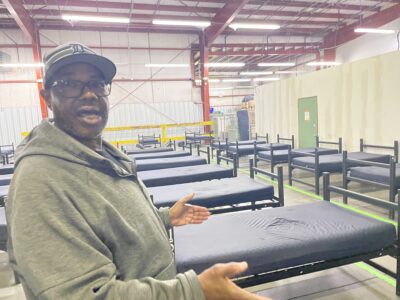
photo by: Sylas May/Journal-World
Lawrence Community Shelter Executive Director James Chiselom speaks about the shelter's plans for its congregate men's space on Tuesday, March 3, 2026. The shelter wants to replace the current beds with new "step-up" beds.
James Chiselom doesn’t like to talk about how the Lawrence Community Shelter looked in 2024, when he started as executive director.
“People couldn’t feel safe here, people were abused here, people were victimized here,” he said. The shelter had cycled through seven other leaders in roughly a decade, and less than a year earlier it had warned that closure was imminent without more funding and support.
“It is very hard to create your identity or develop an identity when there’s so many negatives about this place,” Chiselom told the Journal-World this past week. “And a lot of those negatives were real.”
But since then, Chiselom said, “things have gotten so much better.” He taps his desk three times for emphasis: “So. Much. Better.”
Just in 2025, the shelter helped transition 77 people to HUD-defined permanent housing and 127 people to other housing options, as the Journal-World reported. It served 706 night-by-night guests, and it opened its new Pallet 24 cabins behind its main facility at 3655 E. 25th St.
It’s taking steps to do more fundraising and reduce its dependence on millions of dollars of local government funding. And it can do more long-term planning now that its revolving door of leadership has stopped.
“Eight directors in the last 12 years,” Chiselom said. “There’s a reason for that. This is not an easy job.”
He said it’s a job the public often misunderstands. A job where you’re always on call, where the expectations can sometimes seem unrealistic, where you may even get physically threatened or beaten up.
And it’s a job whose responsibilities are bigger than just you, Chiselom said.
“Nothing we do here is about me,” he said. “I am in charge, I am the director, responsibility is mine, but I don’t do this work to say, ‘Look at what I’m doing.’ I do this work to help the people that need the services we provide.”
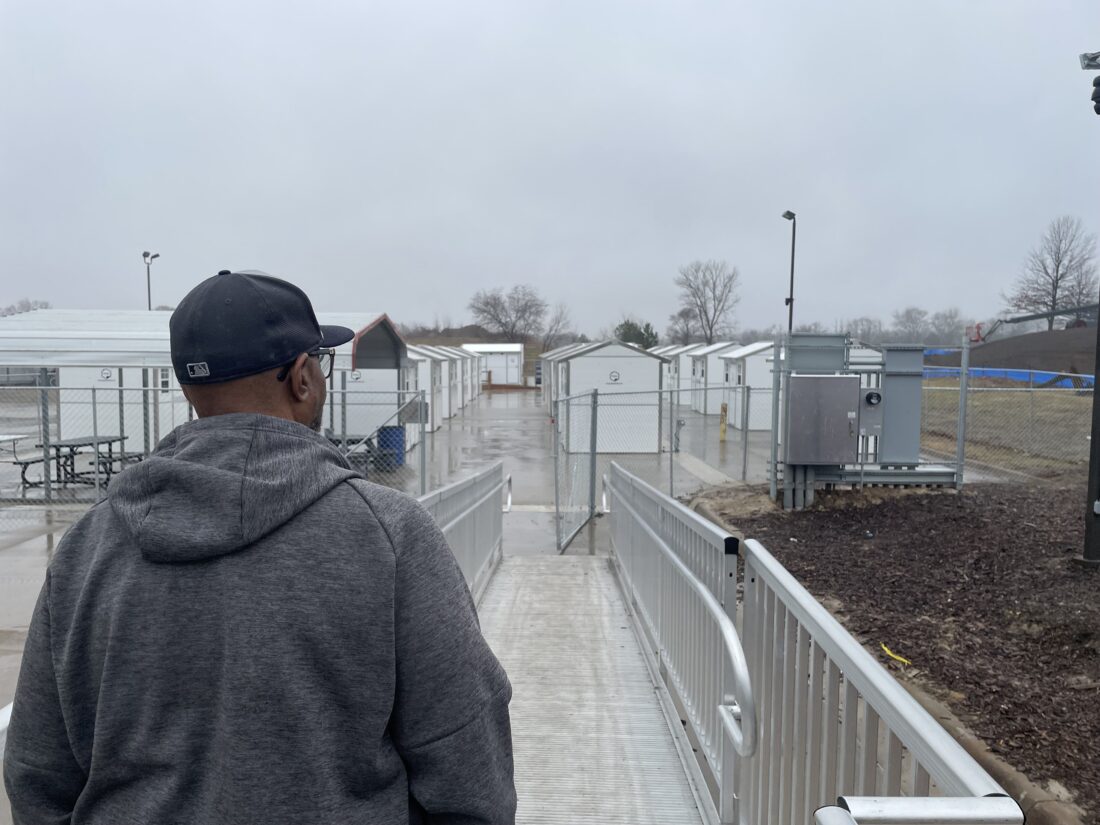
photo by: Sylas May/Journal-World
Lawrence Community Shelter Executive Director James Chiselom walks out to the Pallet 24 site at the shelter on Tuesday, March 3, 2026.
Lowering barriers
It’s 7 p.m. Thursday, at the start of intake for the shelter’s night-by-night guests, and several dozen people are lined up outside. As they check in, two staffers at a table help them. They know many by name. One gets a “happy birthday” wish and a double fist bump as he comes in.
The laundry machines are already running; you can smell the soap and hear lockers slam. Sometimes there are shouts, but most are from a movie playing in the media room next door.
There was a time Chiselom thought night-by-night was one of the worst ways to do emergency sheltering. But Lawrence changed his mind.
“In Lawrence, it’s a necessity to have a night-by-night program,” he said, “because we have a contingency of unhoused folks that want to just be housed.”
“They don’t want to talk, they don’t want to engage, they don’t want to improve anything for them, they don’t want us working more than they want to be worked with,” he continues. “They want a space to come in out of the cold, out of the weather, just to be safe, and that’s what I want to make sure that we have.”
The Lawrence Community Shelter’s night-by-night program is a “low-barrier” program, which means that guests aren’t turned away for things like substance use problems or criminal history. Many reasons that people would want to stay outside are anticipated here. Each guest can have a plastic tub to store their belongings in, and there are amnesty lockers outside to store things that aren’t allowed in the shelter.
Guests can even bring their pets, and some of the sleeping arrangements have cages for them. In the media room, one man sits in an armchair alongside two small dogs with perky ears, one cream-colored, the other black.
There’s an “intake packet” guests are given when they arrive, but it mainly just spells out the rules guests are expected to follow, and the guests’ signature is an affirmation that they understand them.
There are rumors out there that this packet contains an agreement that guests won’t speak to the media. Looking through a copy of the packet, the Journal-World found no such rule.
“If you find that policy in there, I’ll owe you an exquisite lunch,” Chiselom said.
It is true, he said, that shelter staff cannot “independently talk to the press about their opinion” without the director’s express knowledge, which he said is similar to media policies that many other organizations have. He thinks some people might have mistaken that staff policy as a policy that applies to guests.
On the whole, Chiselom doesn’t want to impose requirements on guests if he doesn’t have to.
“My whole thing when I started was to provide multiple options for our unhoused population,” Chiselom said. “So now I’m a big proponent that there needs to be low-barrier night-by-night shelter for those that are not ready to engage, don’t want to engage, or cannot engage.”
Even being from outside of Douglas County doesn’t disqualify you for services.
The city has had a policy since August 2024 that prioritizes serving people who are from Douglas County. Among other things, it states that when guests show up to the shelter and can’t prove they are Douglas County residents, they get a three-day “respite period” during which they can gather materials to prove their residency. Failing that, the city’s Homeless Solutions Division can attempt to figure out whether they’re residents through other means, like hospital or jail records or by asking past landlords.
But in practice, Chiselom says, the shelter is helping people from outside the county for more than just the three-day respite period.
“When people say non-Douglas County residents don’t receive services, that’s bullshit,” he said. “You know why? Because I provide the services.”
He gave the Journal-World a chart showing that the shelter has hosted 80 people from outside of Douglas County in 2025 and 2026. Over that time, only 22 of them had three or fewer total nights at the shelter. Some people’s stays were in the double digits – the highest number was 69 nights.
In total, the chart shows, people who are not Douglas County residents have accounted for 1,245 bed-nights in 2025 and 2026.
Chiselom says he does support the residency policy. “What we saw was an untenable situation the way it was going,” he said, with people even being sent to Douglas County from other jurisdictions. But the shelter still houses people from outside of the county, “because people need to be housed, and we don’t have a good way to distinguish how not to house because of the residency policy.”
If that’s a problem for some people in Lawrence, he said, they should be looking at the communities where the out-of-county guests are coming from.
“That’s not saying we’re wrong,” he said. “That’s saying the places that people come from that don’t have these services are wrong. That’s where we should be pointing the finger and where these services need to be, instead of sending people here.”
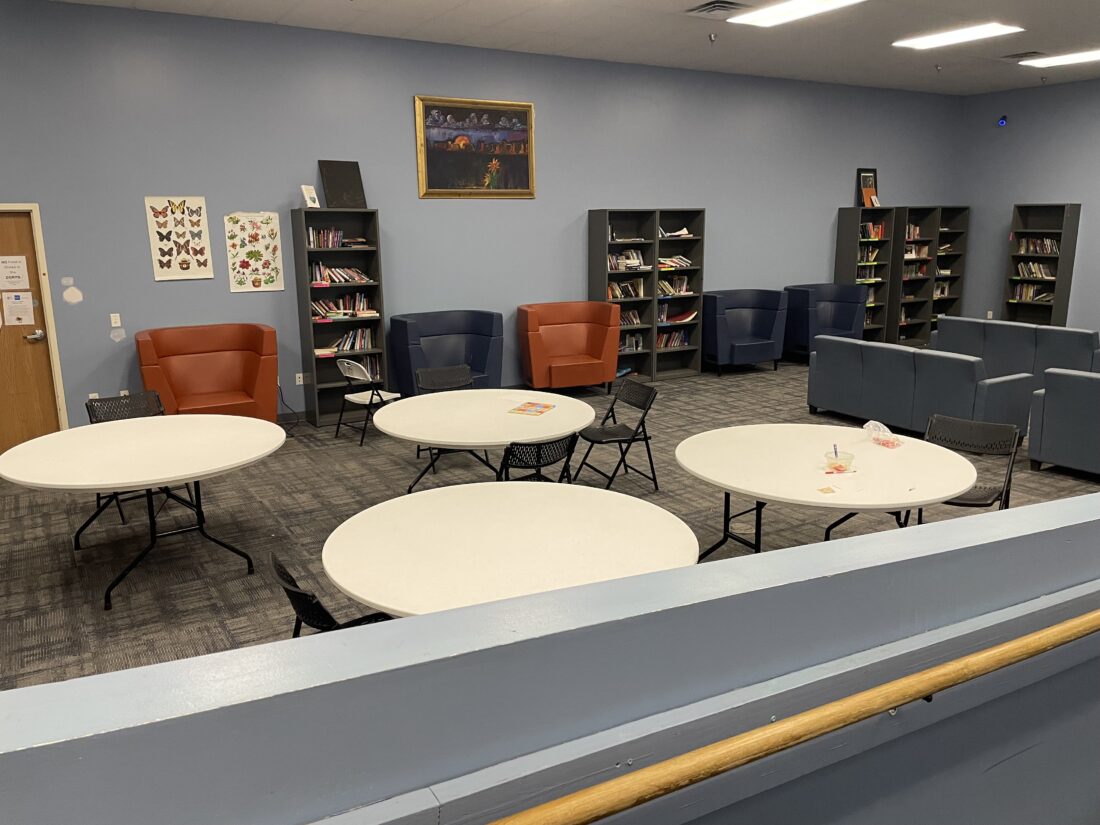
photo by: Sylas May/Journal-World
A reading and media room at the Lawrence Community Shelter is pictured on Tuesday, March 3, 2026.
A spectrum of services
Chiselom thinks it’s important to look at the shelter from the perspective of a person who’s been living outside.
He says it’s hard for him to judge people who camp outside, because he’s never been in that situation himself. But if he had to live in a camp, he thinks, “it would have to be pretty traumatic for me, probably.”
“And that’s the lens I look through when I’m giving both sides of the story,” he said. “I look through my lens as the director of an emergency shelter, but also look through the lens of a person, had I been relegated to having to make a choice of where to live if I didn’t have any place.
“What would it take for me to do that? It would mean I would exhaust every means possible, for me, to not have to do that.”
The night-by-night decisions are made with that approach in mind, he said. For instance, he points to Pallet 24, the collection of 24 Pallet cabins behind the shelter. Each one can house up to two night-by-night guests. But Chiselom said some of the staff didn’t want them to be used for the night-by-night program at all.
“The pressure on me to not have the Pallets night-by-night was big,” he said. “I said, well, where would somebody who doesn’t want to be here do the best at? It’d be in a semi-private space, they have their own climate control, you only have to bunk with one person instead of 50 persons” like in the congregate shelter rooms indoors.
He told the staff they would try it and adjust it if it wasn’t working out.
“It’s working out perfect!” he said. “People that have not been in the shelter in years come and they love the space that’s provided to them.”
One big thing for many guests is just having somewhere to accomplish the basic tasks of everyday life – doing laundry, bathing, taking care of their hygiene and their health. Both by day and by night, the staff works to care for those needs. One guest needs a shave on Thursday night, and the desk workers offer him not one razor, but two, because “they go dull fast.” Other guests have special medical needs, and the shelter has medical respite beds set aside for them.
During the day, after the night-by-night guests leave in the morning, staff does laundry and cleans the facility. There’s a room full of pillows with a heater constantly running. This is to prevent bedbugs, Chiselom said. It wasn’t long ago that the shelter was infested with pests such as roaches, but it’s now “pest-free and clean.”
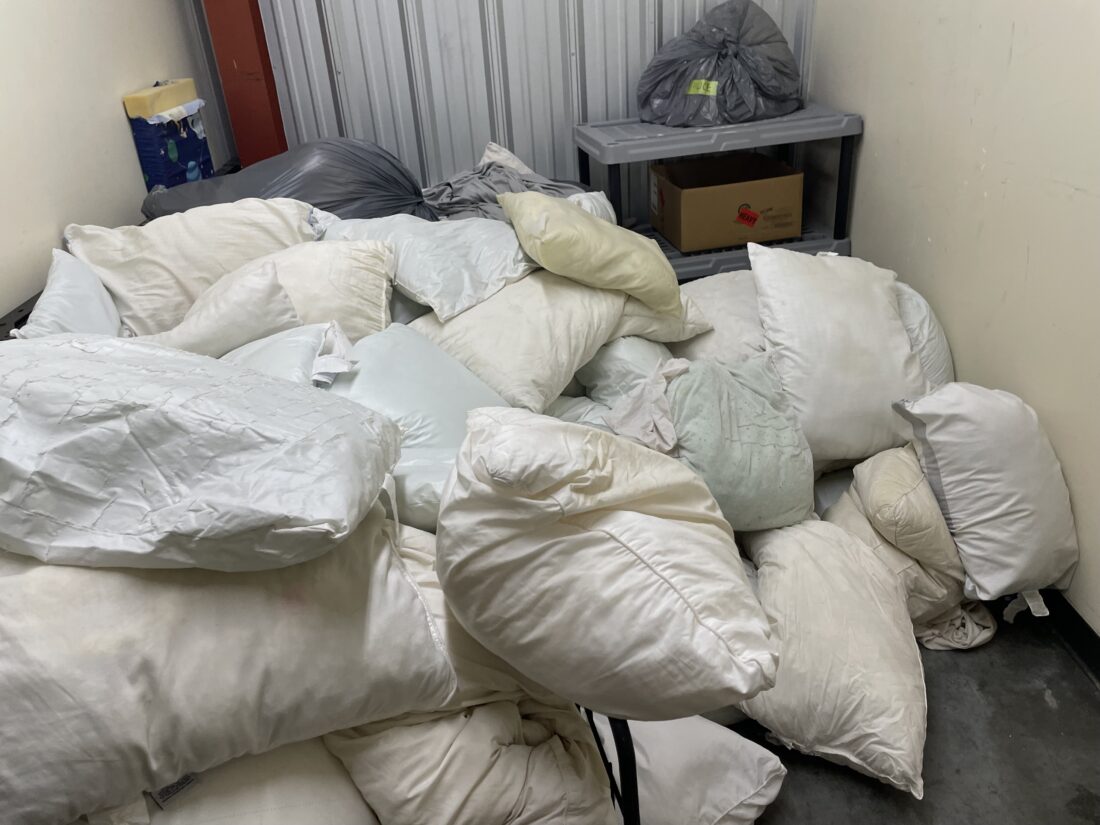
photo by: Sylas May/Journal-World
Pillows are piled up in a heating room of the Lawrence Community Shelter on March 3, 2026. They’re blasted with hot air to prevent bedbugs.
Most of the night-by-night guests don’t want more intensive services than this, he said. They want the things that they can’t get anymore at “multi-use facilities.” He mentioned the city’s recreation centers, where unhoused people could once shower and cool off or warm up, but which now charge for memberships and day passes.
“They don’t want us asking them questions, they don’t want us case-managing them,” Chiselom said of the shelter’s clients. “They just want to be left alone, have some food to eat and have access to charge (their devices), to be warm, to be cool in the summer.
“And we do that. And we don’t want to make people get what we think they should have. Because we want to provide the things they want. That’s easier to maintain than providing things people don’t want.”
Of course, there are people who want more support and who want to eventually get back into stable housing. For them, the shelter has options, including a 30-day program and a 90-day program.
Some people don’t need the longer program “because they have jobs, they have income,” Chiselom says. “Some people have the ability and just need more encouragement and more support. So we have a 30-day program.”
When Chiselom tells people about how the shelter can help them get into stable housing and remove barriers that prevent them from obtaining it, different people react differently.
“Some people are so afraid,” he says, “and then some people are so happy that now somebody’s going to work with them to get all these things worked out for them.”
“The problem has never been housing people,” he adds. “It’s keeping people housed, or having them with enough skills to stay housed. And that’s what we’re trying to do more of, wraparound services and engage more community partners to do that.”
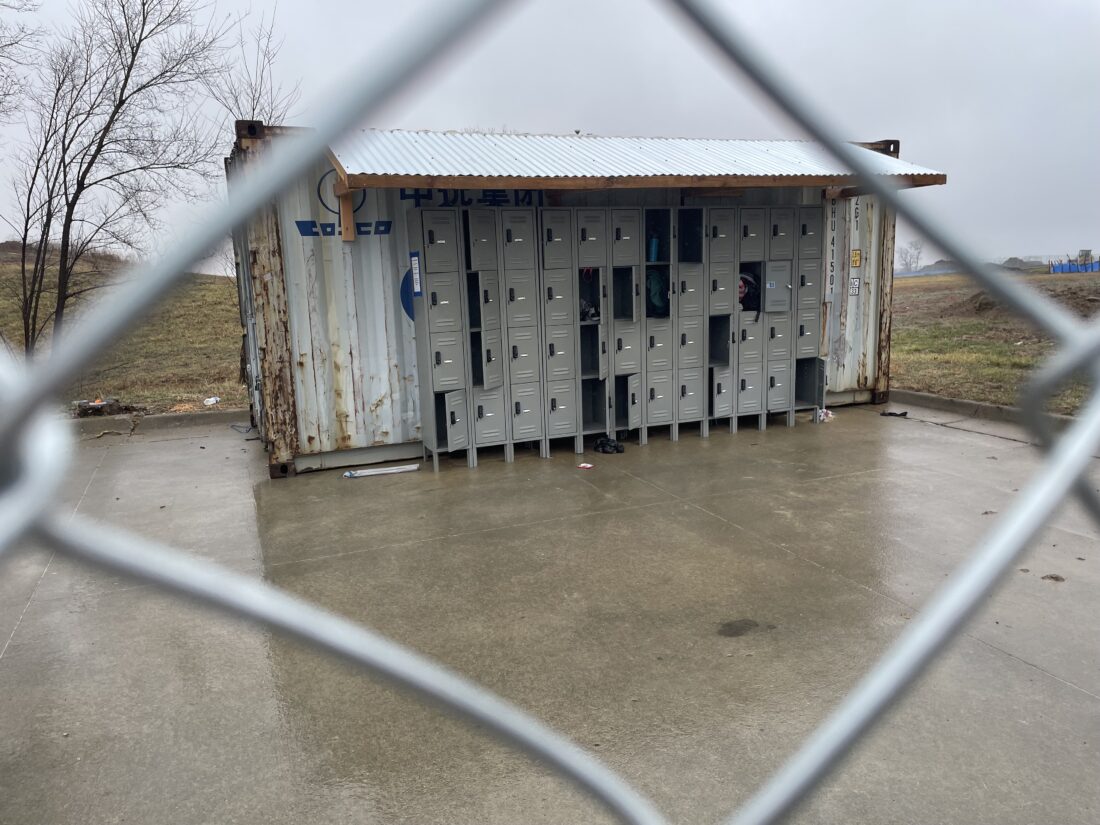
photo by: Sylas May/Journal-World
The amnesty lockers at the Lawrence Community Shelter are pictured on Tuesday, March 3, 2026.
‘Horrible’ behaviors
It’s about 8 p.m. on Thursday, and the police have just showed up at Pallet 24.
First it’s one Lawrence police officer who says he’s here for a report of battery on an employee. Then another one joins him a few minutes later. The employee isn’t injured, but she tells the officer that one of the guests hit her.
“It was a punch and a push,” she tells the officers.
The guest doesn’t seem to be around, but the employee describes him for the police and says he might be carrying around a knife.
The Lawrence Police Department’s call logs partially redact addresses of calls, so it’s hard to tell from the logs whether they’ve specifically been dispatched to the shelter at 3655 E. 25th St. or somewhere else in the same block, such as the Douglas County Jail, 3601 E. 25th St.
But officers have responded to the 3600 block more than 15 times between March 1 and March 5. The reasons for the calls vary from medical emergencies to disturbances to at least one report of battery.
Even with the progress he says the shelter has made, Chiselom is well aware that behavioral problems and violence still exist. And he said there’s a kind of double standard at work, where people often expect the shelter to tolerate behavior that other places in town would not.
“A lot of times, our population that we house at the shelter has been asked not to frequent a lot of places downtown for their behavior,” Chiselom said. “But when it comes to the shelter, the expectation is these same people that can’t go to the library, ride the bus, be in other spaces downtown, that we should take them and not worry about their behavior. And that’s what was happening when I started.”
Recently, he was thinking about the rates of mental illness or substance use among the people the shelter serves. His guess is about 50% of them would self-identify as mentally ill or substance abusers, but that “if you really dug deep,” it would be over 75%.
Putting people with those kinds of problems in a shared space and expecting them to simply adjust to it often isn’t realistic, he said.
“When you have that many people in one space, in the congregate-style living that we have, bunks next to bunks, not a lot of space for people to carve out for themselves, tempers flare and all that,” he said. “And we can’t make anybody do anything, so sometimes we have to ask people to leave and reset.”
“Some of the behaviors I’ve seen are horrible,” he said.
In one of the Pallet 24 cabins, part of the window on the back has been boarded up. What happened here, Chiselom said, is that a guest high on some substance had a “breakdown” in the cabin and tried to climb out.
“They were in here, and they tried to go out the window instead of going out the door,” he said. “That’s how high and psychotic they were.”
It’s not reasonable to try to climb out of the small window, Chiselom said, but half of this man’s body was hanging out of it. “They had to be experiencing something that means they could be a danger to a lot of other people,” he said.
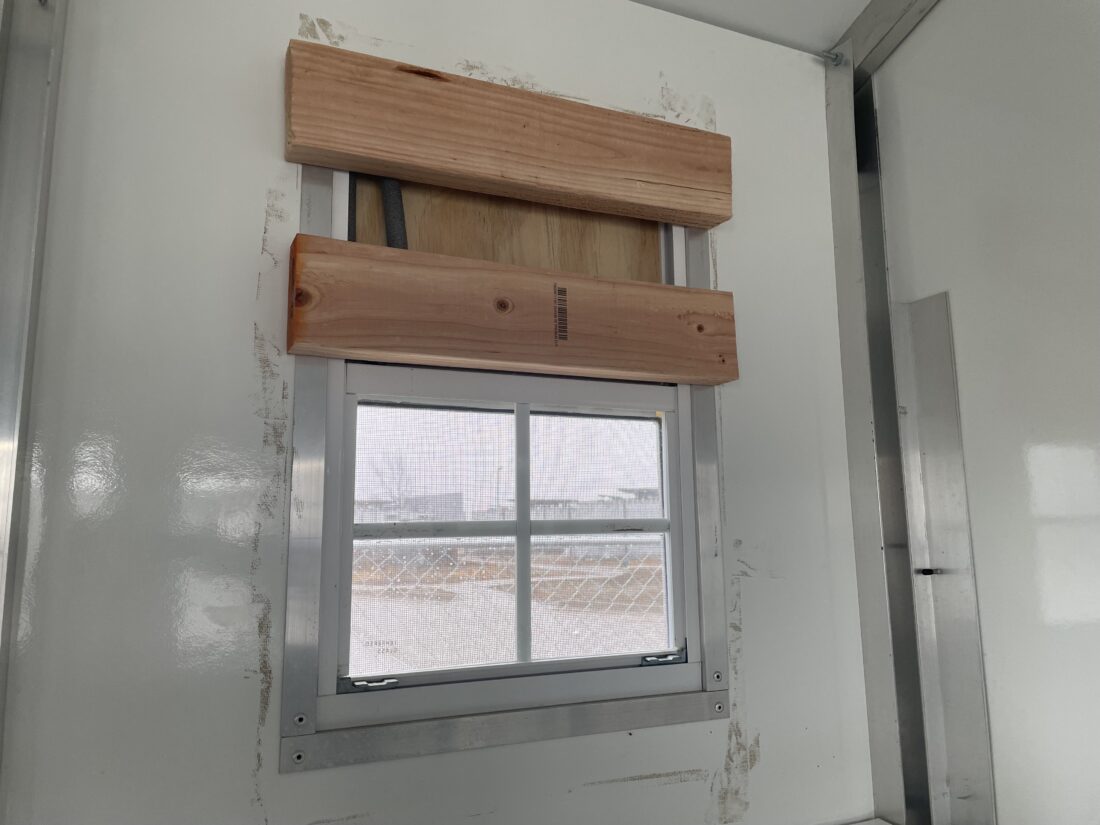
photo by: Sylas May/Journal-World
The window of a Pallet cabin is boarded up in the Lawrence Community Shelter’s Pallet 24 on Tuesday, March 3, 2026. Executive Director James Chiselom said a guest damaged it while trying to climb out of the cabin through the window.
Just outside of the Pallet 24 fence are the amnesty lockers. One time, Chiselom said, someone from outside of Douglas County spent 40 minutes at the lockers, breaking into each one of them.
“Those are the kind of people that we say, ‘How do we keep letting people do this and come here?'” Chiselom said. “I can’t break into the library, breaking lockers, and they let me come back.”
At the same time, Chiselom also wants to keep people in the shelter and avoid turning them out whenever possible. There was a time when guests who were caught with alcohol on the premises could get a 30-day ban, but now Chiselom says the response is to have them pour it out, and if they’re banned, it’s for just 24 hours.
When bans happen, it’s often because the staff has documented a guest’s behavior for a while, and the guest is only removed from the shelter when all other options for preventing that behavior have been exhausted.
“Trust me, our first thing to do is not to ask people not to be here,” Chiselom said. “That’s after we have no more alternatives.”
But there are times when the shelter knows immediately that someone can’t stay.
Chiselom has a photo saved on his phone that shows where the line is drawn. It’s of a deep red and black bruise on his upper arm and shoulder.
“I draw the line when somebody beats me so bad that that happens to me,” he said.
The guest who did that is one of the people who are permanently banned from the shelter, and Chiselom says that will happen if people attack shelter staff. “Anybody that’s physically assaulted staff cannot be here,” he said.
Chiselom isn’t mad at that man. He understands why the man struck him over and over and gave him that bruise: “When you don’t have any power, you take power wherever you can.”
“He had the power to say, ‘I’m not leaving.’ He had the power to physically assault me. He had that power,” Chiselom said. “But it’s not because he was in his right mind about anything.”
“If that happens, and they ask us why we want to exit people forever? Because that! Somebody that will do that, you know they’re able to do at least that next time.”
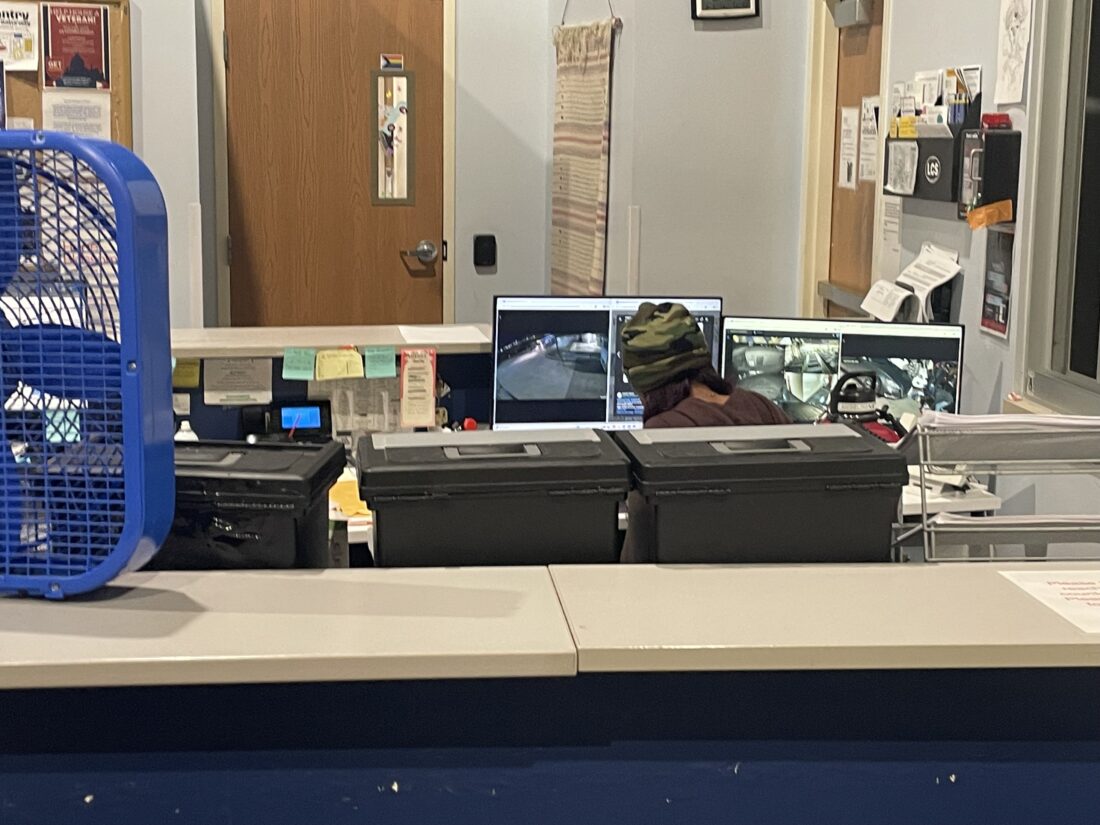
photo by: Sylas May/Journal-World
A staff member watches the cameras before intake begins at the Lawrence Community Shelter on Thursday, March 5, 2026.
Noticing problems
The staff can’t be everywhere at once, Chiselom said, but the campus is equipped with cameras that they can monitor from the front desk and the office of Pallet 24. Chiselom tells his employees that “the cameras are another staff. They help support what we’re doing.”
He says it shouldn’t be a shock that the shelter uses cameras. “Everybody has cameras!” he says.
The cameras can’t do everything. Chiselom said they’re not good at preventing crime on their own, but they do “let you know what happened.”
“I don’t prevent crimes with that,” he said. “I say there’s a crime being committed.”
There often aren’t foolproof ways to prevent crime from happening in a setting like the shelter. For instance, Chiselom said, there’s no 100% effective way to prevent sexual assault. While male and female guests sleep in separate rooms and even check into the facility in different places, he says “nobody’s safe from sexual assault if somebody’s intent on assaulting them.”
“But what we are are vigilant to observe a situation,” Chiselom said. “And it’s not based on the person, it’s based on situations where we’re starting to notice things that are cause for concern.”
The cameras help with that, and sometimes people’s history helps as well. If a violent incident has happened before at the shelter between two guests, for instance, staff will try to keep them separated in future visits and not house them near each other.
But that’s only based on their history at the shelter itself, Chiselom said. “That’s the qualifying factor.”
Other criminal history, such as being on a sex offender or violent offender registry, doesn’t trigger any special procedures, at least at the shelter’s facility on East 25th Street.
“We’re low-barrier, and (being on an offender registry) doesn’t exclude people from receiving services at the main campus,” Chiselom said. It does, however, mean they’re not eligible for programs at The Village, the community of Pallet cabins on North Michigan Street.
Overall, Chiselom said, he worries more about what’s happening right now than what might have happened in a guest’s past.
“We get a lot of information from people about things guests say, or what happens when they’re not here,” Chiselom says. “And we do take all of that seriously, and we start paying more attention based on what we’re hearing is current instead of what the past was.”

photo by: Sylas May/Journal-World
An easily accessible walk-in shower has been installed at the Lawrence Community Shelter in place of a bathtub.
A step up
Walking around the shelter, you can see improvements beyond just the Pallet 24 site. There’s the media room with drop ceilings instead of the building’s usual guts, the fresh coats of paint on the walls, a bathroom with a new, more accessible shower instead of a tub.
And the shelter has more projects planned for the future, to give guests a better experience and to make its operations less reliant on tax dollars.
The project that Chiselom is most excited about is replacing the men’s beds with new types of bunks called “step-up” beds. These are modular pods of bunk beds, and you can get to the top level of bunks by climbing a few steps.
In the men’s congregate space, he points to the beds and the spaces in between them. “Imagine in this space right here, instead of having four beds, you could have eight where you didn’t have to walk up a ladder. And every space had a locker, a private space to plug your phone into, a lamp.”
“Maybe on the top you would see two people because of bunk space, but on the bottom you wouldn’t see anybody,” he said. “The only time somebody could see you is if they came on your side and looked in there.”
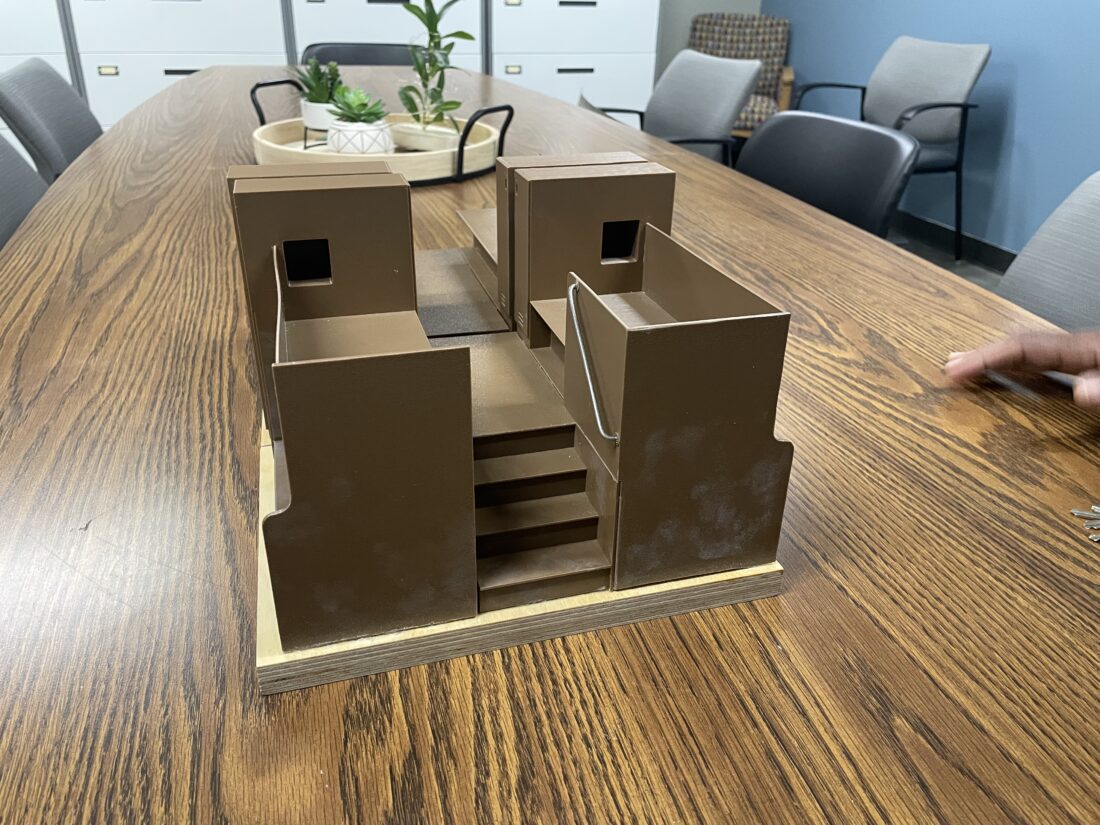
photo by: Sylas May/Journal-World
This model shows a pod of four “step-up” beds that the Lawrence Community Shelter intends to raise funds for.
These beds would appeal to the same kinds of guests that the Pallet cabins appeal to, those who just want a more private space to rest.
“That’s a game changer,” Chiselom said of the step-up beds. Each individual bed costs $2,000, so the shelter will have to find $100,000 to get the 50 beds that Chiselom wants.
The shelter’s other big projects have more to do with raising money than spending it.
The City of Lawrence is providing $3.15 million in funding for the shelter this year, and city leaders are pushing for it to become less reliant on government funds. Last year, the shelter held its first-ever fundraising gala, which raised about $83,000 after expenses, and Chiselom says another one is planned at the end of this year.
In the nearer term, the shelter will be reaching out to corporations’ philanthropic arms and putting together a campaign to seek donations for the step-up beds. Chiselom also wants new campaigns to engage both existing and prospective donors.
“We’ve been monetized on Facebook,” he says, “… so we’re going to do a lot of Facebook campaigns.” He also plans to work with mentors and take classes to develop his fundraising skills even more.
Much of the help the shelter is looking for isn’t monetary at all, but rather in-kind donations that address specific needs. The shelter has a list of such items at lawrenceshelter.org/needslist, and people can drop off in-kind donations from 8 a.m. to 6 p.m. Monday through Friday.
What is clear to Chiselom right now is that the shelter can’t keep asking for funding the way it has been.
“Because we have a lot of funding that comes from the city in large amounts, I don’t believe it’s really appropriate to continue to ask the same people for money the same way,” he says. “I don’t want to ask for money without telling people specifically what I’m going to do with the money that we’re asking for now.”
That doesn’t mean that the money the shelter gets is going to waste, he emphasized.
“People say, ‘Well, you get a lot of money!'” Chiselom said. “And we spend every dollar on this place and the things we do.”

photo by: Sylas May/Journal-World
The “Hope Blossoming” tree in the Lawrence Community Shelter’s dining room is pictured on Tuesday, March 3, 2026. Guests can make flowers whenever they want and add them to the tree to make it grow.
Hope blossoms
In the dining room, you can see one more new feature of the shelter: a big picture of a cherry tree on the wall.
It’s called “Hope Blossoming,” and it was made for the shelter by an artist named Ayomi Yoshida. At first, the tree had no flowers on it, but the guests can make new ones and add them to the tree whenever they like. An explanation of the piece is mounted nearby and says the flowers represent emotions and themes the guests experience: things like “happiness, anger, friends, family or hope.”
Gradually, Chiselom said, they’ll continue to cover the branches in blooms “to actually make the tree grow.”
On Thursday night, across the room from the tree, a few volunteers are getting ready to serve dinner. Tonight, it’s chicken, Mexican rice and refried beans. It’s a long way from Chiselom’s experience in 2024, when he said shelter staff was making meals with whatever happened to be on the shelves.
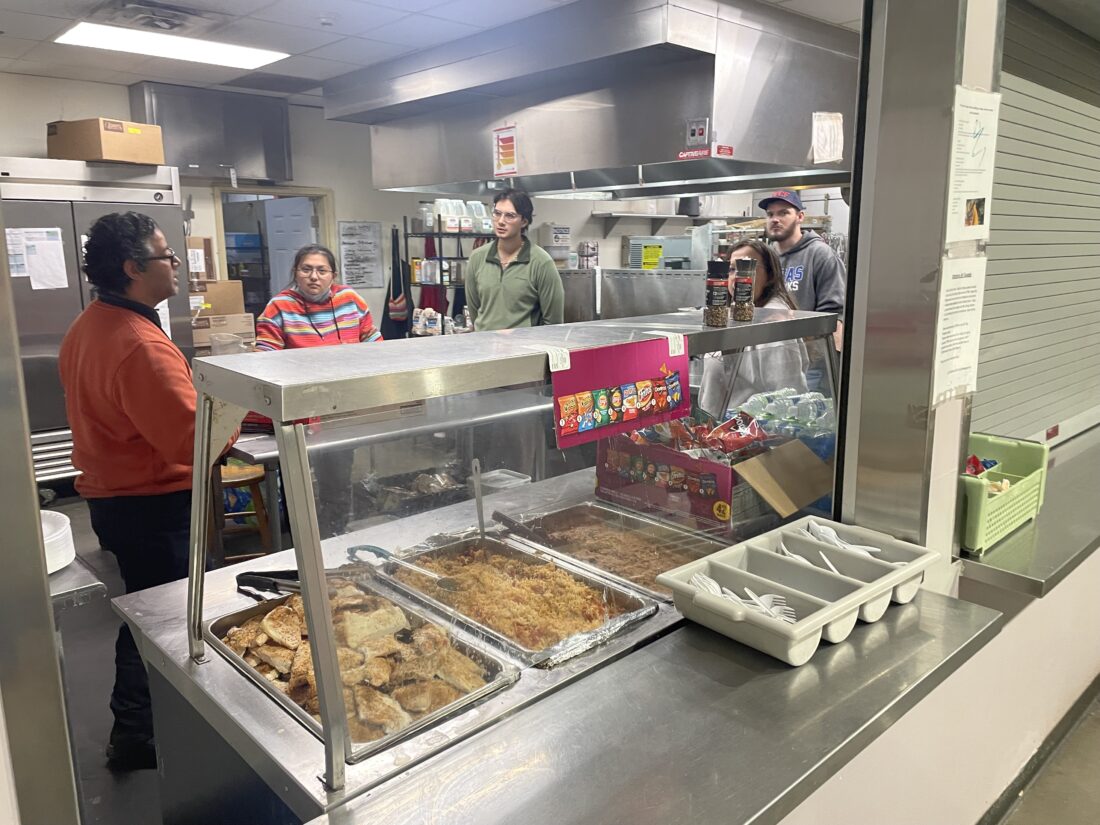
photo by: Sylas May/Journal-World
Ruben Medina, left, speaks to volunteers before intake begins at the Lawrence Community Shelter on Thursday, March 5, 2026.
Ruben Medina, the shelter’s volunteer coordinator, gives the kitchen volunteers a pep talk. He asks them about what the “why” is in their volunteer work, and tells them the “fundamental goal of community health – always start with the people.”
He tells the Journal-World that empathy is important, and that if you haven’t lived in homelessness, “it’s hard to imagine the journey it takes to get out.”
In the past couple of years, Medina says, the shelter has improved by “leaps and bounds.”
A while back, an unhoused woman from outside the county was passing through and stopped at the shelter. “This one’s an angel,” Chiselom says of her. During her stay, the facility made an impression on her: “She was in tears telling me how wonderful this shelter was compared to places she’s been.”
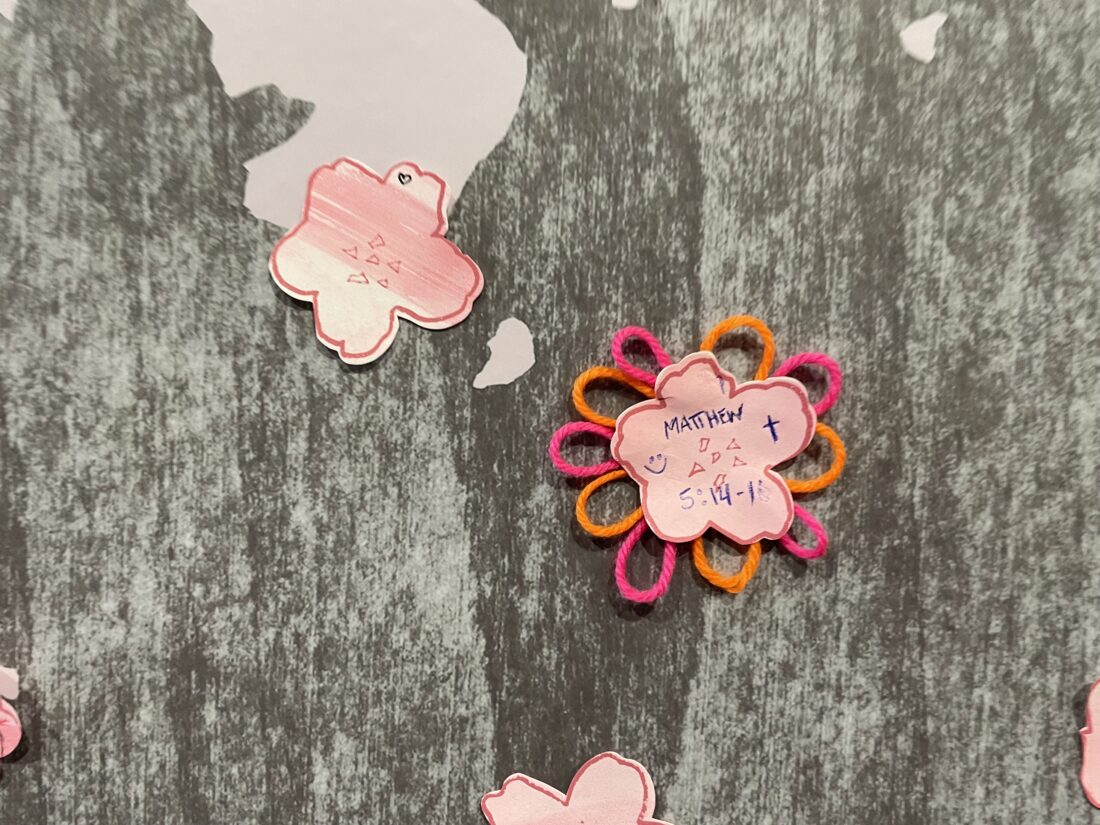
photo by: Sylas May/Journal-World
On the Lawrence Community Shelter’s “Hope Blossoming” tree, a guest passing through left this flower with a Bible verse.
She made a flower for the tree. She decorated it with pink and orange yarn and a citation from the Bible: Matthew 5:14-16.
Those verses read: “You are the light of the world. A town built on a hill cannot be hidden. Neither do people light a lamp and put it under a bowl. Instead they put it on its stand, and it gives light to everyone in the house. In the same way, let your light shine before others, that they may see your good deeds and glorify your Father in heaven.”
If more people could see the shelter’s light, that would make a big difference to Chiselom. He wants people to know that the shelter has changed.
“It’s like the iceberg,” he says. “What you see on top is not a reflection of what’s under the sea. And this was a big old iceberg. There’s a lot under the surface that has to be, not explained, but we have to give people time for what they see to heal that. I can tell you that has changed, but people need to see that with their own eyes.”
If you want to see it yourself, the shelter accepts applications for volunteers online – you can find more information at lawrenceshelter.org/volunteer. And Chiselom says he encourages the public to reach out to him with any questions they might have.
“If anybody wants to know what we’re doing, ask us,” he said. “Come see.”

photo by: Sylas May/Journal-World
Colorful drawings decorate a table outside of the Lawrence Community Shelter on Tuesday, March 3, 2026.
City Government
Lawrence City Commission to weigh whether Costco should be included in STAR bond district
As they approve bikes plan, Lawrence city leaders ask about data collection, Kentucky and Tennessee streets
Lawrence city leaders want to toughen tobacco licensing rules ‘sooner than later’
Algerian government invites Mayor Brad Finkeldei, Lawrence delegation for a visit
Construction on Wakarusa Drive to resume; city manager says KDOT’s secretary has apologized for delay