KU professor hopes ‘average places’ postcard project helps people connect to Langston Hughes’ Lawrence upbringing
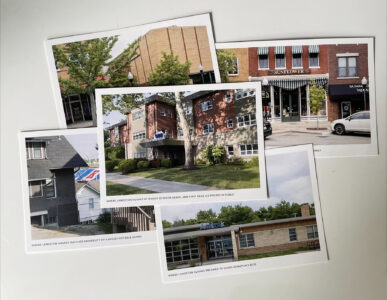
photo by: Contributed
Some of the postcards that make up a collection that celebrates key places in Langston Hughes' childhood in Lawrence are seen here. The project was created by KU professors and local organizations to celebrate his 125th birthday and provide a better sense of history.
Reminders and symbols of Lawrence’s unique history can be seen all throughout the city, but other sites of historic significance are just average places you might walk past without batting an eye.
Tim Hossler, an associate professor of design at the University of Kansas, wanted to find a way to “unveil” the hidden history of one noteworthy Lawrencian: the legendary poet Langston Hughes. Though most famous for being a key figure of the Harlem Renaissance in New York City, Hughes spent his childhood in Lawrence, which influenced a lot of his later works.
Hossler and a group of other organizations including the Hall Center for the Humanities, Watkins Museum of History and KU’s Spencer Museum of Art helped put together a postcard set that details some of Hughes’ life in Lawrence to celebrate his 125th birthday in February of this year, with the postcards including pictures of the current location and contemporary photos from Hughes’ childhood. Some of the sites are still standing and familiar to Lawrence residents today, while others have drastically changed since Hughes’ time.
Hossler hopes that this type of project can help Hughes’ story feel less like abstract history by connecting it to physical places, and it can allow people to reflect on how the overall surroundings aren’t much different even as years pass.
“It is a chance to put yourself in Langston Hughes’ shoes,” Hossler said.
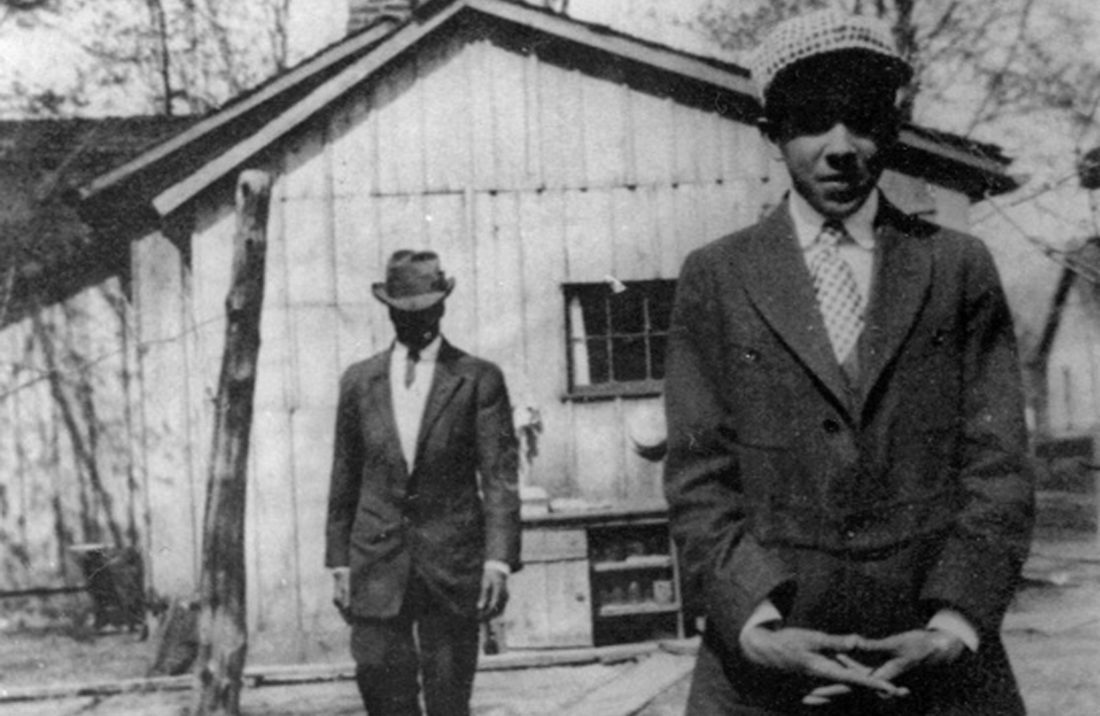
photo by: AP Photo
Langston Hughes, foreground, is shown in his boyhood hometown of Lawrence, circa 1914. Hughes left Lawrence a year later to live with his mother in Lincoln, Ill. He eventually moved to New York where he became the literary stalwart of the Harlem Renaissance cultural movement of the 1920s. The man in the background is unidentified. (AP Photo)
This project is part of a larger idea called the Average Places Project, which uses souvenirs to examine and document seemingly ordinary locations within cities where something historic has happened.
Hossler said he was first introduced to this concept when he went to graduate school at the Cranbrook Academy of Art in Bloomfield Hills, Michigan, a suburb of Detroit. During his studies, Hossler said he learned a lot about the history of the city and found out so many monumental things happened, but some of the historic value did not immediately pop out. By finding more information about average places with historical significance, Hossler realized he was cataloguing important parts of the city’s story.
“It’s like curating a history book,” Hossler said.
Hossler took that inspiration in Lawrence and combined forces with Emily Ryan, director of The Commons at KU, for the Hughes project. Ryan last year had done a similar project called as part of the Obscured Landmarks Initiative that highlighted several sites which showcased Lawrence’s rich history as a hub of Kansas’s abolitionist movement.
Both initiatives came together, with Ryan saying in a statement that Hossler’s project “brings profoundness to places that might otherwise seem completely ordinary.”
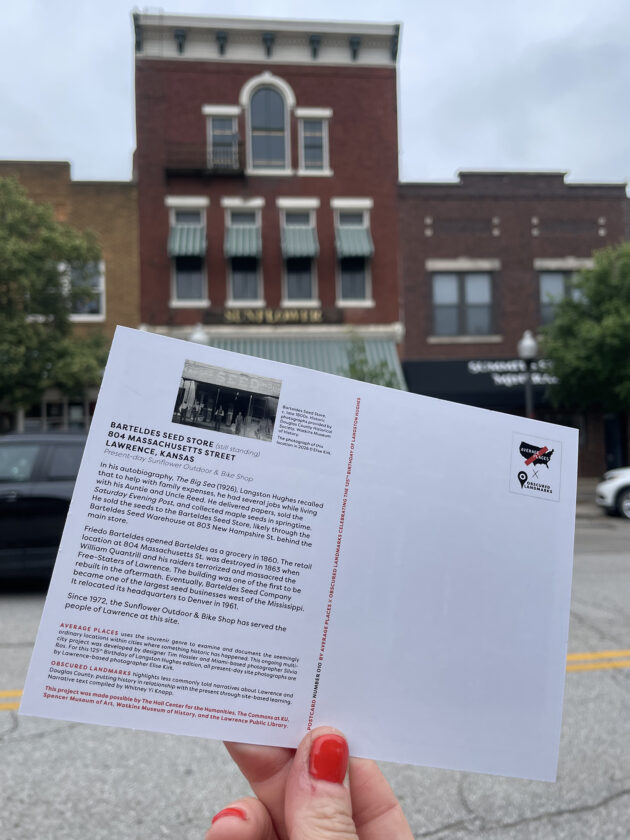
photo by: Contributed
A post card describes the history of the building on 804 Massachusetts St. The site — now the Sunflower Outdoor and Bike Shop — at one point was a seed store where famous poet Langston Hughes worked when he lived in Lawrence.
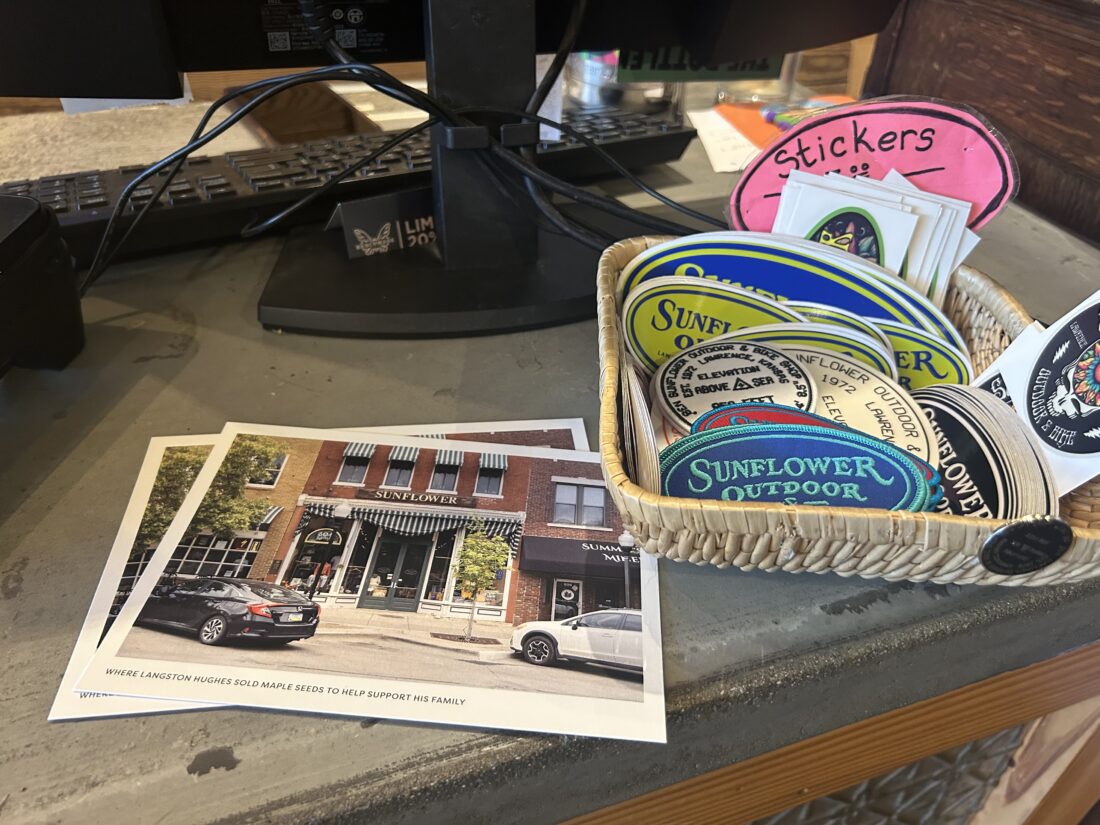
photo by: Bremen Keasey/Journal-World
A postcard detailing parts of Langston Hughes life in Lawrence is available to be picked up at Sunflower Outdoor and Bike Shop, 804 Massachusetts St. It is one of 10 postcards created as a celebration of Hughes’ 125th birthday.
While the initial spark for the project came from KU, Hossler said that other local organizations were “incredibly supportive and helpful.” The Watkins Museum in particular helped provide key research and the archival photos that appear on the back of the postcards which depict how each site looked during Hughes’ life.
Steve Nowak, the executive director of the Watkins Museum, told the Journal-World via email museum staff located the historic photos in its collection to paint the picture of each site in the 1900s. With the postcards now printed, Nowak said the museum is adding those cards temporarily to the section of the museum which explores Langston Hughes and the African American community in Lawrence. He also said the museum will have whole sets of postcards available, and it will produce a map to help visitors “locate and experience these historic places first-hand.”
Working with the museum helped direct the focus of what to depict, including finding ways to show what has changed in the city and what hasn’t. Hossler said the postcards include a mix of sites that currently stand like the Carnegie building at 200 W. Ninth St. Other postcards detail sites which have totally changed, like a former amusement park near Oak Hill Cemetery that now is just trees.
One thing that fascinated Hossler during the project was “the closeness of the locations.” Many of the postcards are located right near downtown Lawrence, but some are just a block away.
For example, Hughes attended seventh grade at Central School, which is on the current site of The 901 Building on 901 Kentucky St., and it was also where he first read poetry in public. The Carnegie building, which was the library at the time and where Hughes grew to love literature, is just feet away. Hossler said he had no idea how close those were, but it made it easier to picture how Hughes might have spent his days after class.
“I was thinking in my mind how easy it would have been to walk over there after school,” Hossler said. “He could’ve taken the same walk I can take now.”
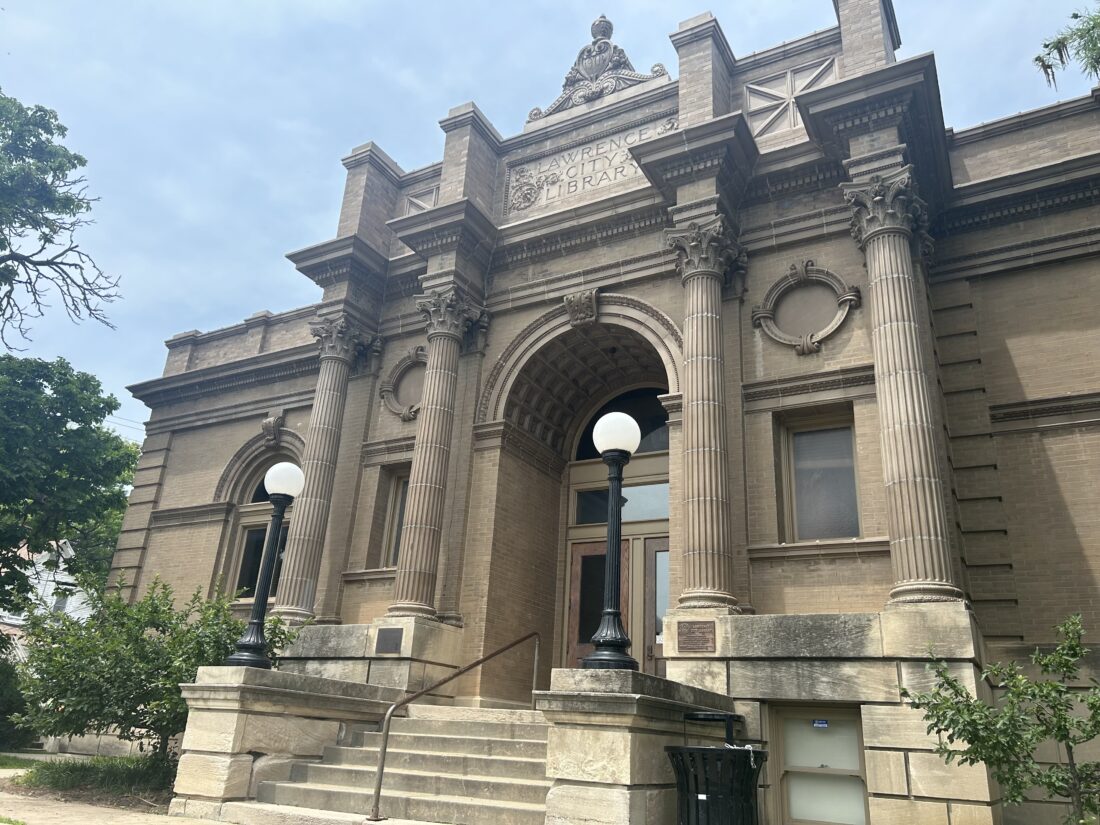
photo by: Bremen Keasey/Journal-World
The Carnegie Building in downtown Lawrence, located at 200 W. Ninth St.
While many of the sites have stayed the same — like the church still standing at 900 New York St. and the aforementioned Carnegie building — other unchanged sites showcase how things have changed in other ways. Modern day Liberty Hall, 644 Massachusetts St., used to be the Bowersock Opera House. Hughes would “frequent the opera house,” according to the project, but he could only sit in the balcony because it was segregated.
Hossler said that fact is one of the “strange, sad things” about Lawrence he found in the project. In a city founded by abolitionists with the goal of ensuring Kansas would become a free state in the 1850s, decades later some venues would institute policies of segregation. Another post card details the former Patee Theatre on Massachusetts Street, which is now an alley between New Hampshire and Mass. Street. Hughes wrote later he would go to see movies there as a kid, but one day, the owner put up a sign that said “No Colored Admitted.”
Hossler said using the places as a guide to telling Hughes’ story helps him seem less like a famous name and more like an everyday person. That can provide a window into what life was like for him, but also any young Black kid in the 1900s.
“You can think about what Lawrence was like and how it could’ve affected him. It makes it more real,” Hossler said.
Although Hughes went on to fame in New York City, Nowak said one thing that surprised him about Hughes is how much his childhood in Lawrence made an impact. While it was a “relatively short time,” that time really shines in his work.
“Some of his most formative experiences, things that stayed with him for the rest of his life, happened here in Lawrence,” Nowak said.
Hossler hopes that more people can learn about how those years in Lawrence impacted the life of Hughes and his work. The whole packs of postcards are free and are available to pick up at the Watkins Museum and the Lawrence Public Library. Hossler also said that some of the sites also have individual cards available.

photo by: AP
This March 26, 1953, file photo shows poet and author Langston Hughes speaking before the House Un-American Activities Committee in Washington, D.C.
KU
KU professors, middle school band director, radio personality among this year’s Phoenix Award honorees: ‘It’s a cool mix’
Hilltop childcare center has been losing money for at least two years, records show
Turnstile rocks KU campus as Day on the Hill returns after two-decade absence
UPDATE: Closure of Hilltop childcare center is final, but the building seems likely to stay
KU to lead national effort to address special education needs and tackle industry’s pressing concerns