A memorial unites Iranian students at KU as they grieve civil-rights protesters killed by Iran’s dictatorship
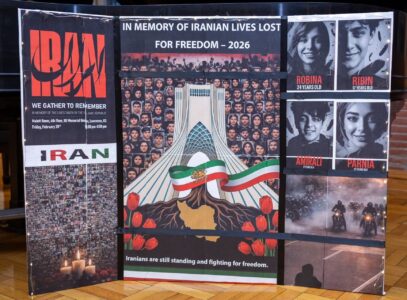
photo by: Contributed
Iranian students at KU, with assistance from International Student Services, created a memorial Friday, Feb. 20, 2026, at the Kansas Union to honor victims of the Islamic Republic's latest crackdown.
When the Iranian government shut down the Internet last month, dozens of Iranian students at the University of Kansas lost their means of connecting with family and friends. They attended classes and lived their “Lawrence lives,” worried sick about loved ones who might be affected by the regime’s brutal crackdown on civil-rights protesters.
“It’s a very heavy time when your mind, your heart, is in another part of the world, and your body is here,” a KU student who uses the name Yasna, instead of her real name, to protect herself and her family.
Yasna, from Isfahan, Iran’s third-largest city, said the historic communications blackout was meant to cover up state-sponsored violence, including torture and executions, and to prevent people from connecting and organizing.
When communications were partially restored, students saw their worst fears realized.
“When the internet came back, we were bombarded with the videos of people who were killed during the protests,” she told the Journal-World. “Each one of us had someone. Each one of us was close to someone who lost their life.”
The Iranian government has acknowledged more than 3,000 people have been killed in the most recent protests, but many other organizations put the number well above 30,000. Thousands more are believed to be imprisoned in dire conditions and without any kind of due process.
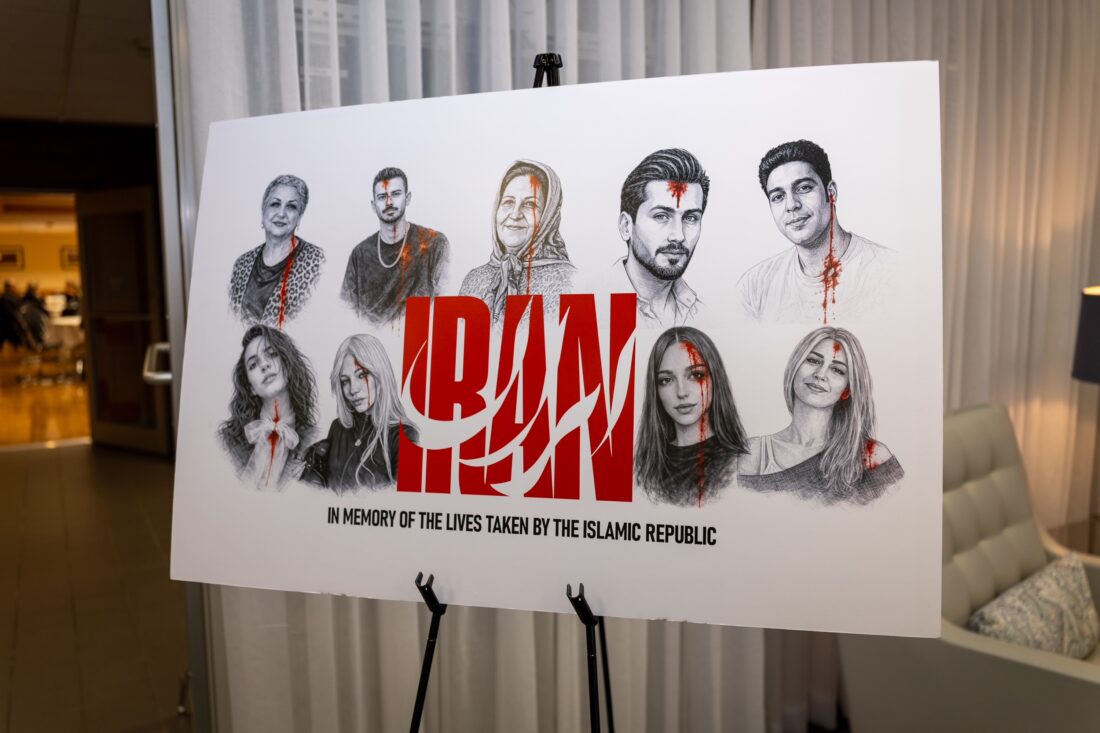
photo by: Contributed
Iranian students at KU, with assistance from International Student Services, created a memorial Friday, Feb. 20, 2026, at the Kansas Union to honor victims of the Islamic Republic’s latest crackdown.
On Friday, the students, with the help of KU’s International Student Services, erected a memorial in the Kansas Union with tributes to those killed. Yasna said the gathering of more than 100 people from Lawrence and surrounding areas was a comfort for so many who have felt little but fear and despair. The framed photos of the dead made people heartsick, but the opportunity to grieve together and support one another also gave rise to some hope that the losses wouldn’t be entirely in vain.
“Hope is the last thing we have,” a student who attended the memorial said. She also asked to remain anonymous for fear of reprisal when her visa expires and she is faced with returning to Tehran. “I guess I have to say I am hopeful. I try to stay positive.”
The current protests in Iran have been brewing for years. Four years ago, Iranian students at KU were similarly situated to today’s students. The theocratic government of Supreme Leader Ayatollah Ali Khamenei shut down all communications after the death of 22-year-old Mahsa Amini.
Amini, a woman from the Kurdistan Province of Iran, died on Sept. 16, 2022, in police custody after being arrested for the “moral crime” of not having her hair properly hidden. The official line is that she died of a heart attack, but it is widely believed that she was beaten to death by police.
Nothing in the government has changed since then, when the now-famous rallying cry was “Woman, Life, Freedom,” Yasna said, and “people are saying enough is enough. We want regime change.”
While the government remained unchanged, the people did not, she said. The sight of women removing their hijabs and defiantly dancing in the streets in the wake of Amini’s death made a lasting impression.
“Since then, people changed a lot,” Yasna said. “They changed a lot.”
When asked what they would like to see with regime change, both women — interviewed separately — gave nearly identical lists: democratic elections, a secular government that does not prefer one religion over another, freedom of thought and speech, equal rights for women and other marginalized groups.
“Iran is a very diverse country,” Yasna said, but the government doesn’t recognize that reality. “It’s a huge dictatorship” that is not even respected by many strict Muslims, who don’t see the so-called Islamic Republic as an even remotely true representation of Islam.
“Our people are just tired (of the oppression),” Yasna said.
International sanctions against Iran have also deeply impacted the economy, which has created widespread hardship on top of civil-rights abuses.
As President Donald Trump talks of potentially attacking Iran, the two students described that prospect as “complicated.” On the one hand, a targeted toppling of the 86-year-old Ali Khamenei, who has been in power for 37 years following the 1989 death of Ayatollah Ruhollah Khomeini, who founded the Islamic Republic, would be a welcome “rescue.” On the other hand, there are a lot of unknowns and fears about what a large-scale war could bring.
Iranians cannot bring about the government’s collapse on their own, Yasna said, while noting that she does not speak for anyone but herself.
“They need help,” she said. “They definitely need help.”
“But at the same time,” she said, “when it comes to war, the question is what are we talking about? If it is a case of ordinary people being killed, definitely we don’t want it. If the war is something that is going to destroy the beautiful parts of our country, we don’t want it. But if it is something that just targets the leader of Iran, we definitely want it.”
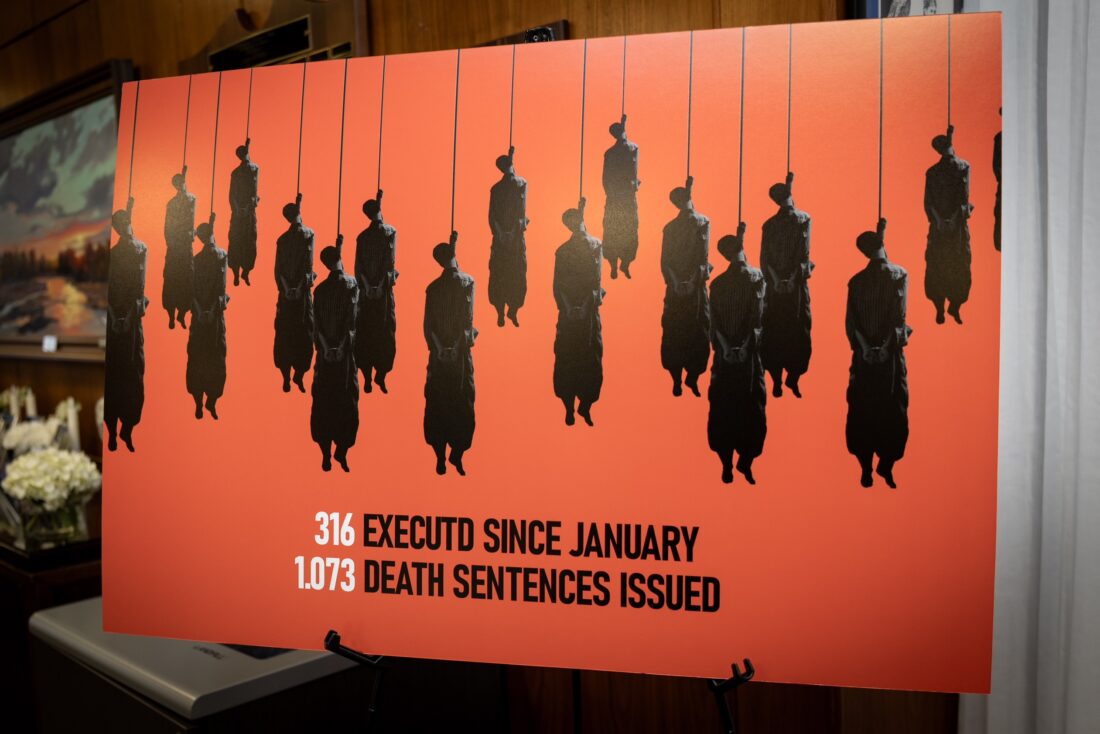
photo by: Contributed
Iranian students at KU, with assistance from International Student Services, created a memorial Friday, Feb. 20, 2026, at the Kansas Union to honor victims of the Islamic Republic’s latest crackdown.
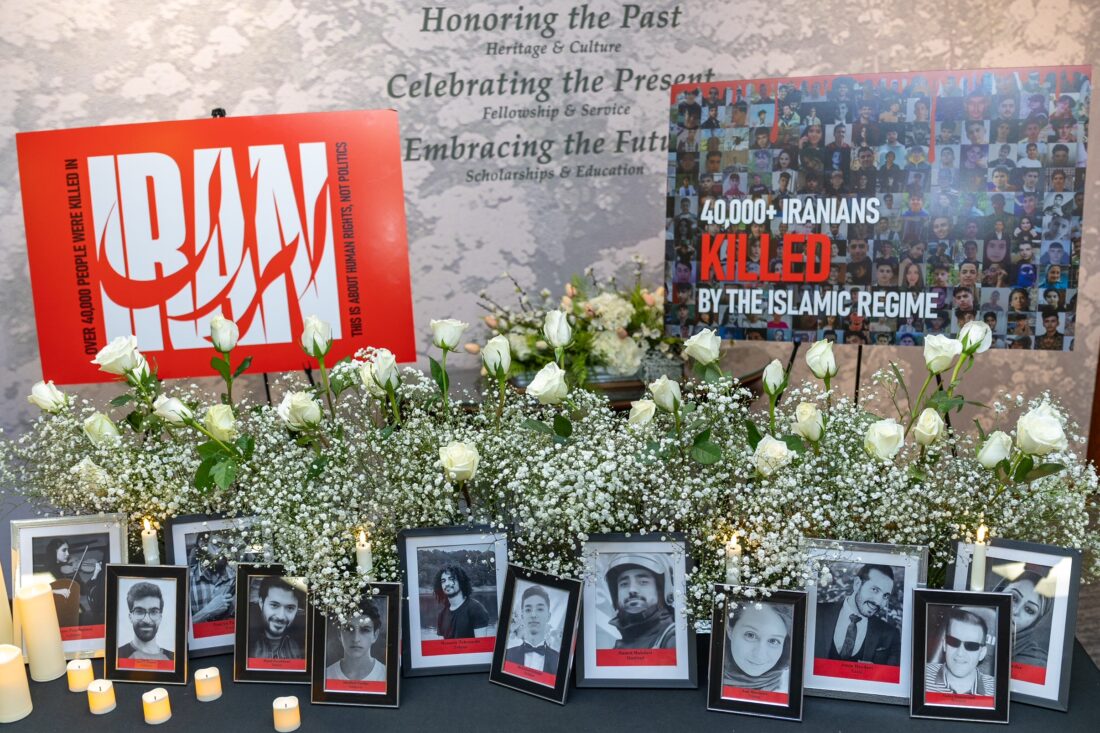
photo by: Contributed
Iranian students at KU, with assistance from International Student Services, gathered for a memorial Friday, Feb. 20, 2026, at the Kansas Union to honor victims of the Islamic Republic’s latest crackdown.
KU
A memorial unites Iranian students at KU as they grieve civil-rights protesters killed by Iran’s dictatorship

Expect bowling, a scavenger hunt, casino games and more as KU’s Kansas Union celebrates its 100th anniversary this year
After 43 years across Kansas airwaves, Darrell Brogdon reflects on his career ahead of his retirement

KU’s Physics and Astronomy department hosting ‘Pluto Day’ event, celebrating science of space and the dwarf planet’s KU connection
KU names dean of College of Liberal Arts and Sciences as university’s next provost; promotes from within to fill Liberal Arts dean