Two special exhibitions opening Thursday at Spencer Museum of Art to highlight contemporary Japanese and Asian-American art
Event marks the first time all three artists have shown together in the U.S.
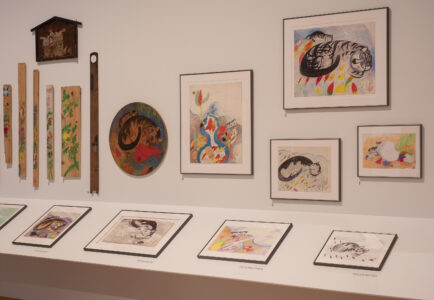
photo by: Contributed/Ryan Waggoner, Spencer Museum of Art, University of Kansas
Some of the works of Japanese-American artist Jimmy Tsutomu Mirikitani are seen on display for the special exhibition “Street Nihonga: The Art of Jimmy Tsutomu Mirikitani” at the Spencer Museum of Art.
The Spencer Museum of Art will open two special exhibitions Thursday that will showcase the diversity and richness in Japanese and Asian American art.
The two special exhibitions — “Street Nihonga: The Art of Jimmy Tsutomu Mirikitani” and “Brush, Block, and Blood: Three Generations of Yoshida Women Printmakers” — will feature works from artists that innovated unique styles based on traditional Japanese artistic traditions.
The “Street Nihonga” exhibition, which is co-curated by Maki Kaneko, KU associate professor of Japanese art and Kris Ercums, Spencer Museum Curator of Global Contemporary and Asian Art, is the “largest assembly of works to date” of Japanese-American artist Jimmy Tsutomu Mirikitani, according to a press release.
Mirikitani was born in the United States in 1920 but raised in Hiroshima, where he was trained in a Japanese painting style called Nihonga. He returned to the U.S. in 1940, where he endured incarceration at Tule Lake during World War II and learned of his family and friend’s deaths in Hiroshima from the dropping of the atomic bomb. Mirikitani also survived periods of homelessness in New York City, and his art became a “survival strategy” and way to record his memories.
Kaneko said in a press release that with his art, Mirikitani used materials he found in New York’s streets, in the process “transform(ing) traditional Japanese painting techniques” and creating a new style, which Kaneko coined “Street Nihonga.” Kaneko, who had been researching his life since 2015, said she is glad to have worked with the Spencer “to bring this project, and Mirikitani’s art, to a wider audience.”
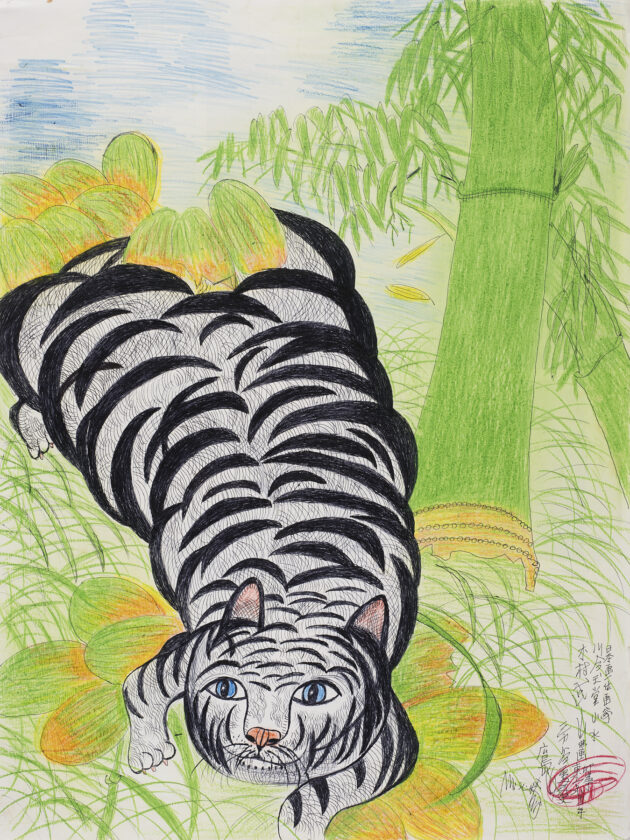
photo by: Contributed/Spencer Museum of Art
Jimmy Tsutomu Mirikitani, “untitled (white tiger cat with blue eyes, bamboo),” date unknown, Collection of Linda Hattendorf, Taos, New Mexico.
This is one of the works on display for the “Street Nihonga” special exhibition at the Spencer Museum of Art at KU.
Alongside the exhibition on Mirikitani, a specially commissioned video installation by Japanese artist Ayomi Yoshida titled “The River of Time” will be on view at the Spencer. The installation features video images of herself, her grandmother Fujio Yoshida and her mother Chizuko Yoshida overlaid on rippling water. The piece accompanies the other special exhibition — “Brush, Block, and Blood” — that features prints from all three of those artists that “trace more than a century of artistic innovation, intergenerational dialogue and the enduring power of women’s creativity,” according to the release.
The exhibition is the first time all three of those artists’ works are shown together in the United States, and Ercums said in the press release the exhibition will celebrate the three artist’s contributions that have “transformed the legacy of one of Japan’s most distinguished artistic lineages.”
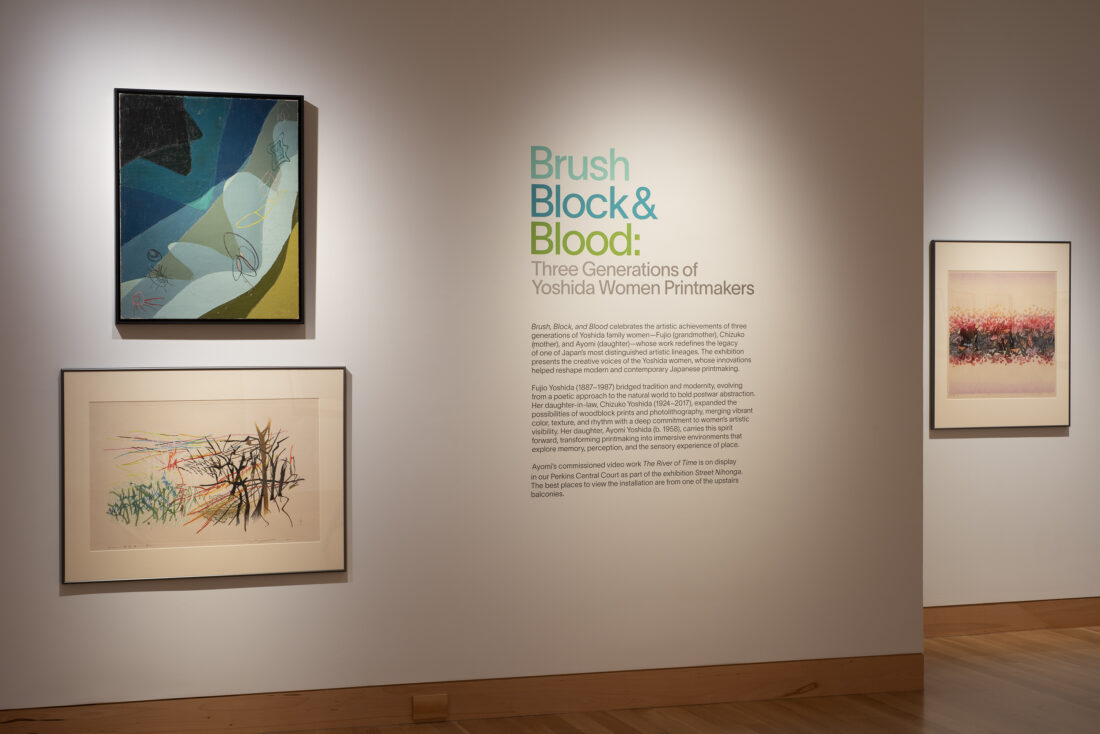
photo by: Contributed/Ryan Waggoner, Spencer Museum of Art, University of Kansas
Works on display that are part of the Spencer Museum of Art’s special exhibition entitled “Brush, Block, and Blood: Three Generations of Yoshida Women Printmakers.” The exhibition features the artistic innovations of a family of three Japanese printmakers.
Those two special exhibitions are joined by two smaller exhibitions featuring Japanese and Asian American contemporary art that draw from the Spencer’s collection. “Studio Nihonga” will highlight traditional Japanese painting methods to contrast the “improvisational and resourceful practices” from Mirikitani’s work. The other exhibition, “Form & Flux: Contemporary East Asian Ceramics,” explores how artists blend centuries-old traditions in ceramics to reimagine that form in ways that “that challenge conventional notions of pottery.”
Ercums said all the exhibitions on display throughout the spring will “demonstrate how contemporary Japanese and Asian American artists sustain cultural practices while pushing beyond conventional boundaries.”
“Street Nihonga,” “Brush, Block, and Blood” and “Studio Nihonga” will remain on view through June 28, while “Form & Flux” will remain on view into August 2026. A full program of related events can be found on the Spencer Museum’s website.
Arts and Entertainment
Go, See, Do: Dinosaur-themed pancake party, bookstore romance and more events
New tenants hope to revive historic Castle Tea Room as a wedding and event venue
45th annual Kansas State Fiddling and Picking Championships to feature Grammy winner Dom Flemons
‘Love Garage,’ a beloved photo spot near KU’s campus, gets a fresh new look
Go, See, Do: Vinland Fair, Lawrence Farmers Market celebration and more