

For area Indigenous women, ‘reproductive justice’ goes far beyond Roe
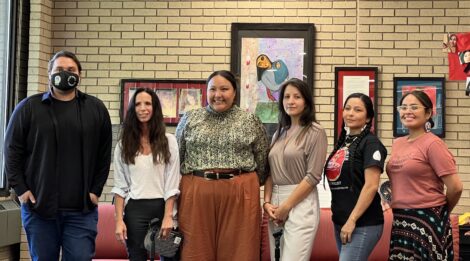
photo by: Tatum Goetting/Journal-World
Pictured from left: Robert Hicks Jr., Pyramid Lake Paiute Tribal member; D'Arlyn Bell, Cherokee Nation Tribal citizen; Kansas Rep. Christina Haswood, Diné; Chloe Gunville, Cheyenne River Sioux Tribal citizen; Monique Mercurio of the Navajo people and the Ohlone Costanoan Nations; and Sierra Two Bulls, an Oglala Lakota (Sioux) citizen at Tommaney Library at Haskell Indian Nations University on Thursday, June 30, 2022.
In the wake of Dobbs v. Jackson, the U.S. Supreme Court decision that recently overturned Roe v. Wade, area Indigenous women are having conversations about “reproductive justice” that go far beyond the right to abortion.
One such conversation occurred Thursday at Tommaney Library at Haskell Indian Nations University. The discussion, which was also livestreamed on the Indigenous Community Center’s Facebook page, was intended to inform people not only about the consequences that Indigenous people could soon face, but also about the historic assaults on their bodily autonomy.
Seven panelists hosted the forum: Kansas House Rep. Christina Haswood, Diné; Robert Hicks Jr., Pyramid Lake Paiute Tribal member; D’Arlyn Bell, Cherokee Nation Tribal citizen; Wyomee Cooke, of the Red Running into the Water Clan; Sarah Deer, citizen of Muscogee (Creek) Nation of Oklahoma; Monique Mercurio of the Navajo people and Ohlone Costanoan Nations; and Chloe Gunville, Cheyenne River Sioux Tribal citizen. Sierra Two Bulls, an Oglala Lakota (Sioux) citizen, moderated the panel.
The panelists discussed topics ranging from abortion access for Indigenous people to the foster care system.
“When we talk about reproductive justice in Indian Country, it’s a much bigger picture than abortion,” said Deer, a lawyer and professor at the University of Kansas. “The sterilization abuse that we know about that happened in the 1960s and ’70s means that many women who wanted children couldn’t have them. So for us, reproductive justice isn’t just about abortion but the right to have children and raise children.”
Between 1973 and 1976, the Indian Health Service regions sterilized 3,409 Native women without their permission. The U.S. General Accounting Office found that 36 women under the age of 21 were sterilized during this period.
Deer co-authored an amicus brief in the Dobbs case. The brief was filed on behalf of Native birthing peoples to provide the Supreme Court with written arguments about how overturning Roe v. Wade would harm Native women, girls and birthing people.
“Many people who lead pro-abortion work have no idea what Native people have been through,” Deer said. “[They] think that their rhetoric is applicable to us. Understanding the history is really important.”
Since the overturning of Roe v. Wade, tribal lands have come up in conversations on social media as potential safe havens for those seeking abortions and abortion clinics.
“[Pro-choice people] are suggesting that somehow tribal lands are going to be their loophole,” Deer said. “It is absolutely disrespectful and ignorant.”
Access to abortion has already been difficult for Indigenous women because of the Hyde Amendment, which banned the use of federal money for abortion care. This means Indian Health Service clinics, where many Indigenous people go for medical care, are banned from performing abortions except in certain circumstances.
The Hyde Amendment impacted Indigenous communities’ access to abortion by forcing Indigenous people to drive hundreds of miles to access the care they needed.
“That’s reality,” Hicks said. “Indigenous people’s lives are at risk. This is something that is much deeper than people realize.”
Deer said she had an abortion at 19 years old after her birth control failed and she got pregnant. She said if she had a baby at that age, it would have completely changed her life.
“If I had a baby at 19, it would have completely limited my capacity to be the best person I can be,” Deer said. “I have no shame that I had an abortion.”
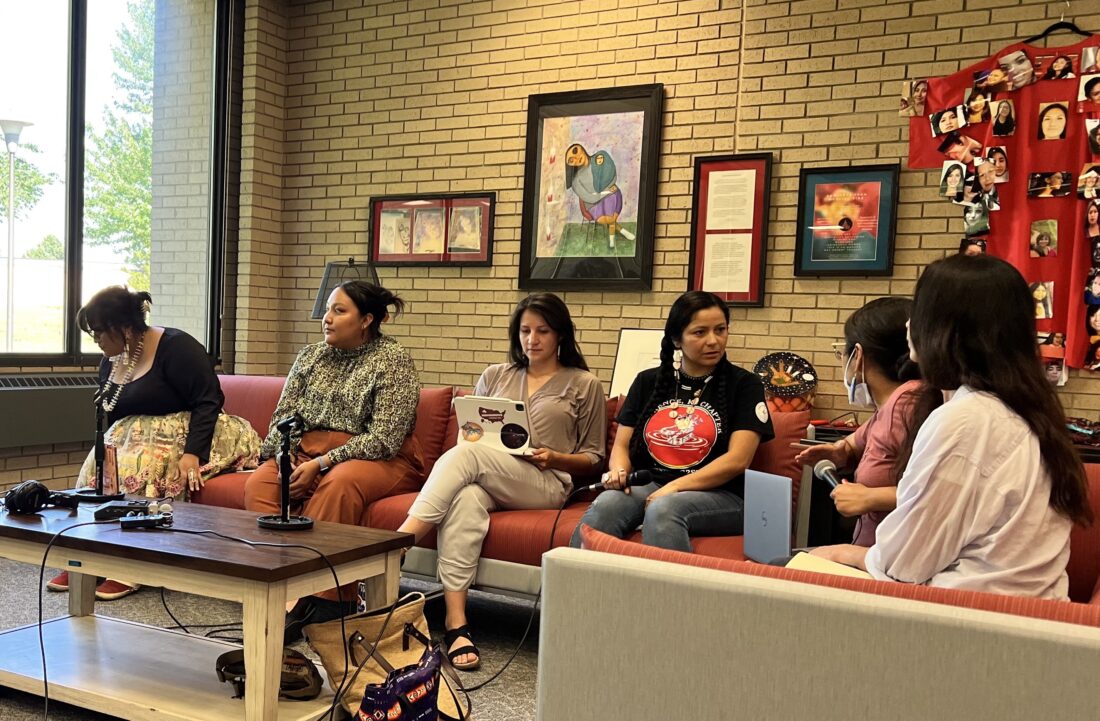
photo by: Tatum Goetting/Journal-World
The Indigenous Community Center hosted a panel discussion on reproductive rights relating to the Indigenous community at Tommaney Library on the Haskell Indian Nations University campus Thursday, June 30, 2022.
Indigenous people have a long history related to abortion and reproductive care. Mercurio said that even before colonizers came to America, tribes used natural remedies to naturally abort fetuses. Abortion was also seen as a ceremony.
Even though they did not have abortions, Haswood and Two Bulls said they benefitted from emergency contraceptives while they were in college.
“The power of choice was always a comforting feeling,” Haswood said. “With that being seen now as a privilege, it’s really devastating.”
Abortion bans are now in effect in multiple states, though several of those are being contested, and the procedure will likely become illegal in the coming weeks in many others.
Right now, abortion remains legal in Kansas. Generally, abortions are prohibited in the state after 22 weeks, except in cases of life or health endangerment.
In August, Kansas voters will vote on a measure that would amend the Kansas Constitution to state that nothing in the constitution creates a right to abortion or requires government funding for abortion and that the state Legislature has the authority to pass laws regarding abortion.
The Aug. 2 primary will be the first post-Roe abortion vote in the United States.
The deadline to register to vote for the August primary is July 12. Kansans can go to kdor.ks.gov/apps/voterreg and can check registration status at myvoteinfo.voteks.org.
Other News
Documentary exploring the barriers facing mothers to screen next month followed by community discussion
Douglas County commissioners seek path to recover $2.4M awarded to abandoned Bert Nash supportive housing project
De Soto residents may get a nearly $50M recreation center without a tax increase, but it will take dollars from lots of data centers
Opinion: With new president in place, now is the time for Lawrence to invest in Haskell Indian Nations University
Douglas County commissioners to review new financial policies, including changes to reserve fund rules
