

This weekend is likely your last chance to get that sunflower photo at local farms
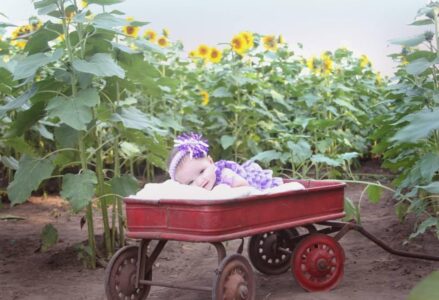
photo by: Kristy Wempe-Bellinger
Kennisyn Bellinger, shown here in 2014, is photographed every year by her mom, Kristy Wempe-Bellinger, at Hunsinger’s Sunflower Patch.
Kristy Wempe-Bellinger has been taking her daughter Kennisyn, now 8, to Hunsinger’s Sunflower Patch annually since infancy. She takes a photo every year, and when she looks at the pictures, she’s struck by how fast her daughter’s childhood has flitted by.
“I have used the sunflowers to showcase her growth,” Wempe-Bellinger says. “My parents instilled lots of family traditions and documented it with pictures of us kids that we go back and look at and see how much we’ve changed. It was important to me to continue those family traditions with my daughter and showcase and support local agriculture.”
George Hunsinger and his wife, Cheryl Hunsinger, of Hunsinger Sunflower Patch, 922 East 1450 Road, planted a sunflower crop for the first time seven years ago.
“We just started doing it as kind of a hobby,” George says. “I plant them about the middle of June. They do have a small window on the pretty bloom. About 10 days — that’s about it.”
Though the sunflowers have already seen their best days, there’s still time to eke out a last-minute sunflower photo over the weekend.
Kris and Ted Grinter, of Grinter Farms, 24154 Stillwell Road, anticipate a crowd at their sunflower field this weekend — especially in the wake of a “Good Morning America” segment that featured their iconic Kansas farm.
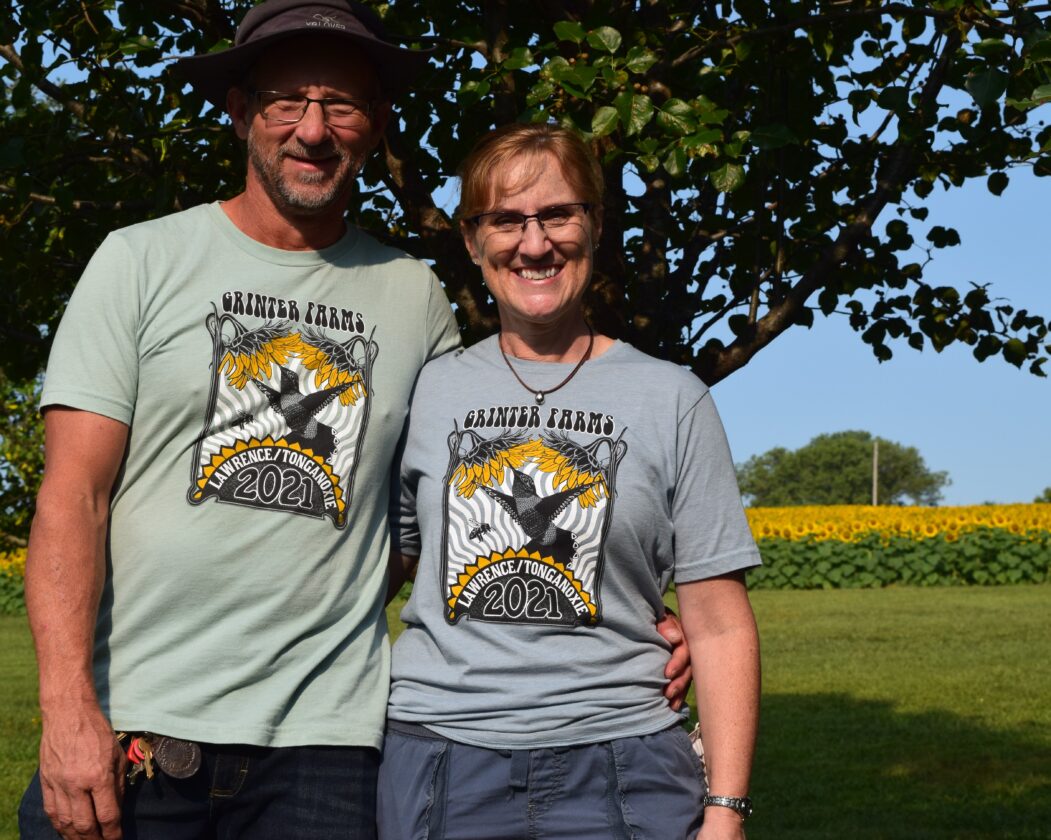
photo by: Chansi Long
Kris and Ted Grinter stand in front of their sunflower farm after being featured on “Good Morning America” Thursday, Sept. 9, 2021.
“It will probably be really busy this coming weekend, Kris says. “Sunflowers only bloom for about two weeks, and they’ve already been open for more than a week. They still look OK now. Probably in another week they’ll look really sad, bug-chewed and dry.”
Ted plants the sunflowers in mid-July.
“They grow quick,” he says. “They’re already blooming and starting to go downhill. They’re getting mature. You get about two weeks of pretty and the rest is getting ugly.”
Ted uses a 16-row planter to plant the seeds.
“In a perfect world — if everything goes well — it takes an afternoon,” he says.
The Grinters’ sunflower farm has been a Kansas feature for decades.
“During the OPEC oil crunch of the ’70s, the price of oil went up 300%, and to a farmer that is a big deal,” Kris says. “So Ted’s dad thought ‘if I had sunflower oil, I could just filter it a little bit and pour it right directly into the machine, and run off of that.'”
To use sunflower oil as machine fuel, Ted’s dad would have had to convince several local farmers to plant sunflowers so they could attract a company with a crusher.
“He had to get enough farmers to woo a crusher to move a business out here. Every farmer said, ‘You’re crazy. I’m not doing it.’ So we still don’t have a (sunflower seed) crusher,” Kris says. “It was risky. But Ted and his dad tend to be a little crazy.”
The Grinters and the Hunsingers harvest the sunflowers in October, bagging them and selling them as birdseed. Last year, the Hunsingers’ sunflower crop didn’t come to fruition because of heavy rain. They tried to plant, but the soil was so wet that the seeds wouldn’t take, and their fields had standing water for weeks.
“The local bird people were mad last year because there wasn’t (any seed),” George says.
But this year the Hunsingers planted two crops, two weeks apart, and in a few weeks, they will all be gone. In the meantime, Wempe-Bellinger has a growing file of photos of her daughter in the field.
“It’s kind of difficult when taking pictures of kiddos to get them to stand and smile. … that’s not what they want to do, especially with these giant beautiful flowers,” Wempe-Bellinger says. “They want to smell them, they want to see the bugs. They want to play in the mud. And isn’t that what childhood is all about?”
Other News

Lawrence Music Alliance to sponsor live music acts ahead of select World Cup watch parties
11 Douglas County creatives to participate in pop-up market in Kansas City’s Union Station during World Cup

Over 100,000 Kansans yet to receive state tax refunds; Department of Revenue says staffing issues contribute to delays

Douglas County Commission candidates to take part in two forums ahead of the primary election

Event and free meal being offered in Lawrence to heighten awareness about veterans and suicide
