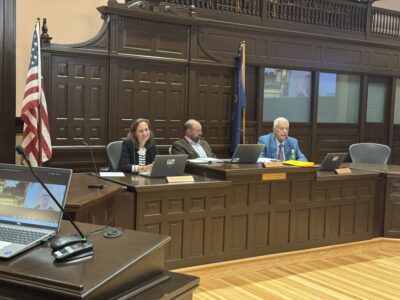
County commission gets first look at proposed school truancy program through criminal justice department
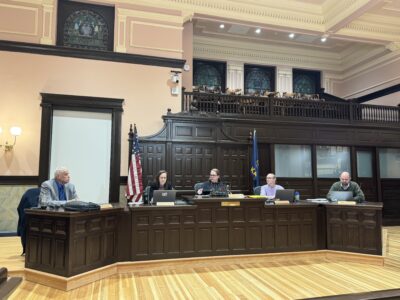
photo by: Josie Heimsoth/Journal-World
Douglas County commissioners met on Wednesday, Jan. 28, 2026.
Douglas County commissioners reviewed a proposed elementary and middle school truancy initiative set to launch as early as the 2026-2027 school year.
On Wednesday, county commissioners heard from the Douglas County Criminal Justice Services department during a work session to review “EveryDay Counts,” the proposed K-8 initiative designed to identify and address the root causes of chronic school absenteeism.
During the commissioners’ 2026 budget process, commissioners expressed an interest in transitioning elementary and middle school truancy services, which is currently run by the Center for Supportive Communities, to the Criminal Justice Services – Youth Services division.
The truancy program from CJS is designed to address truancy early, support families, and limit court involvement whenever possible. It follows Kansas truancy law and uses a three-tiered, graduated response, meaning students receive increasing levels of support only if earlier interventions are not successful.
“We want to reengage students,” Leigh Housman, assistant director of CJS Youth Programs, said. “We want to support the families and then we want to improve attendance outcomes. For starters, in reengaging students, it is getting that line of communication open with the family and the school district.”
Since 2023, the Center for Supportive Communities supported these services at a cost of $150,000 per year from the county. Commissioners approved a $62,500 consent item in December 2025 to allow CSC to continue services through the end of the 2025-2026 school year, leaving $87,500 available for the remainder of 2026. The proposed CJS program is estimated to cost $77,016 for fiscal year 2026 and $123,868 in fiscal year 2027.
The proposed program operates using a tiered model of support, with increasing levels of intervention based on the student’s level of attendance risk and family engagement.
Tier I focuses on universal prevention and early intervention. Staff will contact parents or guardians to explain the truancy process, identify barriers, and offer voluntary case management. Participating families agree to an attendance contract requiring eight consecutive weeks with no unexcused absences, and if the student attends without issues, the case closes.
Kate Holman, a juvenile services officer for CJS Youth Programs, said for the program they are partnering with Building Peace, an organization that partners with Douglas County’s court system not to offer legal advice, but mediation and/diversion when possible. This organization helps primarily with Tier II cases.
Tier II serves students at higher risk of chronic absenteeism through meetings with Building Peace’s facilitators. Using restorative practices, students, families, and school representatives identify root causes of truancy and develop a written attendance agreement, supported by ongoing monitoring and resource referrals.
Finally, Tier III involves court referral when Tier I or II requirements are not met or participation is declined. The District Attorney’s Office determines next steps, which may include juvenile court involvement and court-ordered attendance or services.
The next steps for “EveryDay Counts” include going before the County Commission for approval at a future date and to allocate the remaining funds that were set aside in 2026 to fund the launch of the program. If approved, CJS staff are planning to hire an additional juvenile services officer in the summer 2026, identify data to be collected and establish a “School Engagement Plan.”
IN OTHER BUSINESS, COMMISSIONERS:
• Received a presentation from county staff and consulting firm Clarion Associates regarding its review of the county’s zoning and land use regulations to see how they can be improved. The comprehensive review will include two chapters in the county code – Chapter 11, Subdivision Regulations, and Chapter 12, Zoning and Planning. No votes or formal action was taken following the presentation, as it was for informational purposes only.
The actual diagnostic review will be conducted from March through May, and it will detail strengths and weaknesses of the existing land use regulations and identify recommendations for future ordinance updates, as the Journal-World reported. County staff will provide feedback on the review, and the project team will resolve any open issues and prepare a public draft to discuss at work sessions with the Lawrence-Douglas County Planning Commission and Douglas County Commission.
• Authorized the county administrator to bind insurance coverage with Travelers for general property and liability insurance coverage in an amount not to exceed $1,055,161. Current insurance coverage will expire on Feb. 1 and a renewal package has been proposed to continue coverage across multiple risk areas, including general liability, law enforcement liability, employment practices liability, public entity liability, property, auto, crime, inland marine, and cyber insurance.
Insurance “exposures” – such as the number of employees, vehicles, and property values – affect premium costs, and several exposure increases are driving higher renewal rates this year. The auto and property lines are experiencing the most pressure due to increased exposures, multiple open claims, and significant past losses, including approximately $660,000 in fire and water damage claims from 2023 and several ongoing auto claims, according to a memo in the agenda.
• Authorized a letter of intent to participate in the 2027 Kansas Department of Health and Environment Division of Health Care Finance program, which will signal the county’s intent to provide at least $350,000 in funding for outreach, prevention, and early intervention services. These programs focus on identifying families with at-risk infants, providing intensive and long-term home visitation, promoting healthy child development and parent-infant bonding, and connecting families to medical care and essential community resources.
Since 2013, the county has partnered with the Kansas Head Start Association and Lawrence-Douglas County Public Health, serving as the fiscal agent for services that support new parents and families with young children. By signing the letter of intent, the county is committing to funding LDCPH at no less than $350,000 in fiscal year 2027 to meet the program’s non-federal match requirements.
• Signed a Hazardous Materials Emergency Preparedness grant application requesting $80,000 to support hazardous materials preparedness efforts. The grant funding would go towards planning and conducting a multi-jurisdictional, full-scale transportation hazardous materials exercise. The county will provide the required $20,000 match through in-kind staff time, including hours spent planning and participating in the exercise by county employees and partnering local agencies.
• Updated the county’s Title VI Plan to include the services provided by the Senior Resource Center for Douglas County. A Title VI Plan establishes the county’s commitment to providing equitable access to services, outlines procedures for public engagement, and ensures compliance with federal and state grant requirements. As the Journal-World reported, commissioners voted to make the SRC a county department in 2025.
Other News

U.S. Army says cleanup at Sunflower Ammunition Plant is ‘slowing down’; PFAS investigation at site still needs funding

‘One of a kind’: Sale at the Lawrence Arts Center will find new homes for late musician’s unique custom guitars

Go, See, Do: KU homecoming, Halloween happenings and other events

Student-run coffee shop opens at Community Connections at Pinckney, teacher receives surprise $1,000 award

‘This is for all of us’: Midco Prairie, an oasis of native plants in downtown Lawrence, opens to the public