Douglas County commissioners to review progress, challenges in behavioral health system under five-year community health plan
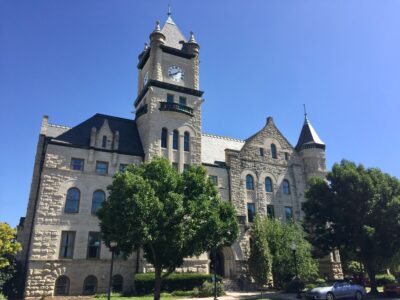
photo by: Journal-World
The west side of the Douglas County Courthouse, 1100 Massachusetts St.
Douglas County commissioners will discuss the progress and challenges in strengthening the county’s behavioral health system — including suicide prevention and crisis system coordination — under the five-year community health plan on Wednesday.
County commissioners will be given a semi-annual update on the work in the behavioral health component of the 2024-2029 Community Health Improvement Plan, or CHIP – the five-year strategic roadmap for health and wellbeing for Douglas County. The goal of this area is to create a more integrated behavioral health system that supports individuals across their lifespan.
During the presentation, staff will be reviewing the progress on data, implementation challenges and opportunities for improvement in three key focus areas: implementing Zero Suicide, optimizing the behavioral health crisis response system and integrating lived experience.
While suicide attempts in Douglas County have been decreasing, deaths by suicide have been increasing. The county has a Suicide Fatality Review Board, a multidisciplinary group that reviews individual cases to identify risk factors and missed opportunities for intervention. This work has already led to prevention strategies, the presentation said, such as installing 988 crisis hotline signage in parks identified as high-risk locations and launching related public awareness campaigns.
Another set of milestones included establishing several other coordinating bodies — the Crisis Response Coalition, Crisis System Operations Team, and Community Advisory Group — to oversee and continuously improve the behavioral health crisis system. There has also been a 15% increase in follow-up care after discharge from the Treatment and Recovery Center and reductions in unnecessary emergency department visits and jail bookings.
Additionally, staff emphasized the importance of incorporating lived experience into the behavioral health system, such as expanding the peer support workforce and securing funding for peer-led organizations.
Despite the success from the plan so far, there are ongoing challenges the behavioral health system faces, such as funding limitations, data integration issues and housing project delays. According to a memo in the agenda, there are “limitations of state funding and reimbursement sources for peer support across the system of care.”
As the Journal-World reported, the Bert Nash Community Mental Health Center announced last month that it would be stepping away from a planned supportive housing project at the intersection of Sixth Street and Rockledge Road. An advisory board has recommended to the City Commission to claw back previously awarded affordable housing trust funds towards the project.
This presentation is for informational purposes only, and no action will be taken by county commissioners.
IN OTHER BUSINESS, COMMISSIONERS WILL:
• Hear about the findings from an annual review of Plan 2040, the comprehensive, long-range planning document for Lawrence and unincorporated Douglas County that guides land use, development and policy decisions through the year 2040. The review is a routine, state-required process in which the Planning Commission evaluates whether the plan remains current and effective.
The annual report said that Plan 2040 continues to serve as an accurate framework for guiding decisions on long-term planning and growth in Lawrence and Douglas County. No action will be taken following the presentation, which is for informational purposes only.
In 2025, three amendments to the comprehensive plan were considered, with two fully adopted and one still pending. The amendments adopted involved one changing about five acres near Bob Billings Parkway and K-10 from public/institutional use to a mix of medium-density residential and neighborhood commercial, and another redesignated a small area in the Oread neighborhood from commercial to high-density residential to support an affordable housing project. A third amendment, still pending final approval, proposes updates to the future land use map for the New Boston Crossing area in the southern development plan.
• Consider approving the 2026 Natural and Cultural Heritage Grant awards as recommended by the Douglas County Heritage Conservation Council. This year, there were 42 grant applications with the requested funding exceeding $1,050,000. This is the largest number of applications received in the program’s history and highest total funding request.
In 2026, a total of $250,000 was made available for grants. Of the total funding, $40,000 was available exclusively for Seed Grants, which include requests $5,000 and below. The remaining $210,000 was available for Target Grants – requests above $5,000 and up to $60,000. The Heritage Conservation Council is recommending funding for 22 projects, including 11 Seed Grant and 11 Target Grant proposals.
• Hear an update from Lawrence-Douglas County Public Health, outlining current operations, financials and how the organization is expanding and strengthening core health services. LDCPH has begun providing nursing care at the juvenile detention center and is planning to relaunch family planning services in July 2026, as the Journal-World reported.
LDCPH is also pursuing funding to expand community-based primary care, particularly for underserved populations through partnerships and street outreach programs. In addition, WIC services are being expanded through targeted outreach in smaller communities like Eudora and Baldwin City, while family support programs are seeking to launch a universal home visiting initiative to provide early support to families beginning in mid-2026.
• Hold a work session with K-State Extension – Douglas County to discuss the organization’s programs, partnerships and impact. Its work spans areas like agriculture and natural resources, youth development through 4-H, community health, food systems and economic development. Extension works alongside community partners to achieve the goals of the anti-poverty and food security workgroups in the Community Health Improvement Plan. No action will be taken following the session, which is for informational purposes only.
• Consider approving the 2026 Vegetation Management Plan, which directs daily operations including roadside mowing, park maintenance, revegetation practices, herbicide use and noxious weed control in the county. The plan was first adopted in 2022 and it has a two-year cycle. The last plan was last approved in 2024, and as the Journal-World reported, commissioners directed staff to add the plan for consideration on Wednesday’s agenda at the last business meeting for review and public input.
• Consider approving a grant application from Douglas County Criminal Justice Services for $91,900 in funding from the Kansas Department of Corrections to ensure youth have access to mental health and substance use assessments and services.
The County Commission’s work session will begin at 4 p.m. Wednesday in the Douglas County Commission meeting room at 1100 Massachusetts St. The business meeting will follow at 5:30 p.m. The meeting will also be available via Zoom.
Other News
Eudora voters to decide sales tax election to fund increased fire protection in the city
Perry-Lecompton voters to weigh new joint recreation system funded by property tax levy

Theatre Lawrence’s ‘LIZZIE’ puts a Riot Grrrl edge on infamous ax murders
PHOTOS: 19th annual Lawrence Zombie Walk
Housing Stabilization Collaborative’s new system directs rental and utility aid to more vulnerable households, review finds