Recent storms and North Lawrence tornado have kept the city’s forestry staff busy day and night
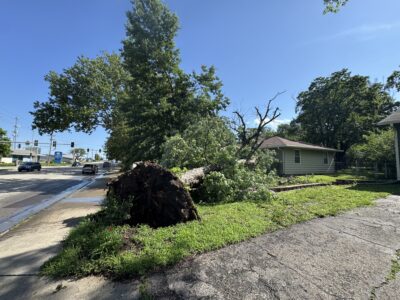
photo by: Chad Lawhorn/Journal-World
A tree, pictured June 9, 2026, fell just a few feet away from Iowa Street traffic as part of overnight storms. The tree, south of the Iowa Street and Harvard Road intersection, just missed blocking the busy street.
Whenever trees fall or break along Lawrence’s roadways, it’s a job for the city’s forestry staff – and sometimes it’s much, much more than a full-time job.
That’s certainly been true this month, when Lawrence has seen storms with heavy rain, high winds and even a weak tornado in North Lawrence. All of those things can cause trees to fail, and so “this last week and a half’s been kind of a lot of work,” said Mark Hecker, assistant parks director for the City of Lawrence.
“I talked to our forestry manager yesterday,” Hecker told the Journal-World on Thursday, “and I said, ‘How many nights out of the last seven have you guys been called in?’ He said, ‘Well, five out of the last seven.'”
The city has a three-person forestry crew and one forestry manager who oversees them, and after the North Lawrence tornado cleanup wrapped up this past week, Hecker told the Journal-World they had a lot on their plate.
Report damage
If you see a tree or other storm debris blocking a road or sidewalk, there are multiple ways to report it to the city and get it cleaned up.
A social media post this past week from the city about the North Lawrence cleanup said that if the situation isn’t an emergency, you can report it through the online platform SeeClickFix or on the city’s website. If the situation is an “immediate hazard,” the release said, like “a leaning tree, a broken limb hanging overhead, or a tree involving utility lines,” you can call the non-emergency dispatch line at 785-843-0250 or, for more serious “life-safety emergencies,” 911.
When the city gets “storm after storm after storm,” as it has at times this year, Hecker said, the staff sometimes gets called in at 1:30 or 2 a.m. for emergency work, and then have to work their normal day shift after that. “You can’t just send them home and say, ‘OK, we’re done,’ because you still have hazardous situations out there.” And, while the city does contract with private companies to provide extra capacity, it tries to handle as much as it can in-house.
The tornado in North Lawrence on June 9 was just at the edge of what the forestry staff could handle on its own, Hecker said. “If it were much bigger than this, we’d have to have some more help.”
As the Journal-World reported, the tornado was an EF-0, and while that’s the weakest kind of tornado, it still brought winds of 65 to 85 mph and damaged and uprooted a number of trees.
Soon after it passed, the crews’ first priority was to ensure that traffic could flow smoothly.
“Our first blow through in that area was to get the streets opened up, get things pushed out of the way,” Hecker said. For that, the city’s public works crews could help out the forestry staff: “They have more backhoes, more trucks than we do to help us with hauling off.”
Downed trees in the road might cause trouble for travelers, but removing them is actually one of the simpler parts of the cleanup job, Hecker said.
“With trees down, they obviously impact traffic, but they’re somewhat easier to deal with in that you can kind of cut it up and push it out of the way, get the streets open again,” he said.
The hardest part of the cleanup comes after the streets are opened up. It’s when arborists go up in the bucket truck to remove the damaged tops of trees.
In North Lawrence, Hecker said, “some of the trees are just old and their tops are dead, and they probably should have been removed a long time ago.” The high winds snapped them, and it’s dangerous to leave them hanging there.
“Sometimes they break over the street; sometimes they break over somebody’s house, or their garage or shed,” he said. Even when crews are removing them, they have to be careful with how they bring them down. “It’s not something you can just go up and cut it down and let it fall.”
And they have to think about all this while they’re carving up tree limbs several stories off the ground.
“You’re up there 40 to 50 feet in the air with a chainsaw, and sometimes after dark, and that’s kind of a hazardous job there,” Hecker said.
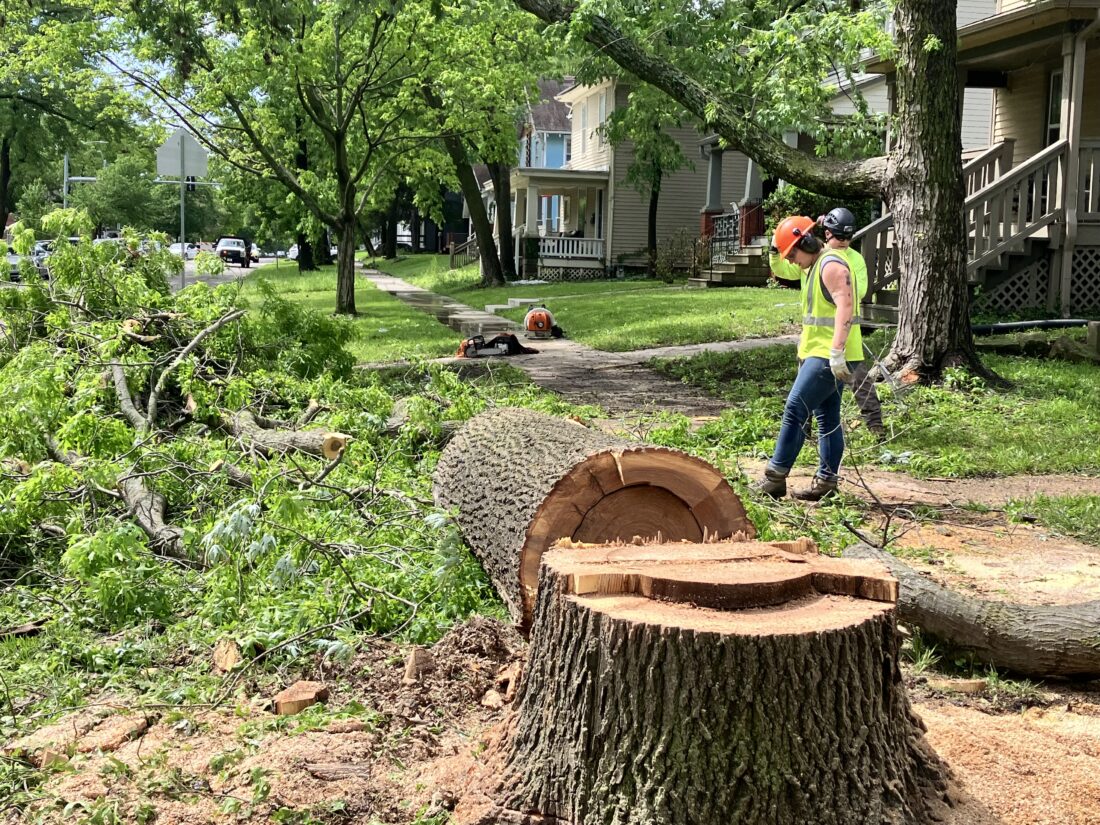
photo by: Kim Callahan/Journal-World
The 1300 block of Kentucky Street was closed to traffic Monday morning, April 27, 2026, as crews worked to remove a fallen tree.
‘Mother Nature always wins’
Though the crews have been busier than usual recently, Hecker says this storm season has still been “somewhat normal” so far. If it seems more intense, it might be because a couple of storms have come through in quick succession.
“We’ve had multiple events in a fairly short period of time here, where we have 50-, 60-, 70-mph winds, and that always brings the trees down,” Hecker said.
There has also been a lot of rain with some of these storms, which saturates the soil and makes it easier for winds to blow the trees over.
According to data from the National Weather Service’s Topeka office, Lawrence has received 17.82 inches of rainfall this year, 1.72 inches more than normal. June has been about average so far in terms of rainfall, and May actually was drier than usual. But in April, Lawrence recorded 7.63 inches of rain, which was 3.60 inches higher than normal. Near the end of April, a strong storm knocked down trees around the city, including one that fell on the Homeless Resource Center and another that blocked traffic on Kentucky Street.
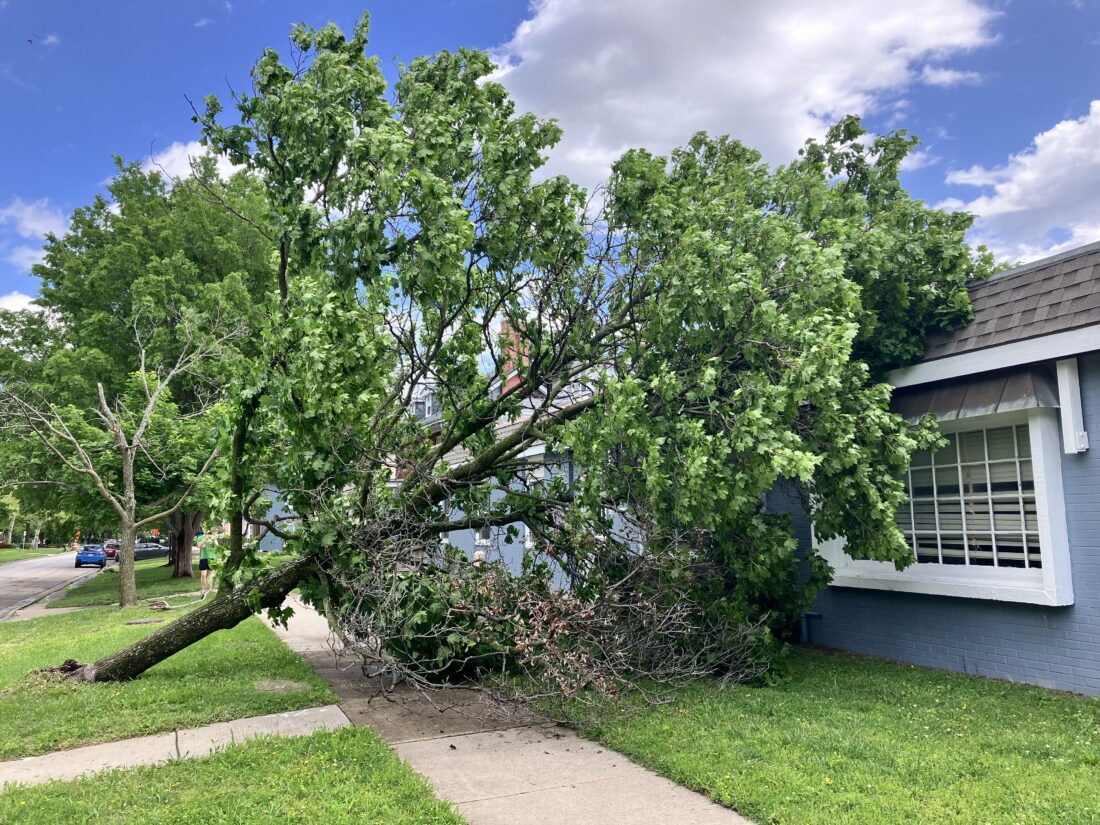
photo by: Kim Callahan/Journal-World
A tree fell into the Homeless Resource Center at 10th and Kentucky streets on April 27, 2026.
“Mother Nature always wins, basically, with the rain or the wind,” Hecker said. “Trees are just structural items that have to be supported by the root system.”
While you might think of summer as peak storm season, winter can be even more taxing for the forestry crew. Hecker said storms that cause widespread damage are worse than ones that are localized, and ice storm damage is more widespread than spring and summer storms. There’s a lot of debris to clean up from those types of events.
“Ice storms are the worst, because it just breaks things and they fall straight down,” he said.
Crews can be busy for several days dealing with the aftermath of a storm, but once the imminent dangers are gone, they will “kind of let it settle a bit,” Hecker said. They’ll give property owners time to gather and stack their debris, and then the crew can “come by fairly quickly and just pick it all up.”
For the June 9 tornado, he said, that process was completed by Wednesday, a little over a week after the tornado passed through.
“All in all, it’s all cleaned up and looking pretty good,” Hecker said.
From there, the trees and branches go to the city’s big wood chipper, where they’re turned into chips that are distributed to gardeners at the compost facility at 1420 E. 11th St. Hecker said there are sometimes capacity issues with that after a particularly big storm, and then the trees have to be sent to the landfill, but the city hasn’t had to do that this year, and “we don’t like to do that unless we have to.”
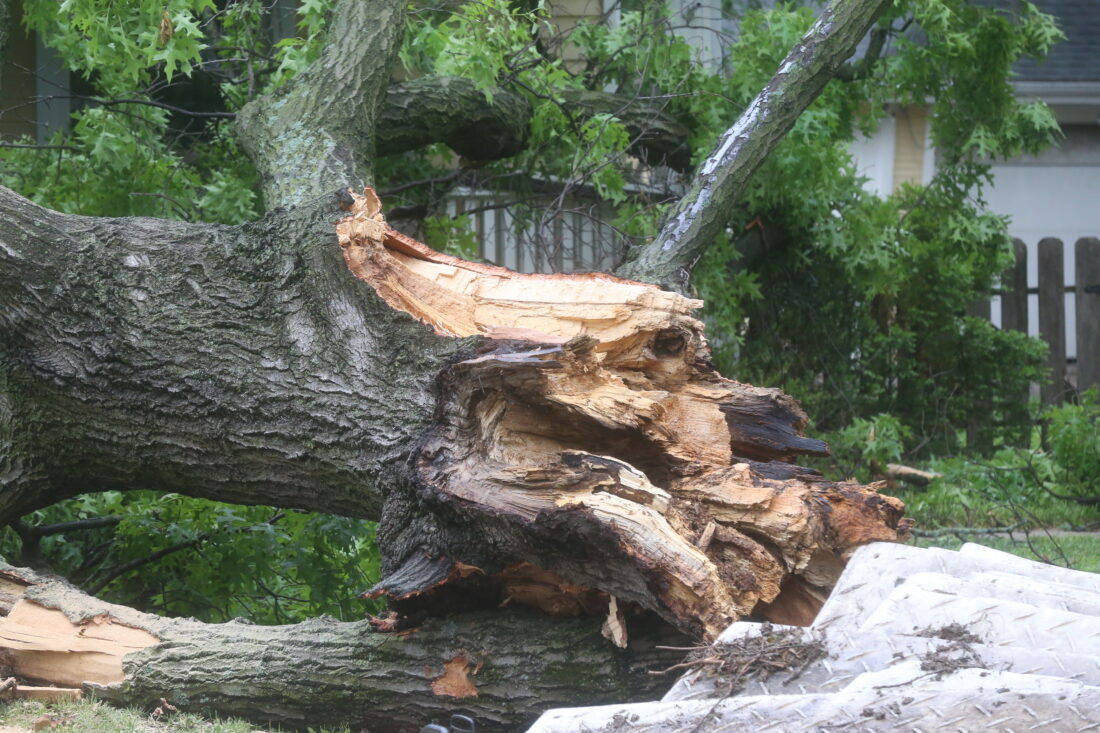
photo by: Chad Lawhorn/Journal-World
A snapped tree in the 400 block of Maine Street is pictured on May, 19, 2026.
Managing risk
The city arborists work on trees on the public right of way, but trees can fall on private property, too. In North Lawrence, the crews saw “a lot of personal trees” torn out, Hecker said – “lying on the house, lying on the garage.”
“That’s unfortunate, because some of those were huge trees,” he said. “That’s a costly measure for the landowner.”
What can property owners do to reduce the risk of falling trees? There are some steps you can take, but Hecker describes them as “things we all should do, which most of us don’t do.”
The best preventive measure, he said, is to hire a certified arborist every few years to examine your trees and look for dead or weak wood, rot and other signs that a tree is at risk of failure. “But, honestly, most people don’t do that, and you have to kind of have a good eye for it.”
Hecker also realizes that many people want to keep their trees, even if they’re starting to decline and might pose a risk.
“You don’t just think, ‘Hey, I’m going to hire somebody to come and cut down my tree because it’s kind of dead.’ It’s usually when it’s completely dead or falling down that people act on it,” he said.
But Hecker also said there’s only so much you can do to lessen your risk, even if you do “the best job ever” of taking care of your trees.
“People do the best they can to manage the resource,” Hecker said. “But sometimes Mother Nature tries to do something else.”
City Government
Lawrence City Commission to weigh whether Costco should be included in STAR bond district
As they approve bikes plan, Lawrence city leaders ask about data collection, Kentucky and Tennessee streets
Lawrence city leaders want to toughen tobacco licensing rules ‘sooner than later’
Algerian government invites Mayor Brad Finkeldei, Lawrence delegation for a visit
Construction on Wakarusa Drive to resume; city manager says KDOT’s secretary has apologized for delay