Social service agencies and volunteers work to count the number of people experiencing homelessness
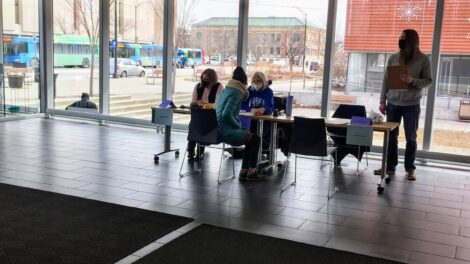
photo by: Rochelle Valverde
Wanda Haney and Lori Lange, both volunteers with Justice Matters, and Mathew Faulk, director of supportive housing for Bert Nash Community Mental Health Center, conducted the point-in-time survey at the Lawrence Public Library, 707 Vermont St., on Feb. 23, 2022.
Local social service agency employees and volunteers are working to conduct the annual “point-in-time” survey, a process that seeks to count every person experiencing homelessness in Douglas County.
The annual survey is a count of both sheltered and unsheltered people who were experiencing homelessness on a single night, with this year’s date being Feb. 22. Douglas County Homeless Services Coordinator David Tucker said the survey is a coordinated effort in which agency employees and volunteers work together to survey people at various locations, such as the Lawrence Community Shelter, the Lawrence Public Library and the Salvation Army, as well as places where people camp around the county.
“There’s a lot of known campsites they’re going to, and of course they range out a bit further than just the known ones,” Tucker said.
Tucker said that typically the survey occurs in January, but that it was postponed until February this year because of the recent surge in COVID-19 cases. He said participants answer a one-page survey that asks questions such as where they slept the night of Feb. 22, how long they’ve been experiencing homelessness, the causes of their homelessness and what kind of services they are receiving.
Mathew Faulk, director of supportive housing for Bert Nash Community Mental Health Center, was at the Lawrence Public Library, 707 Vermont St., on Wednesday as part of the survey effort, along with two volunteers with the faith-based advocacy group Justice Matters.
Faulk said the information gathered in the survey, in addition to being required for certain U.S. Department of Housing and Urban Development-funded programs, is helpful for local social service agencies and governments working to address homelessness. He said there is a margin of error since the survey data is dependent upon the ability to physically count people, but that accuracy has been improving in recent years. He also noted the count is simply a snapshot in time and doesn’t represent the overall need throughout the year.
“The survey is not a depiction of how many people, for example, within a year, experience homelessness within a community,” Faulk said. “It’s just for this one night.”
The 2020 point-in-time survey counted 408 people experiencing homelessness on the night the count was conducted. Of the people surveyed, 185 people, or about 45%, were in transitional housing; 148 people, or about 36%, were in emergency shelter; and 75 people, or about 18%, were unsheltered. Tucker said because of complications related to the pandemic, the 2020 survey is the most recent point-in-time data available.
Tucker said this year’s survey began Tuesday evening, but that most of the count would occur throughout the day on Wednesday. He said that although a majority of the people experiencing homelessness are located in Lawrence, the survey also includes Eudora, Baldwin City and other locations throughout Douglas County. He said that outreach to locate more distant campsites throughout the county would continue until Friday.
Low temperatures on Tuesday night and Wednesday were in the single digits, with the wind chill falling below zero. Even so, Tucker said outreach workers were still finding people living outside, either camping or in vehicles. He said surveys were also being conducted at the Community Building, 115 W. 11th St., which the City of Lawrence has been using as an emergency shelter when the overnight temperature is below 35 degrees.
“We have a lot of unsheltered people in Douglas County,” Tucker said. “Luckily we do have the emergency winter shelter that the city is running.”
Tucker said local agencies would have a good idea of the numbers in March, but it will take a few months before the results of the survey are compiled and an official report is issued.
Other News
Peaslee Tech’s new homes made from garage doors arrive in North Lawrence
KDOT awards $104.7-million contract for north segment of South Lawrence Trafficway expansion

At 40, her first mammogram changed everything: LMH Health nurse urges others to get screened

Lawrence filmmaker explores program uniting incarcerated mothers and their children in new documentary
Clinton State Park to open new 1-mile, accessible trail and improve two boat ramps near marina