

Nearly 40 additional funding requests from community agencies head to Douglas County commissioners as budget hearings begin
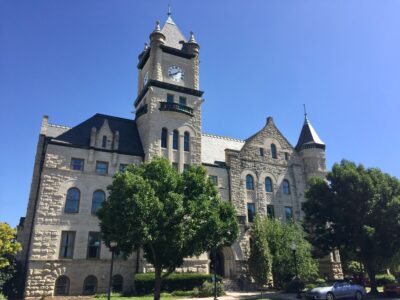
photo by: Journal-World
The west side of the Douglas County Courthouse, 1100 Massachusetts St.
When Douglas County commissioners gather next week for hearings on the county’s 2027 budget, they’ll have about 40 requests from community agencies. There’s a common theme shared by nearly all of them — they’re not currently included in the county’s recommended budget.
County commissioners told staff in May to prepare a flat property tax rate – or mill levy – for next year’s budget, as the Journal-World reported. With that direction, staff are proposing a $201.5 million budget with a mill levy of 40.669 mills. One mill equals $1 per $1,000 of assessed property value.
The tax a property owner pays is determined by both the mill levy and the property’s assessed value. The total assessed property valuation increased 4.9% in 2026, compared to a 5.7% increase the previous year. As the Journal-World reported, County Administrator Sarah Plinsky said it was challenging to put together a proposed budget with a flat mill levy and the assessed valuation increase at 4.9%.
Douglas County funds 45 community partners that provide different services – such as behavioral health, human services, economic development, heritage and land management services for the county. Plinsky said the budget doesn’t leave much room for community partners to request additional funding, and a lot of those additional – or supplemental – funding requests are not included in the proposed budget.
“I have that conversation up front with community partners that the commissioners will get to see what you’ve requested,” Plinsky said. “But I don’t recommend funding it in my proposed budget because I think it’s their decision.”
However, Plinsky said she made room for one of the requests to be funded in the proposed budget out of the more than 50 supplementals. This request totals $5,708.
“The only one I funded was a request from the (K-State) Extension Council,” Plinsky said. “We have had a lot of conversations with the Extension Council over the years, and they have state employees, and they have like county grant funded employees. The state gave their employees a 1% raise, so I gave the county funded employees a 1% raise.”
The decision for what will be funded will ultimately be up to the county commissioners. The general fund is the main operating fund that pays for most day-to-day county services. It is primarily supported by property taxes collected through the mill levy, along with other broad revenues like sales tax and fees.
Plinsky said while there’s limited space in the general fund, there may be room for one-time funding requests to utilize funding from the county’s behavioral health fund – which has a fund balance of $22.3 million and part of its revenue is supported by a dedicated quarter-cent sales tax.
“We have capacity in the behavioral health fund for some projects that we could do, but under the general fund with a flat levy, I’m in a position that if the commissioners want to add anything in the general fund, I either need to increase revenue somewhere or cut something,” Plinsky said.
“I think commissioners are going to have to make some very tough decisions,” Plinsky said.
Some of the supplemental funding requests exceed $100,000, and some partners have submitted multiple additional funding requests to commissioners. Here are the additional funding requests with the largest price tags and whether they could utilize the behavioral health fund:
• Bert Nash Community Mental Health Center – requesting $1.5 million to go towards capital improvement for the Judge Jean Shepherd Youth Recovery Center project. The YRC will offer crisis services to youth ages 6-17 and expand outpatient services in the county. As of May 6, 2026, Bert Nash has secured $6,576,039 in private donations, state grants and other commitments towards the project with the goal to reach $12 million. This request could utilize funding from the behavioral health fund.
• DCCCA – requesting $175,000 in ongoing funding to sustain its school-designated prevention program – to reduce the likelihood that young people will begin using alcohol, tobacco, vaping products, or other drugs, or develop related behavioral health problems – after its current grant funding expires on May 31, 2026. The request also includes a summer youth internship program to develop student leadership and prevention skills. This request could utilize funding from the behavioral health fund.
• Family Promise of Lawrence – requesting two one-time supplementals of $327,095 and $158,000 to pay off loans for a temporary family shelter and a supportive housing development. Both of these requests could utilize funding from the behavioral health fund. The first request is $327,095 to pay off a loan used to remodel a building that now serves as the county’s only temporary family shelter, which has increased capacity to six families and supported 37 families since 2024, with most exiting to stable housing.
The second request is $158,000 to pay down the remaining loan for two supportive housing homes that provide short-term lease-based housing and case management for families transitioning out of homelessness; these homes have served three families so far, including 16 children, all of whom moved into permanent housing.
• O’Connell Children’s Shelter – requesting $100,000 in ongoing funding to expand and strengthen its existing high school truancy program, serving youth and families countywide in grades K-12.
• Baldwin City Economic Development Corporation – requesting $500,000 in one-time funding to assist in the building of a new childcare facility in Baldwin City. The construction costs for this building is $2 million with a total projection of $2,325,000. With projected cash on hand at the end of 2026 being $1,321,979 the organization said it’s at a $500,000 gap. The $500,000 in funding would help reach the $2 million goal.
• Cardinal Housing Network – requesting $349,500 in ongoing funding to help stabilize operations for the organization. The request would fund staff salaries, employee benefits, insurance, resident transportation and vehicle maintenance and utilities and building maintenance. This request could utilize funding from the behavioral health fund.
• Center for Supportive Communities – requesting $150,000 for its SupportEd elementary and middle school truancy program and $100,000 for a high school truancy program. As the Journal-World reported, the county previously allocated funding for the SupportEd program, but decided to use that money to instead fund a county-run program with Douglas County Criminal Justice Services’ Youth Services division.
• HeadQuarters Kansas – requesting one-time $180,000 to help stabilize its budget and maintain participation in regional crisis response efforts, including the Douglas County Crisis Response Coalition, Crisis Systems Operations Team, and Suicide Review Board. The request comes after lower-than-expected state 988 funding from the Kansas Department for Aging and Disability Services reduced projected revenues by over $400,000, significantly shrinking HQ’s year-end fund balance and forcing staff reductions and outsourcing of administrative functions. This request could utilize funding from the behavioral health fund.
As the Journal-World reported, commissioners awarded $300,000 to fill a projected shortfall for HQ in 2026. During the 2026 budget discussions, commissioners reserved the $300,000 in funds for solvency support, but it was only considered after they saw HeadQuarters’ audits for fiscal years 2022, 2023 and 2024.
• Salvation Army – requesting $471,517 for a fire suppression system. “The fire suppression system that previously occupied our building was taken out with the permission of the fire marshal prior to purchase by The Salvation Army,” the budget request said.
County departments can also submit supplemental funding requests. Plinsky said she will occasionally fund requests in the proposed budget based on operational needs staff felt could be accommodated within the budget’s parameters.
Some of the requests funded in the proposed budget from county departments include: additional $165,185 in funding for two positions in Douglas County District Court after grant funding was cut; increased IT software funding totaling $700,000 since software costs exceeded the budget; and two additional Douglas County Sheriff’s Office deputies totaling $239,474 to provide security at the Judicial and Law Enforcement Center.
There are also ongoing adjustments to the county’s pay plan to maintain competitive compensation, reward employee performance, and recognize years of service in the proposed budget. The request includes $1,184,000 for an average 3.4% market salary adjustment by job family, $293,439 for a 1% merit-based salary increase, and $152,640 for longevity pay increases based on employee tenure. Together, these initiatives total $1,630,079.
Commissioners will begin meeting with community partners on Monday from 9 a.m. to noon in the Douglas County Commission meeting room at 1100 Massachusetts St. The Journal-World previously reported the full schedule of budget hearings for next week.
Other News
‘One of a kind’: Sale at the Lawrence Arts Center will find new homes for late musician’s unique custom guitars

Go, See, Do: KU homecoming, Halloween happenings and other events
Student-run coffee shop opens at Community Connections at Pinckney, teacher receives surprise $1,000 award
‘This is for all of us’: Midco Prairie, an oasis of native plants in downtown Lawrence, opens to the public
Douglas County commissioners express interest in fireworks sales dates that include a weekend
