One ‘party planner’ for America’s Bicentennial in Lawrence reflects on the historic celebrations and how things changed before America 250
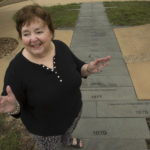
Clenece Hills, pictured at Sesquicentennial Point near Clinton Lake, is affectionately known as Lawrence's birthday lady because she has played such a vital role in commemorating city milestones.
Clenece Hills has served in many roles in her 88 years. A teacher. A radio host. And a top notch party planner for important local birthdays.
Hills served on multiple historic commissions that worked to commemorate historic celebrations, including chairing the commission for Lawrence’s 150th birthday in 2004 and the coordinator for Haskell Indian Nations University’s 100th year in 1984.
“I know how to celebrate birthdays,” Hills said with a laugh.
One of the biggest birthday bashes that Hills helped plan was the one celebrating America’s 200th birthday back in 1976 as the chairperson of the Douglas County Bicentennial Commission from 1973 to 1976.
The celebratory mood was everywhere, and Hills said the Bicentennial commission was backed up with “great support” from national organizations helping to plan celebrations across the country based on the themes of the American Revolution and the founding fathers. And each town in Douglas County wanted to be a part of it.
“There were little festivals all over the place,” Hills said.
For Hills, the icing on the cake for the extended birthday celebration came at 2 p.m. on July 4, 1976. Churches across the county rang out bells at the precise time to create a simultaneous ring of freedom commemorating the celebration.
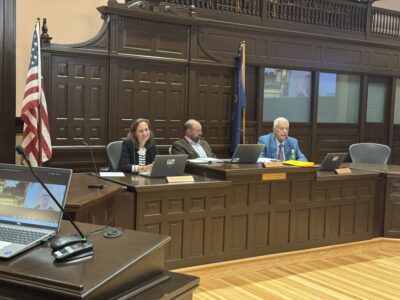
Celebrations might be a tad more muted this year for America’s 250th celebration. Steve Nowak, the executive director of the Watkins Museum, told the Journal-World the efforts in Douglas County to celebrate this year’s America 250 are more “grassroots” celebrations incorporated into already existing infrastructure. Unlike the Bicentennial, local governments did not create special commissions for planning activities.
That doesn’t mean there won’t be any celebrations for America’s 250, but the nature of the celebration is different this year. Big anniversaries like this by nature force people to both look back and look forward, Nowak said, and the 50 year gap means the things people were reflecting on are different from 1976 to now.
“We are a really different nation now. We deal with different kinds of issues and different kinds of crises,” Nowak said. “I think our response this year reflects what is going on in the nation at the time just like the Bicentennial.”
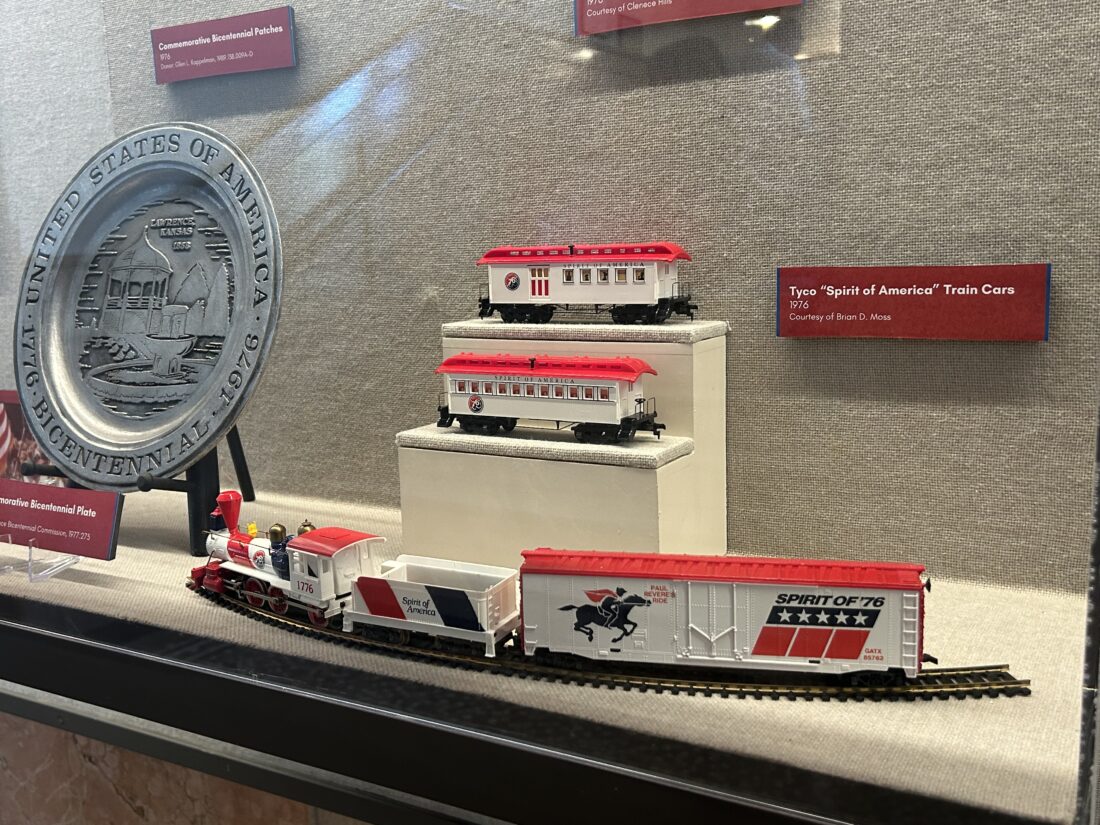
photo by: Bremen Keasey/Journal-World
Commemorative souvenirs from the Bicentennial celebration are displayed at the Watkins Museum. The Douglas County government created a special commission for Bicentennial celebrations in the build up to July 4, 1976.
Nowak may not have lived in Lawrence at the time of the Bicentennial, but he remembers as a kid the streets were very red, white and blue. Organizers like Hills were part of a widespread national movement to celebrate the country’s Bicentennial, with Congress creating the American Revolution Bicentennial Administration in 1973 out of a different commission. That group helped support state, local, and private celebrations, with around 66,000 recognized events in total, according to the Gerald Ford presidential library.
Hills said the commission she served on was initially started by the Lawrence city government, but she soon recommended the project go through the Douglas County government to include all parts of the area. Each community in the county had subgroups to help lead their own festivities, and Hills said the teamwork was evident from the start.
“It was wonderful,” Hills said. “We all helped each other and reinforced each other and worked together.”
Hills said one way the camaraderie was built was through meeting in a different place across the county each month. That included going to little dots on the map like Twin Mound and Kanwaka, along with visiting every city at least once. Throughout her time on the project, Hills estimated she gave about 120 presentations across the county, and she thinks this helped bring more community effort.
“I think that was instrumental in getting a lot of involvement,” Hills said.
Hills said the three ways the commission would acknowledge the 200th birthday were based on the themes of “heritage, festivals and horizon.” One project the commission worked on to celebrate the heritage aspect was creating a Douglas County Historic Building Survey, which looked to comprehensively document all the structures created across the county. Hills said the effort, led by Don Schaake, was a “treasure.”
The “horizons” — or more forward looking project — was the creation of a special Bicentennial bell. Hills said that effort was spearheaded by Ross Wulfkuhle, who would haul the bell around in a wagon to every school in Douglas County so schoolchildren could ring the bell and sign a scroll detailing that they contributed to the project.
That bell now sits at the Douglas County courthouse, though Hills said the community is hoping to find a way to move it to the Watkins Museum. Before it made its resting place at the courthouse, Hills said Wulfkuhle brought the bell to the Carnegie building, 200 W. Ninth St., and put it on a ledge near the site so people could ring the bell all during the Fourth of July parade in 1976.
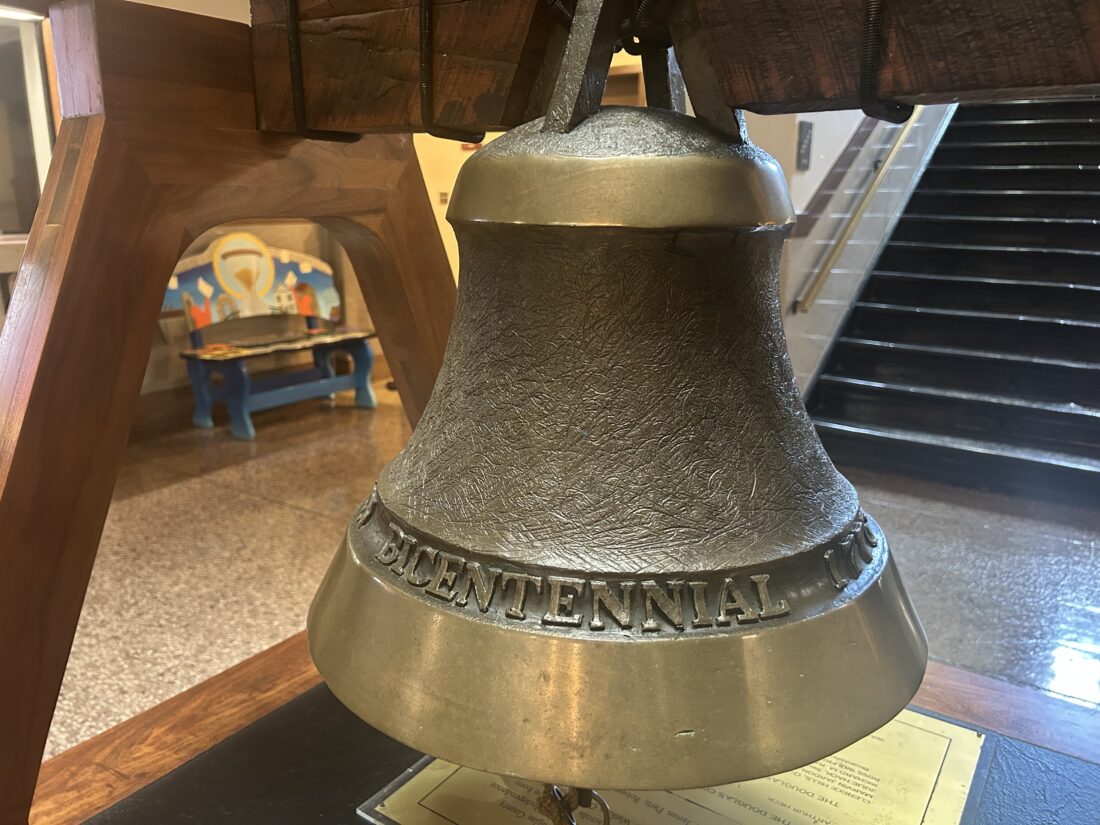
photo by: Bremen Keasey/Journal-World
A bell created for America’s Bicentennial sits at the Douglas County Courthouse. Clenece Hills, a local organizer of America’s Bicentennial celebrations in Lawrence, said the bell was brought to schoolchildren across the county around 1976 so they could ring it.
The parade in Lawrence that day was just one of the many festivals that was a major project for Hills and the rest of the commission. Another major event was the 1975 Flag Day parade on June 14, which marked the birthday of the U.S. Army. Hills also said the commission successfully applied to have the Bicentennial Wagon Train — which carried artifacts, documents and artwork for public view across the country for 21-months — make a stop in Lawrence, which was a “phenomenal opportunity.”
Hills said the planning was helped by getting financial resources through the national organization and local governments to make sure the “special things” happened throughout the Bicentennial celebration. Although all the events and projects culminated with Independence Day in 1976, Hills said it was crucial to spread out the events so more people could reflect on what the 200th anniversary meant.
“I think it is important to remember that anniversaries are not about that date alone, it’s about the whole history through that date,” Hills said.
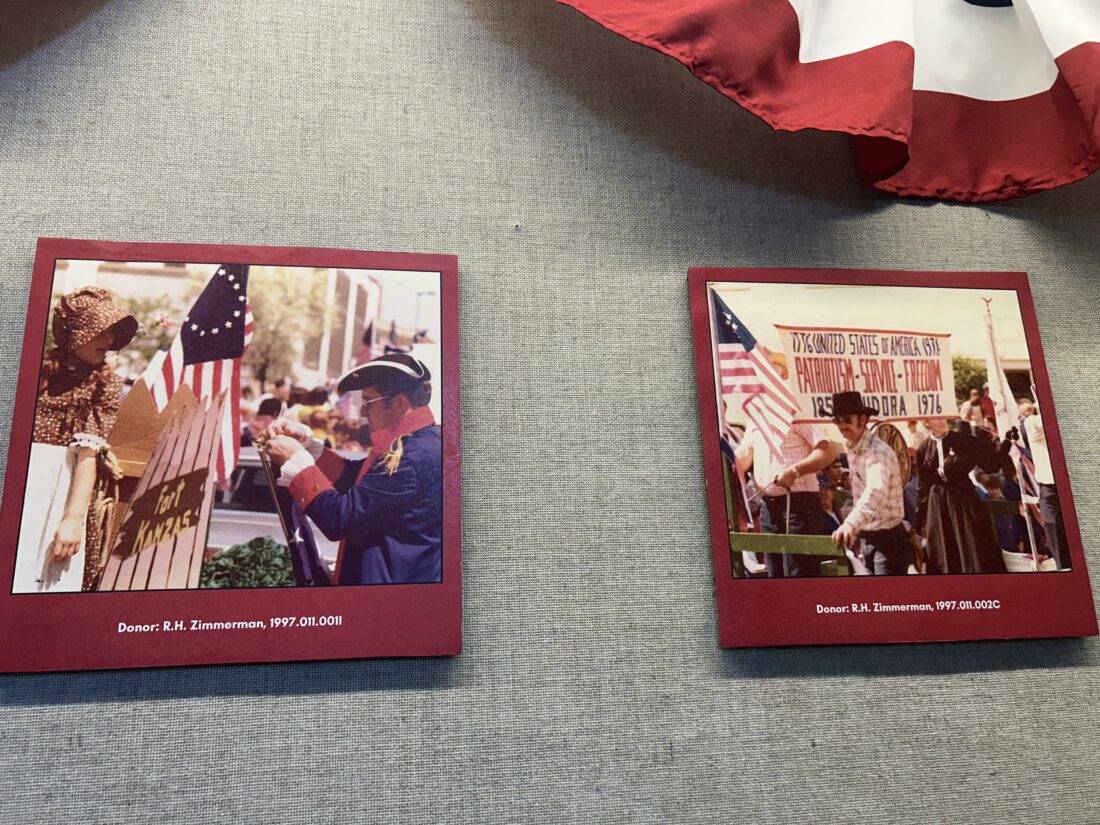
photo by: Bremen Keasey/Journal-World
Photos from Lawrence’s 1976 Fourth of July parade are displayed at the Watkins Museum for a special exhibiton. Clenece Hills, an organizer for the Bicentennial celebration, was a key planner for how the community celebrated.
The historic context is something that might have lent itself to a big patriotic celebration, according to Nowak. The country had gone through a period in the late 1960s and early 1970s of “a lot of upheaval and uncertainty,” from the Vietnam War to political assassinations to the Watergate scandal and resignation of Richard Nixon. Nowak said that the country may have wanted to look back and celebrate the founding of the country and the Revolutionary War era as a sort of “fresh start” to move on from the turmoil of the time.
“I think the focus on founding fathers and the Declaration of Independence (during the Bicentennial) could have been (seen as) a way for the country to put itself back on the right track,” Nowak said.
Nowak said that many of the focus of America 250 is not on those days of the Revolutionary War, but more about reflecting on “what it means to be ‘American.'” That more “introspective” focus on a celebration could be a reason why there is less of a government-led celebration this time around, as well as reflecting the current mood of the nation.
One way the community will celebrate the America 250 is through this year’s Summerfest 2026 happening on July 4, 2026. Nowak said the event will feature a gallery honoring civil servants in the community as part of a collaboration with the Watkins Museum, Dole Institute at KU, City of Lawrence and Douglas County. Additionally, the Watkins partnered with other historical societies in Douglas County for a special America 250 exhibition that focuses on how various groups worked to secure freedom for all people in Kansas.
These types of celebrations still reflect the patriotism and ideas behind the Declaration of Independence, but Nowak said there is not the same fanfare as those 50 years ago. Part of that is the sense many people “aren’t necessarily looking forward” to these celebrations this year, so the more subdued and introspective nature” and lack of huge government involvement reflects that feeling.
Hills understands that feeling. Despite being the serious party planner for the Bicentennial, she said “it’s a different celebration now” and is supportive of how the event is being used to create a dialogue about what it means to be an American and go through the current historic institutions. But she will always look back fondly on the Bicentennial celebrations in Douglas County and what they meant to the community.
“(It was) a nationwide activity and an awful lot of fun,” Hills said. “I don’t regret one second of the time I gave it.”
Other News

U.S. Army says cleanup at Sunflower Army Ammunition Plant is ‘slowing down’; PFAS investigation at site still needs funding
‘One of a kind’: Sale at the Lawrence Arts Center will find new homes for late musician’s unique custom guitars

Go, See, Do: KU homecoming, Halloween happenings and other events
Student-run coffee shop opens at Community Connections at Pinckney, teacher receives surprise $1,000 award
‘This is for all of us’: Midco Prairie, an oasis of native plants in downtown Lawrence, opens to the public