Task force to recommend consideration of 6-member City Commission elected by districts
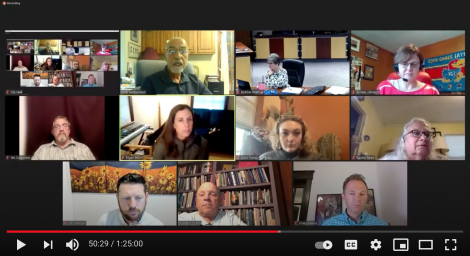
photo by: City of Lawrence
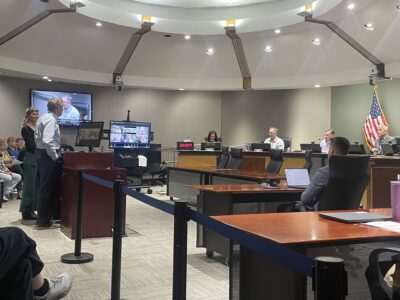
The City Government Task Force is pictured during its meeting on May 17, 2021.
A task force of Lawrence residents that has been reconsidering the city’s form of government has come out in favor of expanding the City Commission and having election by districts, as opposed to at large, in addition to having a directly elected mayor.
As part of its meeting Monday evening, the City Government Study Task Force voted 8-0, with a few members absent, to recommend that the city consider changing to a six-member commission in which the commissioners are elected by geographic districts, with each serving a four-year term. Currently, the commission is five members, serving four- or two-year terms, and all five members are elected at large, meaning that all represent the city as a whole.
Task force members agreed that having six members elected by district would improve representation and encourage more direct interaction between commissioners and their constituents. Task force chair John Nalbandian began the discussion Monday evening by noting that the city’s current form of government was adopted in 1951. Nalbandian said at that time the city had a population of about 10,000 people, meaning that the city still has the same number of commissioners and format of representation even though it has roughly ten times more residents.
“So you know that fact alone is kind of pushing me in the direction of districts,” Nalbandian said.
Other task force members agreed with Nalbandian. Task force member Burdett Loomis said that back when the current form of government was adopted, the five commissioners could have a pretty intimate relationship with their electorate, but that is more difficult now. Loomis said that with six commissioners and a directly elected mayor, some of the issues with the current form of government would be addressed.
“I do think we are missing two things,” Loomis said. “We are missing the centralization that a mayor gives us, and we’re missing the relatively intimate representation relationship that smaller districts give us. And I think if we go to six (commissioners) and an elected mayor, both issues to a point are addressed.”
The task force voted at a meeting last month to recommend that the city consider changing to a directly elected mayor who serves a four-year term, as the Journal-World reported. Currently, the City Commission chooses one of its own members each year to serve a one-year term as mayor — by tradition, commissioners choose based on whoever received the most votes in the most recent election, though exceptions have occurred.
Task force member Sami Turner said she thought that at least six commissioners elected by districts could help increase engagement and field more candidates. Task force member Eileen Horn also said that, practically speaking, it would be easier for commissioners, because instead of all of them being contacted about all issues, residents would be more likely to go directly to their district representative.
“They are busy people who get a ton of emails, but if their slice of people they directly represent and need to immediately respond to quickly is small, that might make it easier,” Horn said.
The task force also discussed having a hybrid system, in which six commissioners are elected by district and two are elected at large, but ultimately determined that was too many representatives and could give the wrong message that district-elected commissioners don’t need to concern themselves with citywide issues.
The Lawrence City Commission decided to create the task force in January to study alternative structures to the city’s current commission-manager form of government, including having a directly elected mayor, election by districts or changes to the number of commissioners. Commissioners agreed that they did not want to consider abolishing the practice of having a professional city manager to run the day-to-day operations of the city. Commissioner Jennifer Ananda initiated the discussion in December, following her yearlong term as mayor, when she suggested that Lawrence consider whether a directly elected, full-time mayor would benefit the city.
The current commission-manager form of government employs an elected commission and an appointed professional city manager. Currently, commissioners serve either two-year or four-year terms, depending on how many votes they received in the election; the top two vote-winners serve for four years, and the third-place winner serves for two years. The mayor presides over commission meetings and has ceremonial duties, but has no additional powers and, like other commissioners, works part time.
The task force is scheduled to meet a final time on May 27. During that meeting, the task force members will take a final vote on all components of the recommendation and potentially provide comment on other issues they think the commission should take into consideration, such as whether the directly elected mayor should have any additional duties.
City Government

As club cancels ‘Beetlejuice’ screening at Oak Hill, city says there are no specific rules about events at cemeteries

Opinion: An $80 million Hail Mary that combines Costco and Lawrence’s love of trails
Lawrence Police Department receives KDOT’s top traffic safety award for second straight year
Lawrence City Commission approves extra layers of oversight for data centers, asks for patience on further regulations
Lawrence to participate in program that helps nonprofits rehabilitate abandoned properties as affordable housing