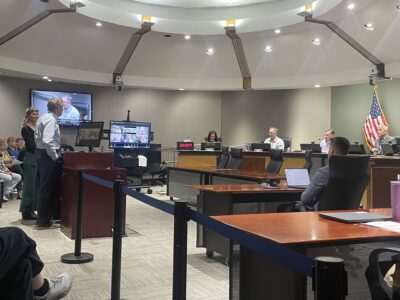
Lawrence City Commission open to collaboration, code changes to address shortage of affordable homes
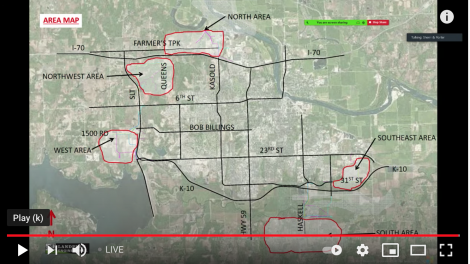
A map presented to the City Commission at its meeting May 18 includes five potential areas for new housing developments.
City leaders say they’re looking forward to an upcoming review of the city’s development code and potential collaboration with developers and nonprofits to help ease the city’s shortage of affordable housing.
As part of its meeting Tuesday, the Lawrence City Commission received a presentation from the Lawrence Home Builders Association, the Lawrence Board of Realtors, the affordable housing provider Tenants to Homeowners and others regarding shortages in Lawrence’s housing market. The presentation included ways the city could support potential housing development and help make development easier, and commissioners said they were excited at the prospects.
“I think this is a great start,” Commissioner Lisa Larsen said. “This is probably the most information I’ve seen, as far as possibilities, in one place, so I’m very excited about the future and what we can do.”
The presentation included five potential growth areas where existing city infrastructure, such as roads and sewer lines, could be expanded to accommodate a new housing development. Those include an area south of Lawrence near Haskell Avenue; southeast of the Douglas County Jail; west along Bob Billings Parkway; north of Kasold Drive and the Farmer’s Turnpike; and north of Rock Chalk Park.
“You have developers out there today that would like to do this stuff,” C.L. Maurer, of Landplan Engineering, told the commission.
For each area, the presentation provided the cost of extending city infrastructure, the potential number of lots, and disadvantages and advantages to each site. For example, for the area near Haskell Avenue, it was estimated that infrastructure extensions would cost $11 million and that the area could accommodate at least 2,500 lots. Advantages of the site were its proximity to the city’s new wastewater treatment plant, existing sewer and water lines, and that it is in the city’s planned growth area south of the Wakarusa River. Disadvantages were that the development would require the city to expand beyond the boundary of the river and the South Lawrence Trafficway.
Bobbie Flory, executive director of the Home Builders Association, told the commission that because of the cost of expanding infrastructure for new housing developments, collaboration and investment from both private developers and the city would have to occur. Flory said with the anticipation of federal coronavirus relief funding that can be used for infrastructure, the city has a unique opportunity to pursue such collaborations. Maurer also said creating benefit districts that would reimburse the city for infrastructure investments was also an option.
When it came to the design of new developments, the presenters advocated for changes to the city’s development code to allow for less uniformity in neighborhood zoning as way to support more affordable housing options. Tenants to Homeowners Executive Director Rebecca Buford said if new housing developments just consisted of single-family lots, people were going to get priced out of living in Lawrence. Instead, Buford said neighborhoods could have mixed housing types and price points, including with single family homes at both affordable and market rates, duplexes for the rental market, cottages for seniors, and even some multifamily housing.
“We want that all together in developments because that’s what’s going to provide the best type of mixed-income neighborhoods,” Buford said. “We don’t want to create segregated neighborhoods, and I think we have a real opportunity.”
Planning and Development Director Jeff Crick told the commission that following the adoption of the community’s new comprehensive plan, Plan 2040, the planning office has been working on a review of the development code. Crick said planners would be looking at what is working in the code and what is not, as well as examining the development review process and where that can be streamlined and made more efficient.
Mayor Brad Finkeldei said he would be interested in considering new developments that have mixed housing types and price points, and in what builders could do with a code that allows for some of that flexibility. Finkeldei also said he believes the city does need to cooperate when it comes to growth of the community, including in affordable housing and partnerships for development in potential growth areas.
“Receiving the report is the first step, and let’s look forward to having some second and third and fourth steps here relatively soon,” Finkeldei said.
In other business, the commission approved making a $1.5 million funding commitment to the Kansas Department of Transportation for the Sixth Street and K-10 interchange project for 2023. The project is in the state’s transportation plan, and city staff is recommending the city make the commitment to potentially help the project move faster toward construction.
City Government
Opinion: Local government made a small mistake. Taxpayers shouldn’t be on the hook to fix it

As club cancels ‘Beetlejuice’ screening at Oak Hill, city says there are no specific rules about events at cemeteries
Opinion: An $80 million Hail Mary that combines Costco and Lawrence’s love of trails
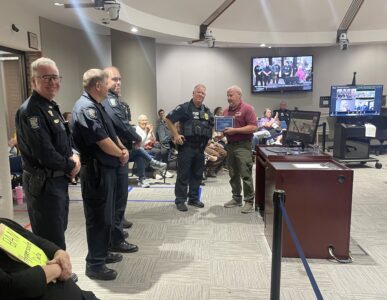
Lawrence Police Department receives KDOT’s top traffic safety award for second straight year
Lawrence City Commission approves extra layers of oversight for data centers, asks for patience on further regulations