KU chancellor says higher education needs about $73 billion in next federal stimulus package
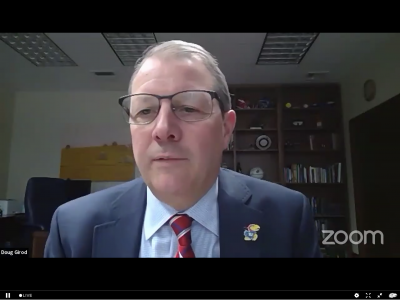
University of Kansas Chancellor Douglas Girod appears in a virtual university update on April 16, 2020.
Higher education institutions across the United States are preparing to ask for around $73 billion in the next round of federal COVID-19 relief funding, the University of Kansas’ leader said Thursday.
Chancellor Douglas Girod announced the figure in a virtual town hall update on KU’s operations, saying colleges and universities need $47 billion directed to them — with a greater emphasis on the institutions. The federal funding agencies that give universities research dollars also need around $26 billion to be made whole after colleges largely had to stop research activity amid the pandemic, Girod said.
In the most recent stimulus package passed in March, Congress allocated a total of $14 billion to higher education out of the $60 billion that was needed, Girod said. KU will see around $15 million from that package, half of which has to be used directly on student needs.
The roughly $7.5 million KU will be able to use in recouping institutional losses won’t come close to the revenue that the state’s flagship university will lose as students move away from campus and into online classes for the foreseeable future, Girod said.
“We are working to quantify those losses, but it’s hard because (this situation) is very new and fluid,” he said. “Right now, there are more unknowns than knowns.”
Girod indicated that KU has not yet had to lay off employees as a direct result of the pandemic, and said that freezes on salary increases and hiring implemented on April 2 were intended to “preserve dollars, to preserve people, and to maintain our workforce as long as we can — hopefully indefinitely.”
Also in Thursday’s university update, Provost Barbara Bichelmeyer praised the community’s response during what she called an “inspiring moment in the history of KU.”
Bichelmeyer also said discussions on a future date for the 2020 commencement ceremony, which was postponed on April 2, are still ongoing. In the meantime, the university is working to devise a plan on how to go about resuming a semblance of normal operations once health officials say it’s safe to do so.
“We’re doing our part to think of every scenario,” Bichelmeyer said. “What will it be like to reopen? How would we know when to reopen? And how would we move forward?”
No indication was given as to whether KU plans to hold courses online during the fall semester, as some institutions around the country have already said will be necessary.
Related story
• April 15 — Return to face-to-face classes still uncertain for fall semester, Kansas Regents told
KU

Opinion: The three projects everyone rooting for Jayhawk success should be watching
KU’s Hilltop childcare center may not even stay open for a month, parents and staff hear

KU merging three programs to create new Department of Earth, Energy & Environment
KU’s Hilltop childcare center set to close next month, officials say
KU keeps same spot in latest rankings of ‘Best Colleges’ by U.S. News & World Report