As the Lawrence school district prepares to roll out blended learning to most classrooms, concerns remain
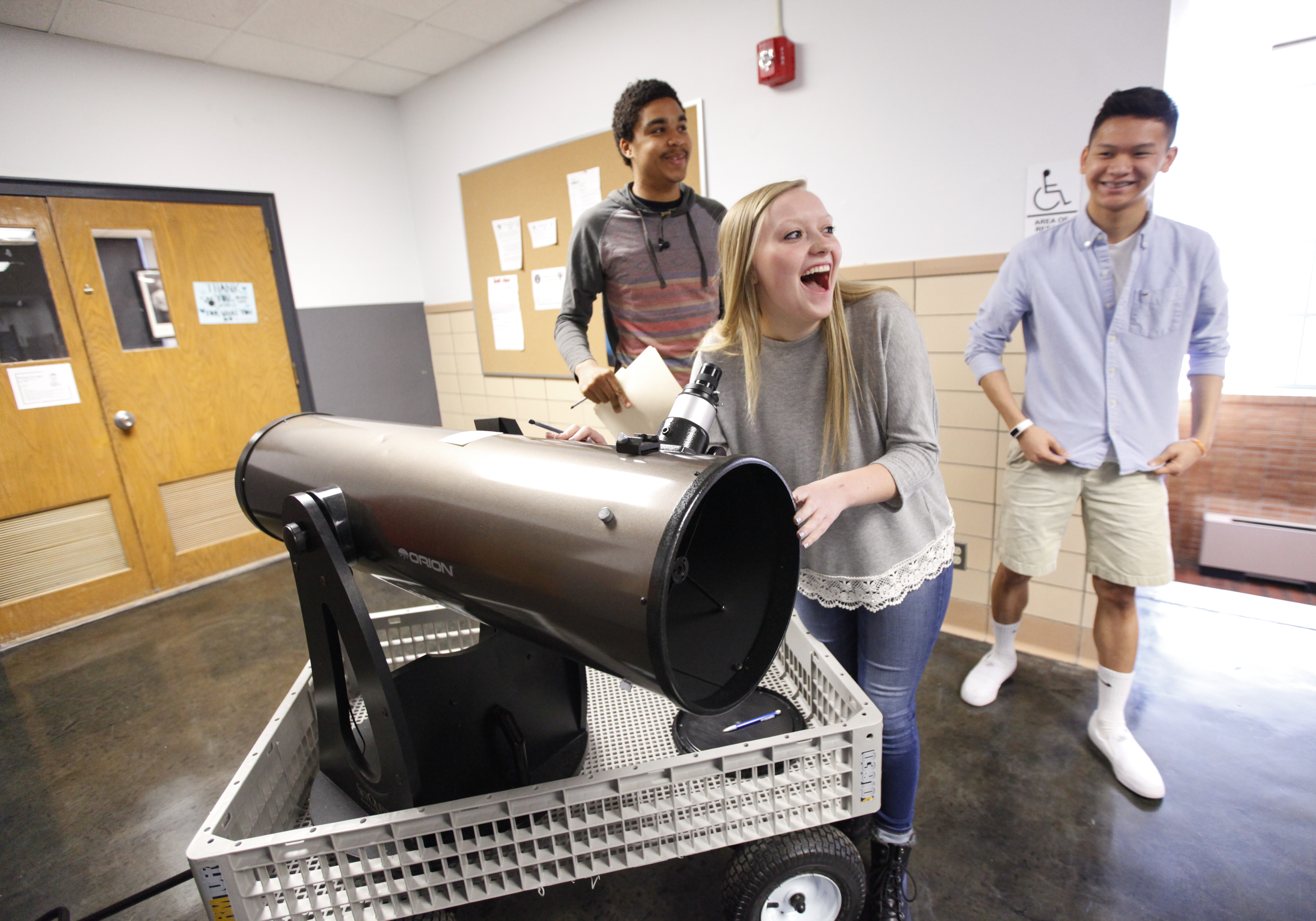
Lawrence High School senior Kassidi Norris laughs as a friend down the hallway intentionally blocks her view with the telescope as she and classmates Jeffon Moten, left, and Eggy Phiomavong work on a field project during Andy Bricker's blended learning astronomy and geology class, Monday, Feb. 29, 2016, at Lawrence High School. Students in Bricker's class spent part of the period receiving instruction on using the device and were then sent off into the hallways to locate various telescopes and then aim them at laptops featuring imagery of galaxies for them to classify.
Andy Bricker’s classroom is empty. Backpacks and notebooks are laid about, but the students aren’t at their desks. They’re in the school’s rotunda, in the hallways, going up or down the steps.
Small groups of students go from station to station throughout the school, directing and focusing telescopes on galaxies not so far away. It’s daytime, and the students are indoors, but images of the galaxies are displayed on computer screens a couple hundred yards away, roughly the same size as they’d be in the night sky, Bricker explained as he walked from group to group, checking in.
The students are working on classifying the galaxies for Bricker’s astronomy and geology class, a blended learning classroom at Lawrence High School. The day’s class period began with a short prelude to the day’s activities.
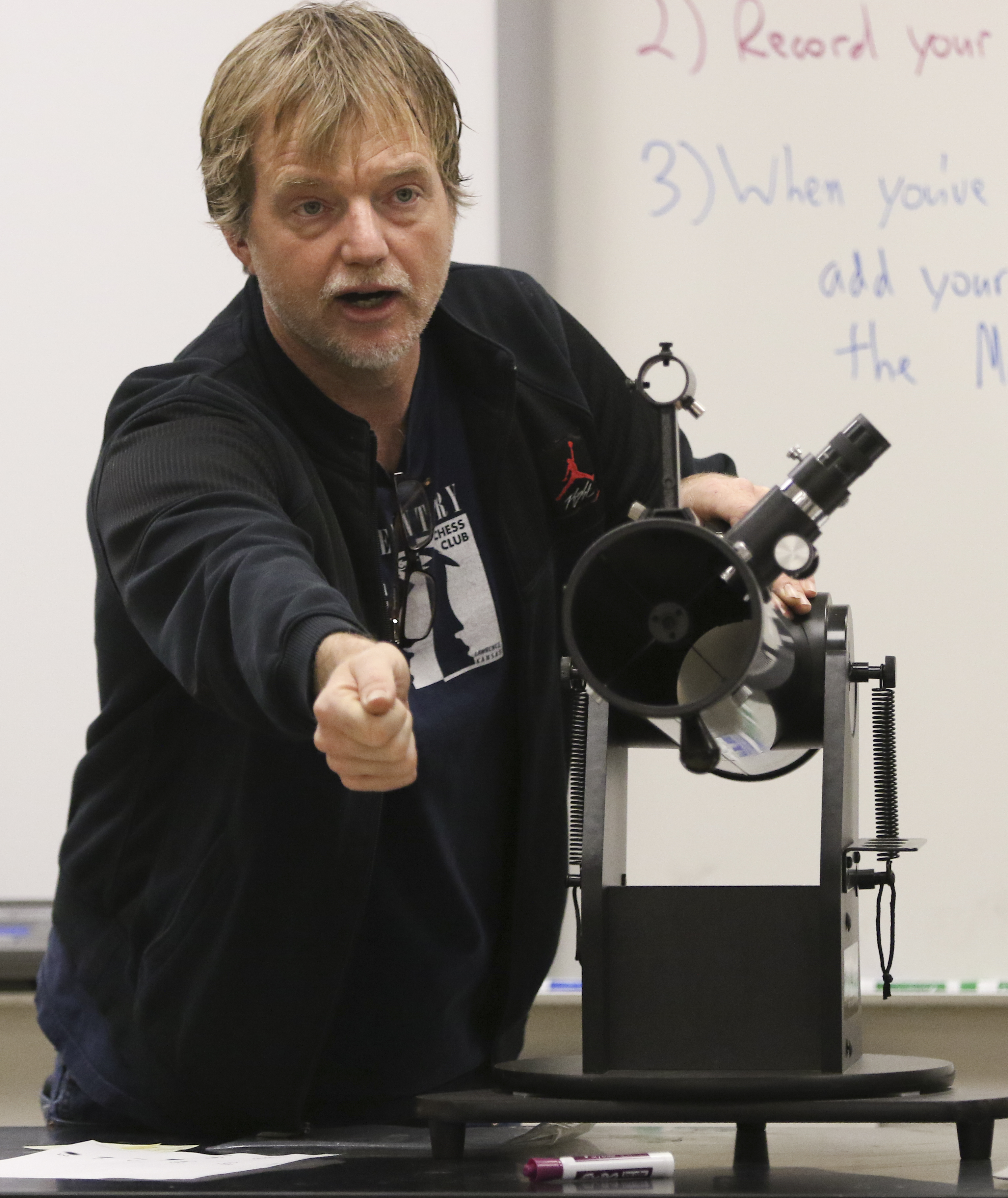
Lawrence High teacher Andy Bricker gives some instruction to his students on how to properly use a telescope prior to a field exercise on Monday, Feb. 28, 2016.
“Let me tell you the general idea, and then I’m going to turn you loose,” Bricker told his students. Next class period, Bricker said the students will enter their findings into a spreadsheet on a shared online drive, and the class will go over their observations.
In a math class at Quail Run Elementary School, the lesson starts without any all-group instructional period. That’s because as a blended classroom, the students are working at their own pace, said fifth-grade teacher Christine Valcich.
“Right now, there are students working in three different chapters,” Valcich explained. Throughout the class period, students also chose to work individually, in small groups and with or without a computer. Meanwhile, Valcich talks with students one on one.
“So where are we headed; what’s our goal for the day?” Valcich asks one student toward the beginning of the class period. The student sets a goal to work 10 problems.
The blended learning model “blends” lecture-based instruction with small-group or individual activities that often rely on technology and online resources.
These two classrooms are not unique; throughout the Lawrence school district, about 300 such classrooms are in place. Starting next school year, the majority of the more than 700 classrooms in the Lawrence school district will use blended learning, and the model is set to expand to all classrooms in coming years.
The advantages of the method touted by educators include more engaging, personalized and self-paced lessons for students. But some say there are components of blended learning that don’t benefit all students, as well as pitfalls of the method that teachers should be mindful of.
How the method is implemented
Especially with classes that involve a lot of reading, LHS junior Kansas Gibler does not think she benefits from blended learning. Gibler has a blended classroom for history, and she said that for her, the model doesn’t always work.
“We have had assignments when we are supposed to read articles off the computer screens and take notes over them,” she said. “I would say that most of those days I’m not engaged whatsoever.”
Others have had more positive experiences. Kyle Camarda has two daughters who attend Lawrence schools, and he thinks expanding the blended learning method districtwide is a “great idea.” Camarda, an associate professor of engineering at Kansas University, said he even uses the teaching method himself.
For his middle school daughter, Camarda said that using technology to individualize and self-pace lessons “worked very well.” But Camarda also said that to use blended learning properly he thinks it’s important to balance instruction and individual or small-group activities. He said he thinks that balance can depend on the lesson, but generally should be about 50/50.
“Sometimes it takes a teacher to come over and say, ‘You’re getting this wrong, let me show you how this works one-to-one,'” Camarda said. “And I wouldn’t want that to go away, and I don’t think it does in properly used blended learning. We’re not taking teachers out of classrooms.”
The balance of instruction and activity also varies by subject. During the math lesson at Quail Run, at least a few students are out of their seat at any one time, checking their answers against answer keys spread out on a table, getting up to work with other students or talking to Valcich.
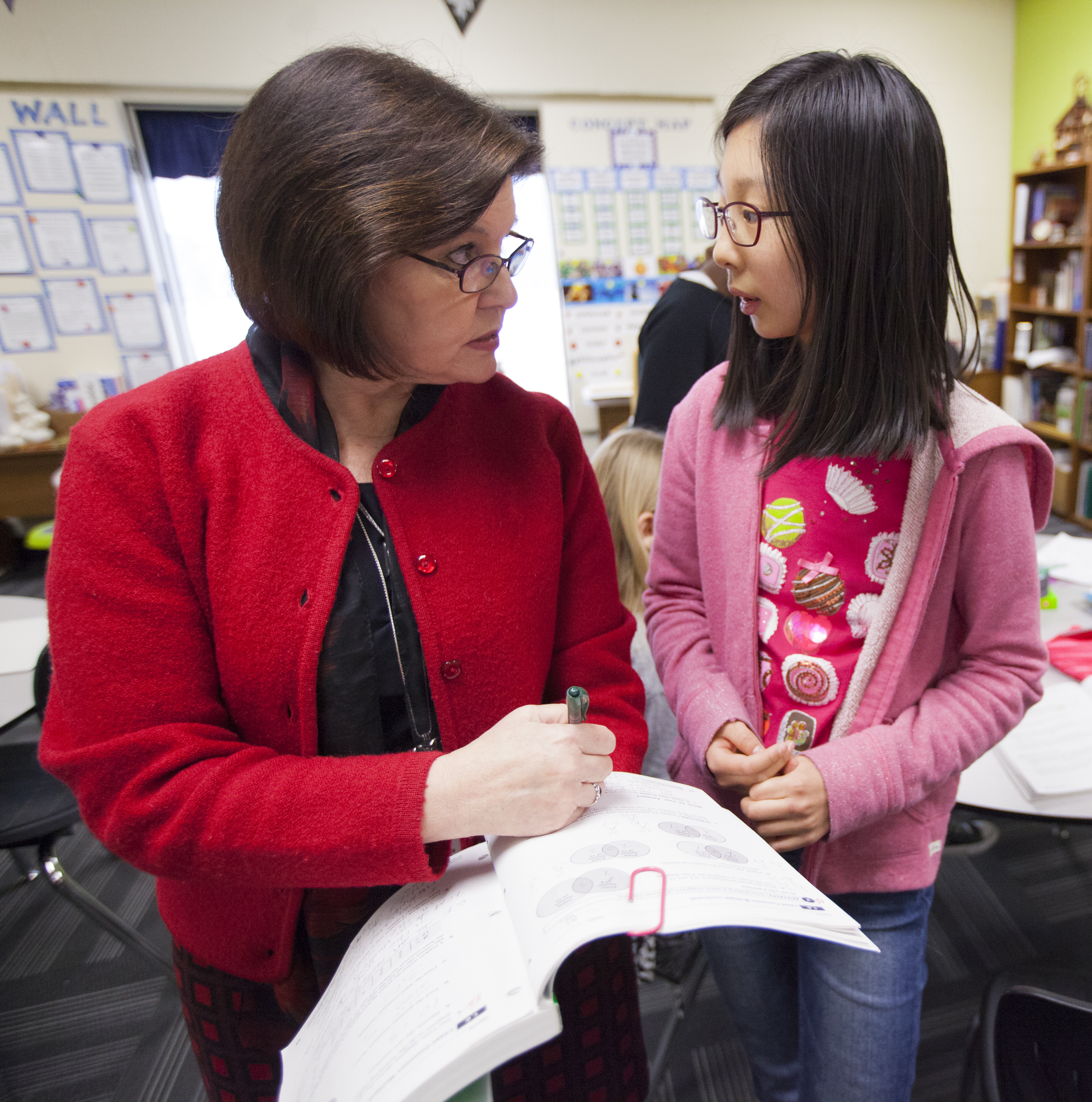
Quail Run fifth-grade teacher Christine Valcich talks with Emma Liu as the two review her work on Tuesday, March 1, 2016 at the school.
“It seems chaotic, but they all have their jobs to do,” Valcich said. Though while her math lesson has very little all-group instruction, she said that for other subjects, such a reading, the balance falls the other way.
For math at least, a lot of the instruction is done with videos of teachers explaining concepts and working through problems. Students can pause the video, or go back and re-watch all or part of it.
“It’s less of the teacher and more of the technology,” said fifth-grade student Zoe Counts. But Zoe said she prefers it that way, because she can work at her own pace and if she is still confused after re-watching a video, she can have the teacher explain it.
Still, throughout the class period at Quail Run, there was more than one student who worked on their math individually and without technology. One student seemed distracted enough by the bustle of the classroom around him that — sitting at a round table surrounded by other students — he put up a special blocker, bent at a 90-degree angle around him, while he worked with paper and pencil, his face very close to the worksheet in front of him.
The possibility for distraction
Regardless of their opinions on blended learning, teachers, students and parents alike recognize that when students are working on a computer, distractions are close at hand, even with school filters removing the worst of them.
“It’s a lot easier for students to be working on something else because you put them in front of a computer,” Gibler said. “And you expect them to do what you’ve provided for them, but oftentimes — especially when you’re not checking that every day — it’s easy for people to not do what they’re supposed to be doing.”
Bricker agreed that the computer offers distractions, but also said that teachers are used to dealing with distracted students, and that the educational aspects of computers and online resources outweigh that. He said that he thinks that challenge exists in any system.
“There’s always a way to distract yourself; there’s always a way to pretend,” Bricker said. “So I don’t think that’s unique to this time. I think the solution has always been that you need to be in touch with what the students are doing.”
But for Gibler, she said it’s more a matter of her personal learning style, and that while she likes being able to access class materials such as PowerPoint presentations or assignments online, she does her best learning from lectures.
“When teachers are talking for the first five minutes and the last five minutes, and the rest of the time (students are) just working on what they’re given, that’s not a style I can learn from,” she said.
In addition, with the increase of group work used with blended learning, Bricker said that teachers need to be intentional about the size of the groups and who is working together, and not always letting students choose their own groups.
“When you put people in groups, there’s a chance that somebody is not going to do anything,” he said. “So there’s the most important danger to look out for: Is everybody engaged? And paying attention to them when they’re in the groups.”
Benefits
Still, proponents of the blended learning method say it offers students much more than they could get from a textbook or lecture.
Bricker said the resources involved in blended learning, such as the online platform Blackboard and computer simulations of labs or activities, offer material he wouldn’t otherwise have. It gives him a chance to be more creative with lesson planning, he said.
“I think it’s just a way to take advantage of more resources, to give students access to the information or activities to learn the information,” Bricker said.
One of the benefits of the method is that offering students a choice of activities means they will be more engaged. In addition to lessons themselves, Bricker said he often lets student choose whether they will work individually or as a group, and with whom they will work.
“When there’s more choices there’s a greater likelihood that there will be something that someone’s more interested in,” Bricker said. “Really, engagement is like the baseline of what it’s all about, I think.”
One of the main district administrators in charge of the blended learning rollout is Angelique Nedved, assistant superintendent of teaching and learning. Nedved said that the overall goal of more engagement, personalization and student choice is “learner agency.”
“That’s really the students gaining more control and understanding of what they need to learn, how they learn best, what they need to relearn, what they need to unlearn,” she said. “And I think that this environment can influence that for our students, and that builds their capacity to be more self-aware, once they understand that.”
Timeline
Using the blended method to personalize learning was the idea of Adam Holden, who was assistant superintendent for teaching and learning from 2012 to 2013. Blended learning in the district began with an initial field test of eight classrooms in the 2012-13 school year. Currently, the about 300 district-supported blended classrooms are mostly at the elementary level, but additional classrooms across all grade levels will roll out next school year.
Following the pilot year, the district surveyed teachers, parents and students from those eight classrooms, and Nedved said Lawrence school board members and administration came to a general consensus to begin expanding the model. Nedved said because the method was new, there were not other surveys or studies to consult on the effectiveness of the method ahead of making that choice.
“The data was pretty limited at that time, because it was so new,” she said. “We were really relying primarily on internally what we experiencing and seeing, and collecting and hearing from classrooms, students and parents.”
The most recent data available is a 2014 district survey of those involved in some of the first blended classrooms. That survey indicated that 97 percent of blended learning teachers thought the initiative had increased student engagement and 76 percent said achievement had increased as measured by assessments. About 82 percent of students said they felt better prepared for blended classes than traditional classes. About 70 percent of parents said their child was experiencing success in blended classrooms.
Since the initiative began about four years ago, teachers who use the model have done so voluntarily after being selected via an application process, Nedved previously said. The district usually gets about 100 applications per year and expects to add another 65 to 75 blended classrooms next school year, she said.
While one of the cornerstones of the blended method is student choice, student enrollment sheets do not indicate whether a classroom is blended or not. Gibler would like choice to extend even further; she said that she thinks the best option, at least for the immediate future, is to label blended classes as such for enrollment purposes, and make sure that students are able to select the option in which they learn best.
“I know kids who would love to be in a blended classroom who aren’t and kids who hate being in a blended classroom who are,” she said.
Still, Gibler recognized that being comfortable working with online platforms like Google Drive or Blackboard is important for students for both college and future careers, and that some degree of exposure is important. For younger students, the adjustment may be easier, she said.
“I don’t want to say that I think blended learning is a bad idea because it doesn’t work for me,” she said. “I have a sister who is in sixth grade right now, and she’s been doing blended learning for years, and by the time she’s in high school, she’ll be comfortable with learning that way and a lot of her peers will be too.”
The district conducted another survey of teachers, students and parents on blended learning this school year. Nedved said those results will be presented to the Lawrence school board by the end of the month. Nedved estimated that all classrooms in the school district will be blended by the year 2021.
City Government
Lawrence City Commission interested in moving public comments to the start of its meetings once a month
When Lawrence’s public works campus opens, employees say the difference will be ‘night and day’
Developer Krsnich asks for an apology, resignation of Affordable Housing Advisory Board chair over comments at City Commission meeting
City of Lawrence hires KU alumna as new human resources director
Proposal would let some speakers comment near the start of Lawrence City Commission meetings — but only if they registered in advance