A Q & A with the University Daily Kansan’s new adviser, Gerri Berendzen
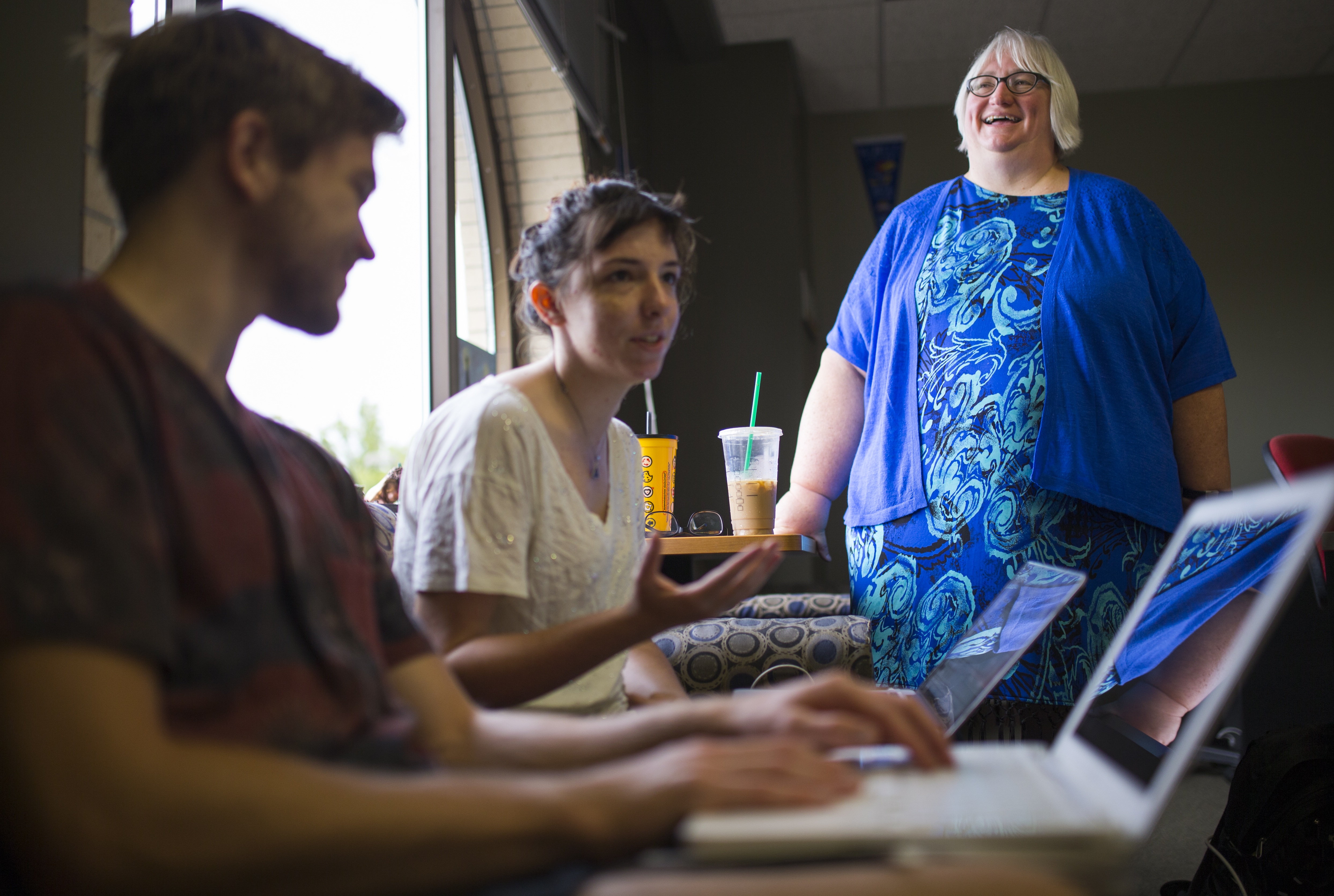
photo by: Nick Krug
University Daily Kansan adviser Gerri Berendzen laughs as she talks with editor in chief Candice Tarver, a senior from Overland Park, and Cody Schmitz, a Concordia, Kan. senior, during a visit to the newsroom on Tuesday, Aug. 23, 2016.
After going without an official adviser during the last academic year, student journalists at the University Daily Kansan, KU’s student-run newspaper, will once again receive guidance from a seasoned professional journalist this semester.
Gerri Berendzen, a newspaper industry veteran with more than 30 years of editing and reporting experience under her belt, filled the position earlier this month. She joins the KU faculty after most recently serving as a Knight visiting news editor at the Columbia Missourian and a visiting assistant professor at the University of Missouri School of Journalism, where she earned her master’s degree in 1986.
Lisa McLendon, who coordinates the KU journalism school’s Bremner Editing Center, was a member of the search committee that ultimately selected Berendzen, a longtime colleague of McLendon’s, for the job.
“Because of her newsroom experience, she has a really good idea of the bigger picture of news, but in her work as a copy editor, she still knows how to focus on the details,” McLendon said.
The adviser position, she said, was left vacated at the end of the 2014-2015 school year. It remained unfilled last year because of what then-Kansan editors said were limited funds after a Student Senate cut that slashed the newspaper’s funding by half. The funding, we’ve since reported, has been restored.
After the tumult, McLendon said, students were “relieved” to know they’d have an adviser at the helm this fall. Berendzen, she added, will be adept at lending knowledge and support without being “the boss.”
“I think that’s the role of the adviser,” McLendon said. “To be there, to offer advice, input, feedback, guidance. Not to take control of the newsroom, but to be there as a soundboard and a guide.”
Near the end of her first week on the job, Berendzen spoke with the Journal-World about her vision for the Kansan, the state of news today and why student journalists give her hope for the future. Here’s a condensed and edited version of that interview.
Even though you’re taking a hands-off approach to a certain extent, do you still have a vision for the kind of role you’d like to see the Kansan take at KU and the larger community?
Here’s the biggest thing, I think: I guess it was last year, when they stopped printing four days a week and they went to two days and they said, “We’re going to be digital first.” But I look at the Kansan and I actually don’t think they operate like a digital-first newsroom. They operate like a newsroom that has two print editions and a digital component.
This paper really has two roles: It’s a community paper for the community of the University of Kansas, but it’s also a learning experience for them. You can’t just say, “Well, the bulk of what we put on the web is going to be put on the web after we put it in print.” That’s not going to work that way. If the KU community really wants to look at us and say, “Well, if I want to know about something that’s going on on campus — if I want to know, for instance, what they’re going to do in 2017 with campus carry — I can get that from the UDK.” But, you know, with us thinking digital first, we’re going to have that for you right away on mobile. That’s the way we’ve got to be thinking.
I’m not one of those people who think there’s going to be a time when there’s absolutely no print at all. I think there’s still going to be print, but I think it’s going to be different. I like to tell people, it’s like horses. In 1830, you had to have a horse to get around. There were no cars. You had to have a horse for your wagon if you wanted to haul things. Horses were essential for everything. You know, in 1910, if you wanted the news, you had to get the newspaper. Newspapers were essential like that. Horses aren’t essential anymore, but people still have them. They’re kind of a hobby.
And I think the news is still essential, but reading it in print isn’t necessarily essential. But there are still going to be people who want to do that. My idea is that this (gesturing to a print copy of the Kansan) can’t be exactly what you’re going to read online. It has to be different. And that’s really what I would like to work on with this staff, is saying, “We’re a multiplatform publication here, and we have different identities.” You can look online and you’re going to get a different experience than what’s in print, so you really want to go out and look at both of those, because you’re going to see both.
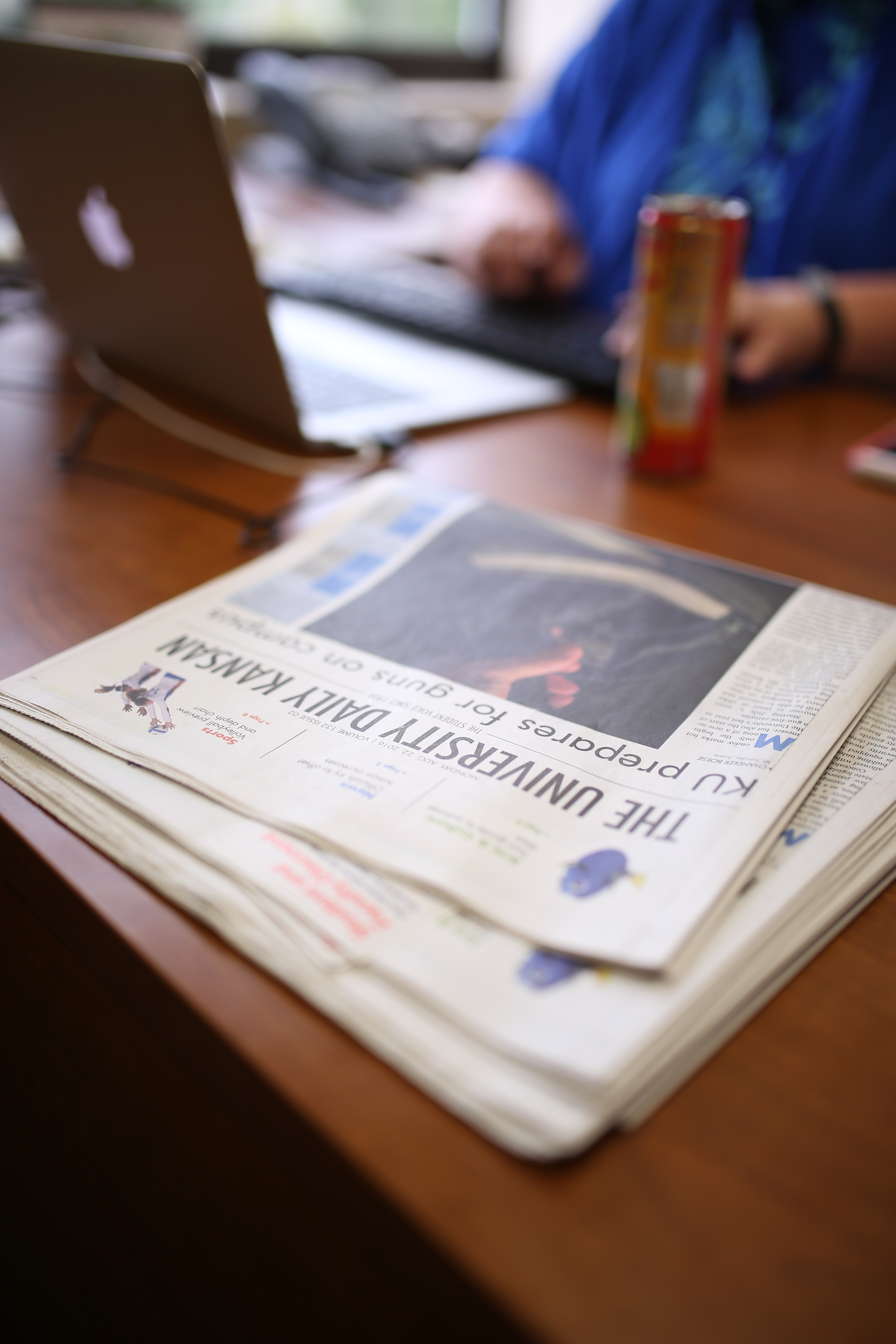
photo by: Nick Krug
A stack of University Daily Kansans sit at the edge of Berendzen's desk on Tuesday.
What do you say to students who may feel discouraged about the state of journalism today?
That came up a lot when I was at Mizzou, and it’ll come up here, too. I was in journalism school in ’80, ’81, ’82, and it was the post-Watergate era, and people were revved (up) about going to journalism school. Lots of people thought, “I’m going to go out and find the corrupt people and bring down the government,” or whatever. And the reality of journalism isn’t that. There are always going to be people who are out there risking their lives covering the wars and going to warzones in Syria, and for every one of them, there’s going to be three times as many or more who are at the school board meeting in a town of 10,000 or covering the county fair. And really, that’s all important, but I came in at a time of this intense enthusiasm, and I think I would have hated to be in the classroom or in an educational venue full-time in 2008 or 2009, because it was hard enough being in a newsroom in 2009. Everybody seemed to be depressed, you know?
But I actually think it’s probably the best time to go into journalism, ever, because you’re not just limited to, “I have to go work for this newspaper, I have to go work for this magazine, I have to go work for this television station.” There are so many different ways for getting news out there now. Some of them won’t stay around a long time, but it doesn’t make any difference because some new thing will start up.
The nature of the business has changed, but I don’t think it’s gloomy. I think it’s just different. I also think that journalism is a great background for lots of other jobs that aren’t necessarily journalism. So, no one is wasting their time going to journalism school because journalism’s going downhill. Not only is there more journalism than ever, but there are more ways you can use that degree that aren’t necessarily traditional journalism.
You were at Mizzou while the Melissa Click snafu unfolded, along with the accompanying protests over reportedly racist conditions at the university. What was that like?
It’s kind of funny because those (journalism) students, I think, kind of accidentally got into something that some people will only have happen to them once in their careers.
Journalism is a weird job. I want to say, “I hope they get that opportunity again,” but in a way I don’t want to say that, because a lot of times when you have that opportunity, it means something really bad has happened.
I’m not sure it was that bad overall, though, because to me, the fact that there were underlying social problems there, and the fact that that came out, is not a bad thing.
Now, there’s gobs of people who disagree with me. There were people who thought it was horrible, that we shouldn’t be talking about race, that it was bad for the university and it made Missouri look like a laughing stock. Missouri’s hardly the only place in the world that has racial problems. Things that live in the dark can’t live in the open.
What did you learn from that experience?
I think the biggest thing I learned is I could not be afraid about the future of journalism, because I think there are lots of bright, young journalists who want to do a good job and make a difference in the world. And they really showed it there.
The other takeaway is not really a good one for journalism. While all this was going on, being in that town, I knew some of the people involved. I was reading things in the Washington Post and the New York Times, and we were all — students, professors — sitting in the newsroom saying, “Where are they getting this? This didn’t happen this way. This is not quite right.” And it really helps you understand why people complain about the media, because you could see exactly what happened. People who parachute in to cover something big — they report on it because it’s big, but they don’t have the background (and) they don’t really know what went on before — are bound to make mistakes, just by missing some nuance or making assumptions that they shouldn’t have, or all kinds of things.
What are the big issues, as you see them, that the Kansan should be following this year?
Some of it I don’t think I’ve been around long enough to know about, but I just think on every college campus, every student media should be paying attention to Title IX issues, sexual assault and abuse on campus. And I know there are students here working on stories on those topics.
I think that the racial climate in the country is a big story for everyone, and there are stories about how that plays out on campus.
I think the rising cost of college is a huge concern to our students, and I don’t think that they are — not the staff, but the students in general — really thinking about the politics of how the state Legislature plays out. But it actually has a personal affect on their lives, and so I think that’s something we need to be doing, too.
City Government
Housing Stabilization Collaborative’s request for city trust fund aid won’t be considered because it was filed late
On sister city visit, delegates from Hiratsuka, Japan, see Lawrence’s friendship firsthand
Voters Guide: Lawrence voters will decide whether to raise transit sales tax
Lawrence City Commission agrees that Costco shouldn’t be in STAR bond district

Lawrence City Commission to weigh whether Costco should be included in STAR bond district