‘Remarkable artifact’ finds new roost in Lawrence
It took sonar to locate it, a squad of former Navy SEALs to raise it and a team of far-flung experts nearly three years to renovate it.
Now Lawrence resident Steve Craig owns it — a Grumman F4F-3 Wildcat fighter, the only one still flying among a fleet of nearly 2,000 produced for the Navy and Marine Corps during the early years of World War II.
“It’s a remarkable artifact,” said Craig, who purchased the renovated plane 18 months ago and now flies it to air shows. “It’s a remarkable piece of history.”
The rare and popular warbird nests these days at Lawrence Municipal Airport, giving the city a small yet visible place in the history of aviation.
Nearly 40 years after Orville and Wilbur Wright took flight for the first time 100 years ago this week, packs of Wildcats downed Japanese Zeros throughout the Pacific Theater. The fighters defended Wake Island and fought from Midway to the Coral Sea and Guadalcanal; eight Navy and Marine pilots earned Medals of Honor while flying Wildcats.
Craig said he was honored to take a seat behind the original control stick, push the throttle forward and take off into the bright blue sky.
“This represents not just the pilots and the air crews,” Craig said. “It’s a tangible piece of history that represents the entire society and the sacrifices made at that time. You can’t bring up a submarine and sail it. You can’t bring up a ship and sail it. But this shows that you can bring up a plane and fly it.”
Today, the plane poses for magazine covers and wows crowds at air shows across the country. Tears well in the eyes of former Navy fliers as their grandchildren touch the aluminum skin of a plane whose brothers carried hundreds of men into battle and back home again.
Only a dozen or so Wildcats survive. Hundreds were shot down during the war, and most of those that weren’t ended up being sold for scrap or melted down to make pots, pans and other items that belied their powerful past.
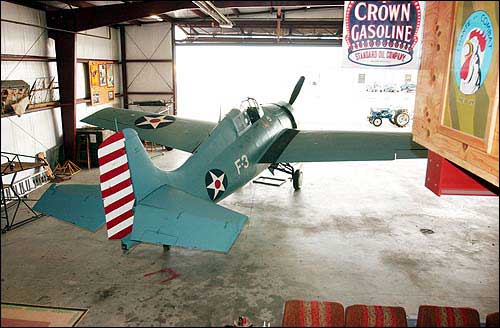
This Grumman F4F-3 Wildcat fighter is at home in a hangar at Lawrence Municipal Airport. Its owner, Steve Craig of Lawrence, purchased the renovated warplane 18 months ago and now flies it to air shows.
Ironically, Craig’s plane endured only because of a fortuitous crash.
This particular Wildcat, built in February 1943, spent a few months handling anti-submarine patrols before being assigned to a training base at Lake Michigan. There, it joined the ranks of aircraft that would train 12,000 pilots — including former President George H.W. Bush — in the art of carrier takeoffs and landings.
Opportune crash
But something went wrong at nine minutes past noon March 1, 1944, aboard the USS Wolverine. Ensign John Forsberg tried to pick up enough speed for takeoff, but his 14-cylinder Pratt & Whitney engine couldn’t manage enough horsepower for the plane to take flight.
The fighter careened off the front of the carrier, and Forsberg managed to swim to safety. As the ensign was sent off to war, his plane was left behind — one of the 150 training aircraft lost in 1943-44.

 6News video: Airport ready for milestone
 Photo gallery: Grumman F4F-3 Wildcat fighter
 A Century of Flight
Years later, the Navy opened a search for some of its lost planes. It wanted one for display at its museum in Pensacola, Fla.
A&T Recovery Inc. went to work.
After painstaking checks of flight-deck logs at the National Archives in Washington, D.C., and blasting sonar off debris cluttered on the lake floor, the salvagers found 12 planes. One of them was the Wildcat: 27 miles due east of Evanston, Ill., four miles from two water intakes on the shore of Lake Michigan.
There, 210 feet below the surface, rested the 3.5-ton hulk of aluminum, magnesium and steel that had sunk nearly 48 years earlier. Astoundingly, it could hardly have been in better shape when it was rediscovered.
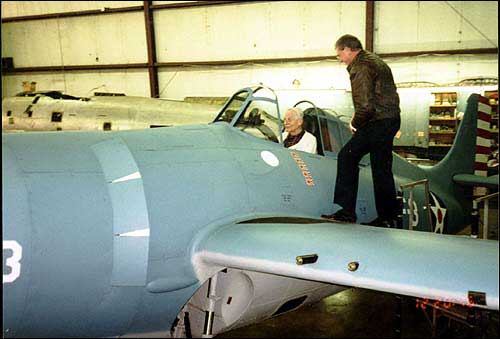
John Forsberg, left, sits in the pilot's seat of a Grumman F4F-3 Wildcat fighter, with Dick Hansen on the wing, as restoration was completed in July 1994. Forsberg was flying the aircraft on March 1, 1944, when the engine failed and the plane crashed into Lake Michigan.
“It was basically in a deep freeze,” Craig said. “It’s a low-oxygen environment, and that left it in excellent condition.”
A team of former Navy SEALs rigged the plane with special balloons to ease the fighter to the surface, where it was loaded onto a barge and hoisted by crane to a hangar where it eventually would be nursed back to life.
‘Keep ’em Flying’
The A&T salvagers convinced the Navy to let them keep the Wildcat and one other as partial payment for finding a dozen planes on the Navy’s behalf.
“They’re like the people that find these sunken Spanish galleons and stuff like that in the Caribbean, and the people who went down to bring up part of the Titanic, or the Edmund Fitzgerald,” said Dick Knapinski, a spokesman for the Experimental Aircraft Assn., a Wisconsin-based organization with 170,000 members in 106 countries.
“You’re looking at a historical artifact that’s been down there, and you have to figure out how to bring it up, but also to do it safely. It shows the devotion of people who like these ex-military aircraft from the World War II era, the 1940s and ’50s. They say, ‘Hey, I hear there’s one out there that can be restored.’
“Their motto really is, ‘Keep ’em Flying.’ And they do.”
Jim Porter and Dick Hansen, two warbird collectors, jumped at the chance to buy the rare bird. With the plane’s flight instruments still functional, fuel lines still sealed and oxygen tank still stocked, they couldn’t have wished for better raw material.
One of the tires on the landing gear even had air.
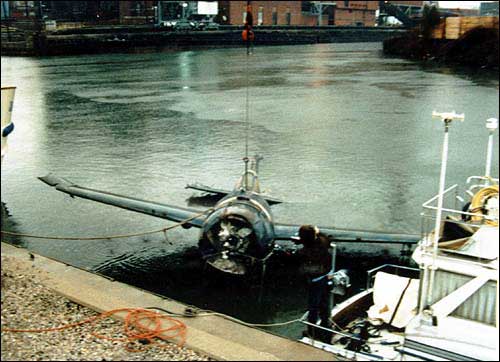
Workers attach cables to the plane in preparation for transporting it for restoration. The plane was pulled out of Lake Michigan in December 1991.
“I’m not a metallurgist, but it’s my understanding that the aluminum, at that depth, had very little corrosion,” said Craig, president and chief executive officer of Lindquist & Craig Hotels & Resorts, which owns eight hotels.
Experts across the country went to work rebuilding the wings and tail, installing a new motor, replacing the propeller and rewiring controls.
Historic look
By the time Craig bought the plane from Porter and Hansen, the Wildcat looked just like the one that pilot Butch O’Hare — namesake of Chicago’s O’Hare Airport — flew during his stint in the Navy. The sky-blue exterior was marked with decals to commemorate O’Hare’s shooting down of five Japanese planes in 1942 to save the USS Lexington, for which he earned the Medal of Honor and became the Navy’s first ace of World War II.
Craig, who went through Navy ROTC at Kansas University and trained on T-34s and T-38s before spending five years in the Naval Reserves, said he enjoyed traveling the country to share the history that now has a home in Lawrence.
“This is something that captures people’s imagination,” he said.
City Government
When to hire for Fire Station 6? How big a raise for staff? Exploring the variables in Lawrence’s budget ‘math problem’
City Commission OKs purchasing former Journal-World printing plant; it could become a City Hall annex
In bike plan draft, Lawrence cyclists are asking for more physically protected bike lanes, not just paint
Lawrence’s sustainability board interested in changes to weed control ordinance that would promote native plants
City of Lawrence plans to buy former Journal-World printing plant building for a City Hall annex